Get Full Government Meeting Transcripts, Videos, & Alerts Forever!
Get email alerts on the Roads topic
No spam. Unsubscribe anytime.
County public works lays out $25 million regional road plan, stresses pavement-condition strategy
Summary
Public Works presented a five-year capital outlook that mixes preventative maintenance and reconstruction funded by Highway User Revenue and the half-cent regional roads tax; officials said deferred work from an expenditure limit cap will be caught up now that the cap has been lifted.
Yavapai County Public Works on Wednesday outlined a five‑year capital improvement plan that relies on Highway User Revenue Fund (HEERF) and the county half‑cent regional roads tax to finance preventive maintenance and larger reconstruction projects.
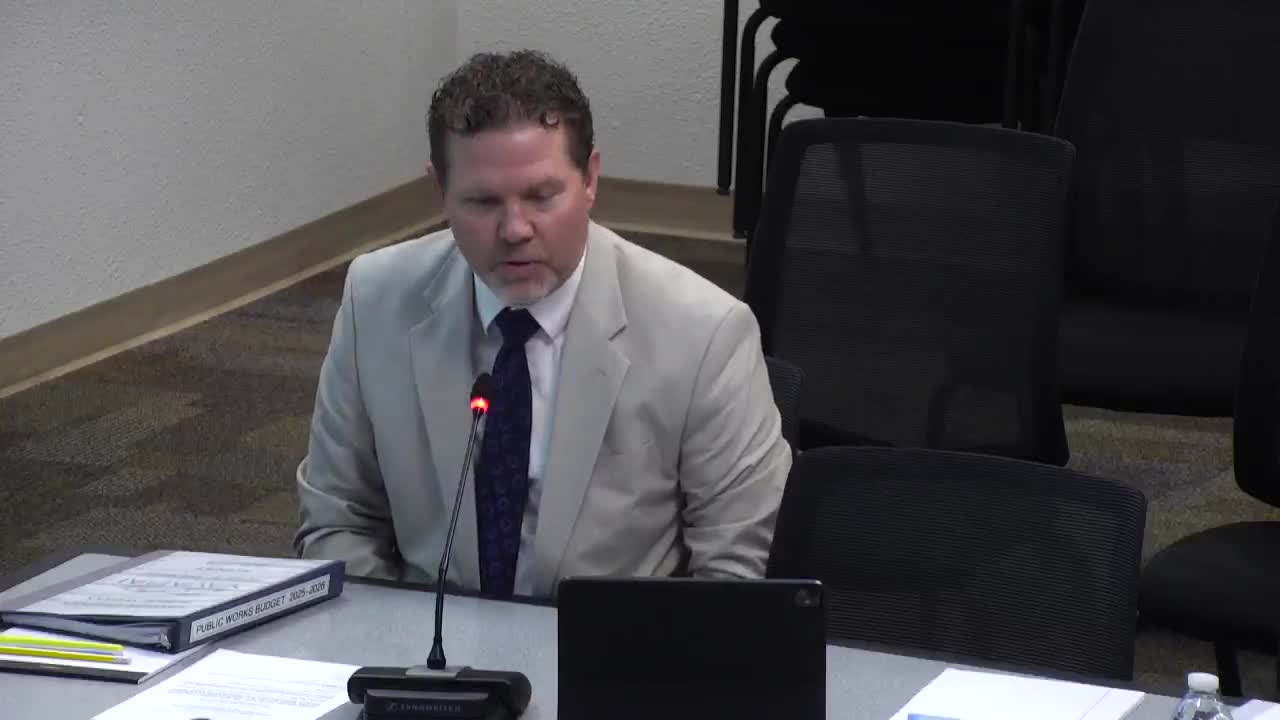
Roger McCormick, director of public works, told the Board of Supervisors the county intends to spend about $25 million next fiscal year from the regional roads program and emphasized a data‑driven approach to scheduling work. “HEERF, the Highway User Revenue Fund, is a fund that we use for general maintenance throughout the entire county of all roadways,” McCormick said.
The presentation explained the department uses a pavement condition index (PCI) — scores of 0–100 — to prioritize treatments that extend pavement life. The plan mixes “preventative maintenance treatments” such as rubberized chip seal and overlays with reconstruction projects, McCormick said. He described the county’s approach as proactive rather than “worst first,” because treating roads earlier “gets the most out of our roads over the life of what they’re designed for.”
McCormick said the county deferred roughly $6.5 million of work while constrained by an expenditure limit cap; with that cap removed by voters, the department will try to “catch up” in the coming year. He showed a projection that by year five the program’s spending would align with expected half‑cent revenue, roughly $14 million in that year.
Supervisors asked about material quality and bidding. McCormick said Public Works tests construction materials and uses quality‑control and acceptance criteria, and that the county can reject low bids when “reasonable cause” related to documented past performance exists.
McCormick also noted the plan accounts for operating costs that often follow capital projects — staffing, maintenance and utilities — and he said those lifecycle costs are being integrated into CIP planning.
The board asked staff for consolidated charts of projects and funding; McCormick said Public Works will provide both detailed and rolled‑up views in the Day‑2 packet.
Why it matters: Roads are a visible, recurring taxpayer concern. The department’s emphasis on PCI and preventative maintenance is intended to stretch limited funds and reduce future reconstruction costs, while the restored spending capacity addresses accumulated deferred maintenance.