Get Full Government Meeting Transcripts, Videos, & Alerts Forever!
Get email alerts on the Utilities topic
No spam. Unsubscribe anytime.
Officials: aging water and sewer infrastructure, heavy BWA reliance drive Angleton’s high utility costs
Summary
City staff told council that a large portion of Angleton’s water and sewer infrastructure is at or past typical replacement age, emergency repairs have been costly, and the city currently relies heavily on the Brazoria Water Authority for surface water; staff outlined well‑rehabilitation plans and pending grant and loan applications.
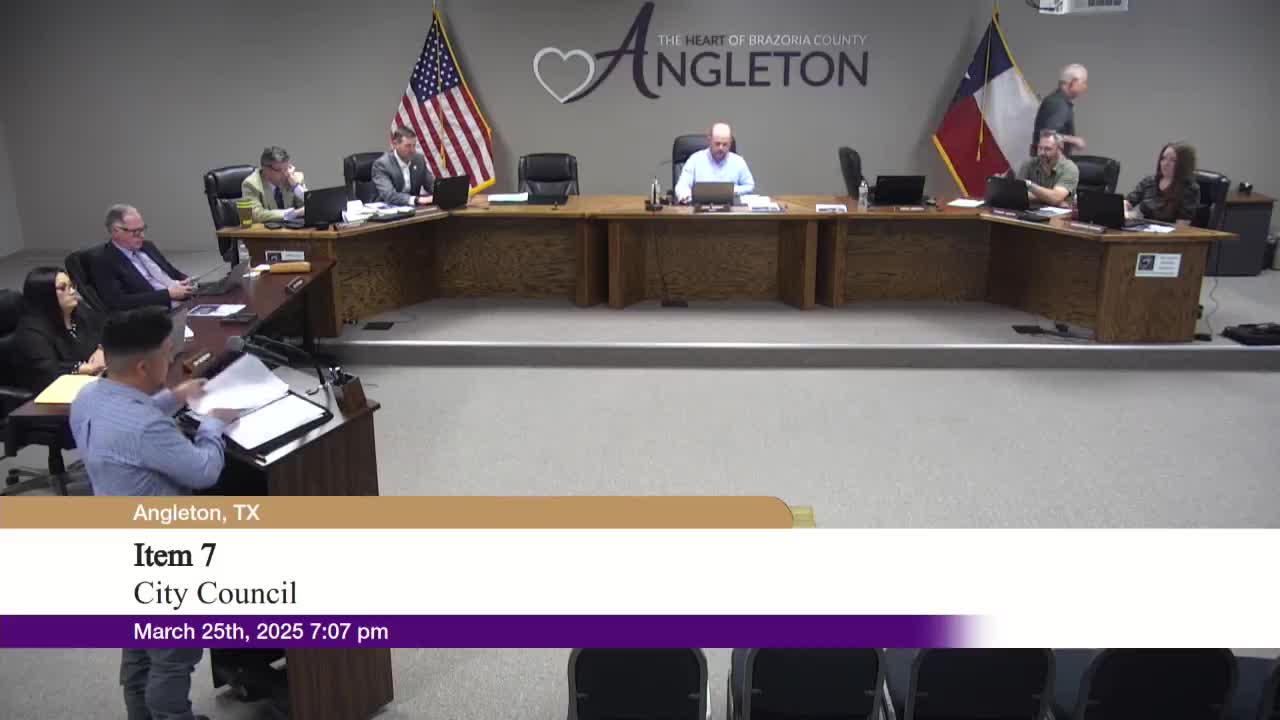
Hector (city public works staff) told the Angleton City Council that a substantial share of the city’s water and sewer infrastructure dates from 1980 or earlier and that many elements have reached typical replacement age, increasing emergency repairs and immediate costs.
Hector said emergencies have been a major driver of recent spending and that planned maintenance programs — hydrant maintenance, valve testing and manhole rehabilitation — need funding and staffing. He reported that staff has identified capital improvement needs for water and wastewater (the transcript did not include a single undebated aggregate dollar figure for the total unmet need), and he warned that emergency repairs are more expensive than planned projects.
On surface water and wells, Hector said Angleton currently operates four active wells and that staff believe the wells appear salvageable after video surveys; staff are collecting bids to estimate rehabilitation costs. Hector also stated the city is “upwards of 90%” reliant on the Brazoria Water Authority (BWA) for surface water purchases, creating a significant operating cost exposure compared with some peer cities.
Councilmembers and Finance Director Susie discussed fund transfers. Susie said the budget for fiscal 2024‑25 has no transfer from the water fund to the general fund (removing a previously planned transfer) and that in prior years transfers had occurred; a council member recalled a prior transfer of roughly $1.5 million in earlier years. Susie also detailed that the city is pursuing larger projects through funding requests to the Texas Water Development Board and has submitted PIFs that could total roughly $35 million for wastewater projects (as presented by staff through consultants), with wastewater treatment plant rehabilitation and lift‑station work among the highest priorities.
Council members asked staff for a clearer breakdown of annual maintenance and operations (M&O) costs versus capital needs and suggested re‑running earlier rate and CIP studies to show a 10‑year funding plan tied to the utility rates. Hector and other staff said they will compile more granular M&O and capital projections, provide data about well capacity and rehabilitation estimates, and continue applications for state funding and grant programs.
No formal vote occurred; the item was an update and discussion of the city’s capital improvement needs, utility fund health and next steps.