
Brazoria County engineer explains 2‑mile overlay program, milling and reclamation options
Get AI-powered insights, summaries, and transcripts
Sign Up Free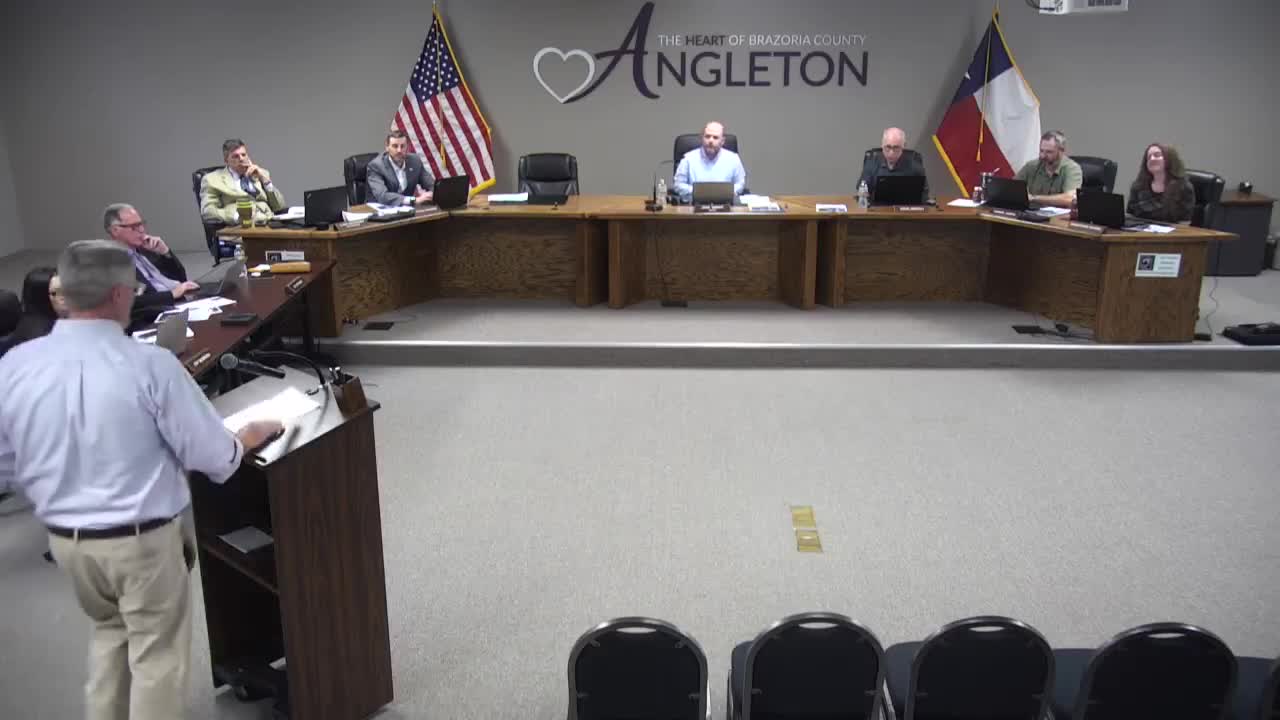
Summary
Brazoria County’s engineer described how the county’s interlocal street program works — two miles of overlay across up to four locations, coordination on milling, and a one‑mile reclamation option for roads that need deeper repair — and addressed scheduling and service‑center coverage questions from Angleton officials.
Matt Hanks, identified in the meeting as the county engineer, told the Angleton City Council that Brazoria County’s current interlocal street program generally provides two miles of overlays for cities and that the county has adjusted policy to reduce repeated mobilizations and improve project efficiency. Hanks said the county now typically asks for up to four locations (not necessarily four discrete streets) totaling two miles to avoid excessive mobilization costs.
Hanks said the county does not own a milling machine in its fleet but coordinates milling through contractors (he mentioned AAA as an example) and that milling does not reduce the two‑mile allowance if the overlay follows promptly. He recommended coring suspected problem areas prior to milling to confirm that the road structure beneath the surface is adequate; if subgrade failure exists, reclamation or deeper base work may be required.
Explaining alternatives, Hanks said the county can perform full‑depth reclamation but that rebuilds take longer and consume more resources, so the county would typically do fewer miles of reclamation in a year (for example, one mile of reclamation versus two miles of overlay). He said that scheduling and service‑center assignments affect which county crew completes the work and that the county recently rebalanced service‑center boundaries to equalize workloads.
Council members pressed about specific local roads (including Henderson Road and recent sections near the city limits). Hanks and city staff agreed that coordination earlier in the planning stage — looking at maps and adjacent work outside city limits — helps avoid incomplete corridors and improves outcomes. Hanks said cities should submit requested streets around the turn of the year to get on the county’s schedule for the coming fiscal year.
No formal council vote was taken on the street program; instead the exchange was an informational update on coordination, options for milling or reclamation, and timeline considerations.
Key takeaways: the county’s standard offer is two miles of overlay across up to four locations; milling can be coordinated with contractors but does not reduce the two‑mile allowance if performed as part of a coordinated overlay; reclamation is available but takes longer and the county will consider it as a special case; submit requests near the turn of the year for work in the next fiscal year.