Get Full Government Meeting Transcripts, Videos, & Alerts Forever!
Get email alerts on the Frisco Center For The Arts topic
No spam. Unsubscribe anytime.
Frisco holds public hearing on proposed $300–$340M Center for the Arts; funding plan, operator LOI draw split public response
Summary
Frisco City Council on April 7 conducted a statutory public hearing on the proposed Frisco Center for the Arts — a $300 million–$340 million project sited on EDC‑owned land near U.S. 380 and the Dallas North Tollway — presenting a funding plan that relies on EDC/CDC/TRZ sales‑tax sources, pledged philanthropy, and an LOI with a nonprofit operator, Frisco Live.
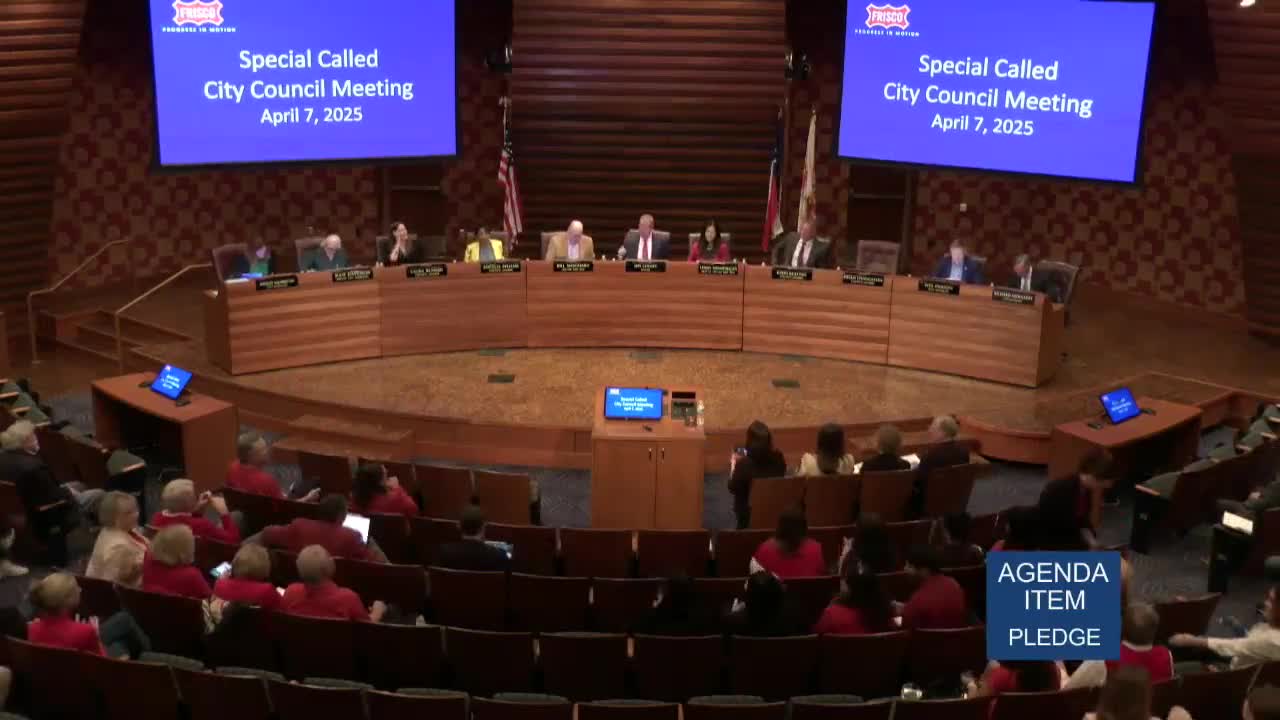
Frisco City Council on April 7 held a public hearing required under Texas law to present details about the proposed Frisco Center for the Arts and the two ballot measures the council placed on the May 3, 2025 ballot. The presentation reviewed concept design, a funding strategy that relies heavily on sales-tax economic-development buckets and pledged private philanthropy, and the city’s recently authorized letter of intent (LOI) with a nonprofit operator called Frisco Live.
The presentation — led by city staff and consultants from Theater Projects, Turner & Townsend Heery and Pelli Clark & Partners — described a project budget range of $300 million to $340 million and a conceptual facility with a roughly 2,800‑seat “large hall,” a roughly 400‑seat community hall and supporting spaces. The project team said the preferred general site is city Economic Development Corporation (EDC)‑owned land near U.S. 380 and the Dallas North Tollway; the immediate facility site is about 6.3 acres, with a potential day‑one surface parking area of roughly 13 acres and total EDC land anticipated for day‑one use near 19.3 acres.
Why it matters: The hearing was the statutorily required public disclosure of costs and impacts tied to Proposition A (an EDC purpose change to allow Type A/Economic Development Corporation sales tax funds to be used for certain community facilities) and Proposition B (authority for the council to issue debt for the project, not to exceed $160 million). Those ballot questions, city staff said, would not change property tax rates and would use sales‑tax‑derived funds rather than the general fund.
Funding and finances: City finance staff presented conservative revenue forecasts and a three‑bucket plan to fund up to a maximum of $160 million of city‑backed support across three sources: the EDC (half‑cent sales tax), the Community Development Corporation (CDC, also a half‑cent sales tax vehicle), and Tax Increment Reinvestment Zone No. 1 (TRZ/TRS‑1, funded by commercial property tax increments). The city’s conservative FY2030 forecast in materials showed approximately $41 million in annual sales‑tax revenue for the EDC fund and recommended maximum annual debt service levels of roughly $5.25 million from the EDC, $3.15 million from the CDC and $2.8 million from TRZ‑1. Staff said FY24 unassigned fund balances were approximately $84 million for the EDC, $72 million for the CDC and $17 million for TRZ‑1 (figures exclude EDC land carried at book basis); the presentation noted the EDC also owns adjacent land with a cost basis the city reported at about $36 million.
Philanthropy and partner contributions: Consultants cited a CSL fundraising feasibility assessment indicating community philanthropic potential in the range of $100 million to $110 million (a mix of individual and corporate gifts). Prosper ISD’s voter‑authorized debt was described in the presentation as contributing about $100 million to the overall capital plan. The nonprofit operator selected by the city through an RFP process, Frisco Live, has pledged a $4 million capital contribution (two payments: $2 million within 180 days of authorization to begin schematic design and $2 million one year before construction completion, as described in staff materials). The LOI also contemplates a one‑time, not‑to‑exceed $6 million start‑up reserve (sourced from tourism‑based funds, not the general fund) and a one‑time maintenance start fund not to exceed $1 million.
Operations and the LOI: City staff said council previously authorized the city manager to execute the LOI with Frisco Live (a nonprofit entity that the presentation said would be formed with the operational support and expertise of Broadway Across America and Broadway Dallas). The LOI defines a 180‑day negotiation window for a definitive venue operator agreement, anticipated to begin in summer 2025 and conclude in winter 2026, if the project progresses. Staff presented an operator‑at‑risk model in which Frisco would own the facility and a nonprofit operator would be responsible for day‑to‑day operations and annual financial results after an initial start‑up period. Under the model the consultants showed, an all‑city‑operated “worst case” pro forma produced estimated operating gaps (about $6 million in year 2, declining to about $2 million in year 5), while the operator model with Frisco Live narrowed losses and showed near break‑even by year 3 and modest surplus by year 5. City staff and consultants emphasized that fundraising, programming partners and the operator’s network reduce operating risk.
Design and site: Design consultants presented concept renderings, massing and a site evaluation. The scheme centers a public “living room” lobby linking a large hall and a community hall and seeks a park‑facing orientation to the south with vehicular and pedestrian connections to adjacent Firefly development. Conceptual parking assumptions included up to 3,200 total seats across both halls and surface parking costs of roughly $10 million (included in the project cost) if structured parking is not constructed initially.
Public comment and council: More than three dozen residents and local arts and business leaders spoke during the public hearing. Supporters — including performing‑arts professionals, representatives of Broadway Dallas and Broadway Across America, nonprofit arts organizations, and many Frisco students — argued the center would add cultural, educational and economic value, create workforce and education partnerships with Prosper ISD and higher‑education institutions, and attract visitors and investment to the northern corridor. Opponents and skeptical speakers raised fiscal concerns: several asked whether EDC/CDC/TRZ funds are the appropriate uses of sales tax receipts; criticized the LOI as lacking binding guarantees from national partners; questioned duplication with Prosper ISD’s planned 1,200‑seat performing‑arts facility; and urged prioritizing basic needs (affordable housing, public safety, animal shelter, mental‑health services) over a major cultural facility. Speakers also pressed the council for stronger contractual protections in the definitive operating agreement.
Formal actions at the meeting: Council unanimously (5‑0) moved to open and close the public hearing; both motions were made by Councilmember Bill (mover) and seconded by Councilmember Tammy. The council noted the public hearing record will be used to meet statutory disclosure requirements tied to Proposition A. No final council approval to spend funds, issue debt or proceed with design or construction was taken at the meeting; staff emphasized that a May 3 ballot outcome would be an authorization to pursue the project steps described, and subsequent definitive agreements and funding milestones would return to the council.
What comes next: Staff outlined the next stepwise milestones if the project is authorized to progress: schematic design authorization; continued capital campaign work with fundraising milestones tied to design and procurement; negotiation of a definitive operator agreement; development of construction documents and final guaranteed maximum price (GMP); and contractor selection. The presentation scheduled two community open houses (April 14 in person at Frisco Public Library and an online session April 17) and reiterated that the LOI‑to‑definitive agreement sequence would require additional council approvals and reporting.
The public hearing closed after roughly three hours of testimony and discussion; Mayor Cheney and councilmembers emphasized the hearing was one step in a multi‑stage process and that a May 3 vote would allow residents to decide whether the city may pursue the financing and contractual steps described in staff materials.