Get Full Government Meeting Transcripts, Videos, & Alerts Forever!
Get email alerts on the Education Finance Levy topic
No spam. Unsubscribe anytime.
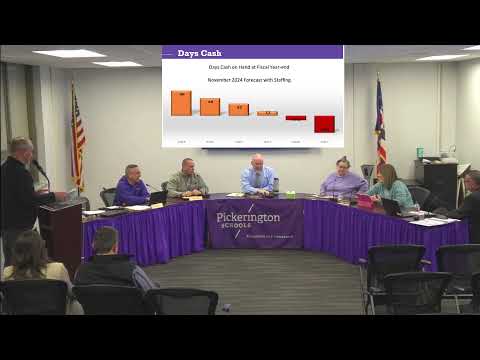
Treasurer warns of funding risk, DPIA changes and levy options; board asks to prioritize teachers/classroom staff
Summary
Treasurer John Walsh told the Pickerington board the district faces funding risk from potential DPIA and state budget changes and presented levy scenarios; trustees said prioritize classroom-facing hires and delay nonessential hires until state clarity.
The Pickerington Local School District’s work session on March 24 centered on the district’s five‑year fiscal forecast, potential levy options and recent changes in assessed property values that affect tax rates and revenue collection.
Treasurer John Walsh opened the presentation with an overview of how property valuation changes and the state’s “20‑mill floor” can alter effective tax rates. Walsh noted district assessed value increases and that, if current projections hold, the district “will, be at the 20 mil floor” for tax year 2025. He said construction and tax-advance timing factor into the general fund position and reminded the board that April will bring final numbers for the early learning center and athletic complex construction closeouts.
Major financial risks discussed
- Disadvantaged Pupil Impact Aid (DPIA)/Community Eligibility Provision (CEP): Administration highlighted a large revenue change since the district entered CEP. The treasurer said the district’s DPIA support increased materially (he cited figures rising to the millions) and warned that proposed federal or state changes could remove a substantial share of this funding. In the presentation administration estimated a potential loss in the range of several million dollars (the work session repeatedly referenced an approximate $8 million figure tied to DPIA sensitivity).
- State budget base-cost uncertainty: Board and administration discussed the governor’s budget simulation and the possibility that enacted state funding could be below forecasted levels; one scenario the treasurer presented showed a shortfall of roughly $6.8 million in FY26 relative to the district forecast depending on final state actions.
- Federal program risks: The treasurer described federal conversations about potential reductions to Title I, Title II and other federal streams; the district’s Title I funding is modest (about $1 million), while a 25% cut in some federal streams would be material for program budgets.
Levy options, timing and mechanics
Walsh reviewed several levy scenarios and how the House Bill 920/valuation adjustments affect millage-to-dollar conversion. Key dates and options noted by administration:
- August 6, 2025: administrative deadline to deliver a notice to proceed to the board of elections if the board elects to pursue a November 2025 levy placement.
- Scenario examples presented included an 8.29‑mill fixed-rate levy modeled to restore forecasted reserves under a full staffing plan and a $15.92 million five‑year emergency dollar request converted by county auditor processes to a millage equivalent on the ballot. A May or November 2026 pathway was modeled as an alternative, yielding different cash‑flow timing and requiring a higher millage (the treasurer’s examples included a 9.05‑mill continuing levy scenario when shifted later).
Board direction and priorities
Trustees repeatedly asked for prioritization of staffing, specifically urging administrators to return a pared, prioritized plan focusing on “people in front of kids.” Several trustees said they do not want to hire large numbers of new staff until the district has more clarity from the state budget and federal funding streams. Trustee comments included:
- A request that administration produce a prioritized list showing the absolute minimum staff needed next year (classroom-facing staff first), with phased additions if new revenue is realized.
- A recommendation to begin community education and engagement sooner rather than later, even if the board delays a final decision on the ballot timing. Trustees said communications should explain growth drivers and tradeoffs for voters.
Administration observations and next steps
Walsh and staff committed to provide: (a) updated construction closeout numbers in April, (b) a prioritized staffing list that puts classroom staff first and phases other hires, and (c) more granular calculations that distinguish general-fund cash from invested construction-bond funds. Senior administrators urged prudence in hiring and asked the board for guidance on timing and the levy structure (emergency five‑year dollar amount vs. continuing millage).
Ending: The board did not set a final levy amount or date during the work session. Trustees directed administration to return with prioritized staffing proposals focused on classroom needs, detailed cash/investment clarity, and communications to begin informing the community about the district’s growth and funding needs.