Get email alerts on the School Waste Reduction topic
No spam. Unsubscribe anytime.
Pickerington Central students win $2,400 zoo grant to pilot cafeteria composting and shared-table program
Summary
A student team from Pickerington High School Central received a $2,400 grant from the Columbus Zoo (sponsored by Patel) and outlined a pilot to reduce cafeteria waste with compost bins, compostable trays, a shared table and student helpers; the team has already collected about 100 pounds of packaged food for donation in two weeks.
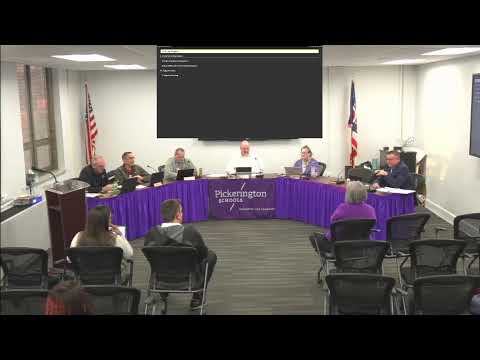
A student team from Pickerington High School Central told the Pickerington Local School District Board of Education on Feb. 10 that a $2,400 grant from the Columbus Zoo (sponsored by Patel) will fund a pilot to reduce cafeteria waste through composting, compostable trays, a shared “share table” and student helpers.
The team’s faculty advisor, Mrs. Brian, an environmental science teacher at Pickerington Central, introduced the seven-student group and described the Teen Eco Summit project the students will present at the Columbus Zoo. “This team has worked really hard to come up with this idea, on issues that they saw in our high school and, solutions,” she told the board.
Kate, the team captain, summarized the student plan: “This year, our project was to improve the waste within our cafeteria.” She said the group has already implemented a shared table where unopened, properly packaged food can be left for others; in two full weeks the table collected about 100 pounds of donated packaged food that otherwise would have been thrown away.
Why it matters: the students argued the pilot addresses both environmental and local-service goals — reducing landfill waste and increasing donations to the district food pantry. The presentation included school-specific data from custodial staff estimating 24–26 trash bags removed daily (about 120–130 bags weekly) and calculations the students said amount to roughly 274,560 gallons of waste annually at current levels.
Details and next steps: the students told the board the compost bins planned for Central cost about $2,000 for the school year; the $2,400 zoo grant will buy the bins and an initial bundle of about 400 compostable trays (the students said roughly $400 would be used for those trays). The remaining funds would be used for implementation steps this school year, and the group said they will seek additional funding next year to sustain the program. The students said the grant must be spent by the end of the school year.
The proposal includes: switching from expanded polystyrene trays and prepackaged utensil packs to compostable trays and single sporks/napkins where feasible; a utensil dispenser to reduce unused utensils being discarded; a staffed share table to capture unopened packaged food; compost collection and a potential future partnership with The Compost Exchange to convert food waste into soil; and student helpers who could receive service hours for managing the program.
Board response and context: Mr. Lanier introduced the students to the board and praised their work. Board members applauded the team; President Lopez congratulated the students and asked whether seniors on the team would carry the effort forward next year. Mrs. Brian confirmed the program will need continued fundraising to operate in future years.
Cost and evidence cited by students: the team presented per-item cost comparisons they gathered: current styrofoam trays estimated at $0.04 each (totaling about 14,000 per year) and cutlery packets at $0.03 each (about 11,900 per year). They noted compostable trays cost roughly twice as much per unit but decompose faster in landfills, and that using single utensils would reduce waste from full utensil packets.
The board did not vote on the presentation; it was offered as an information item. The students said they will run longer-term tests in March and aim for fuller implementation in the following school year if funding and logistics permit.
AI generated
The text on this page is AI generated. Summaries, highlights, analysis, and video transcripts are all produced from the original source material.
AI can make mistakes, so if you spot one, and we will fix it for everyone.
Note: the source content is unaltered by us. Any content source we link to, be it a video, an audio recording, or a document, is presented exactly as its publisher released it. That publisher is usually a government body, sometimes an individual official or another organisation.