Get Full Government Meeting Transcripts, Videos, & Alerts Forever!
Get email alerts on the Land Use Oilfield topic
No spam. Unsubscribe anytime.
Williams County approves suite of oilfield-related land-use permits after debate over beachfront subdivision
Summary
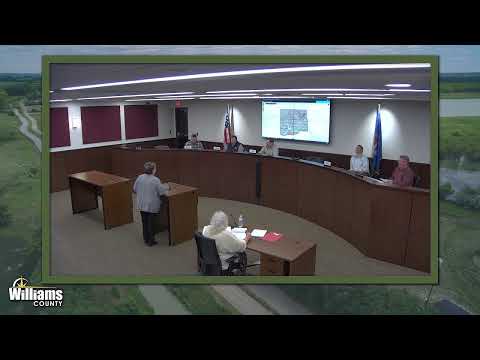
The Williams County Board of County Commissioners on May 6 approved a variance that will allow two newly created 2.07-acre lots to remain in the county’s Agricultural Zoning District and also approved three oilfield-related land-use permits after public comment and technical presentations.
The Williams County Board of County Commissioners on May 6 approved a variance allowing two newly created 2.07-acre lots to remain in the county’s Agricultural Zoning District and also approved three related land-use actions for oilfield infrastructure and mining after staff presentations and public comments.
Michelle Haugen, county planning staff, told commissioners the minor subdivision (LU-0006-25) divides a roughly 78.95-acre parent parcel in Houghland Township into three lots, including a 74.93-acre lot that will remain in agricultural zoning and two 2.07-acre lots for future homes. Planning and Zoning recommended approval, 8–0, and recordation of the plat was made contingent on approval of the requested variance.
At the public hearing ExxonMobil representative Kevin Reichling urged commissioners to deny the variance, saying the proposed lots fall within a currently permitted well-pad area tied to the company’s Grinnell Bakken Unit (GBU) plans and arguing that approval would create “negative impacts” for the mineral owners and for recovery of hydrocarbons. Reichling cited evaluation criteria in section 342 of the Williams County zoning ordinance and subdivision regulations and said company engineers had planned the unit and associated roads and infrastructure as far back as 2019. He said moving the pad “well to the northeast or down the south side” would create “significant drilling challenges” and could reduce recoverable resource, while small shifts of a few hundred feet might be workable.
Roger and Marilyn Baker were the landowners identified in the file; their son, Zach Baker, a professional engineer who said the new home pad on the property is intended as his primary residence, also spoke. A nearby resident raised concerns about prior well placements, irrigation impacts and long delays in compensation for damages from earlier activity.
Commissioners asked technical questions about setback rules and drilling laterals; Reichling said the regulatory setback to an occupied home is typically 500 feet and that a 500-foot move would not create the drilling difficulties he described but larger relocations could. Commissioner comments emphasized private property rights and the limited stretch of lakefront in the area. After discussion, a motion to approve the variance, including Planning and Zoning’s recommended conditions, passed on roll call with all present voting in favor.
Separately under Planning and Zoning, the board approved an 80-acre site’s conditional-use permit for a freshwater holding pond (LU-0008-25) to store about 387,666 barrels (49.97 acre-feet) of fresh water for oil well production; the pond will be lined with 30-mil polypropylene, fenced, and served by diesel trailer-mounted pumps and an industrial groundwater permit. Planning and Zoning recommended approval, 8–0.
The board also approved a conditional-use permit for a freshwater pump station (LU-0009-25) to serve an approximately 6.9-acre pond and a 45-by-35-foot unmanned pump building to supply fresh water for nearby oil production; that item likewise carried an 8–0 Planning and Zoning recommendation.
Finally, commissioners approved an amendment to a previously approved conditional-use permit for a frac-sand facility (LU-0012-25) submitted by Ramsey Hill Exploration to add lands north of 50 Second Street Northwest, intended to prolong mining away from lakefront properties. Planning and Zoning recommended approval, 7–1.
All four Planning and Zoning items were described as having met staff conditions and technical review. The record shows Planning and Zoning recommended approval of each freshwater and frac-sand item and that the board adopted those recommendations in motions that passed by roll call.
The board’s actions distinguish discussion from formal direction: ExxonMobil’s request that the variance be denied was discussion and public comment; the board issued no additional direction to staff to reopen technical review beyond the conditions already imposed by Planning and Zoning. Motions recorded on the record resulted in formal approvals for the variance and the three conditional-use and amendment items.