Get Full Government Meeting Transcripts, Videos, & Alerts Forever!
Get email alerts on the Mining Sand Gravel topic
No spam. Unsubscribe anytime.
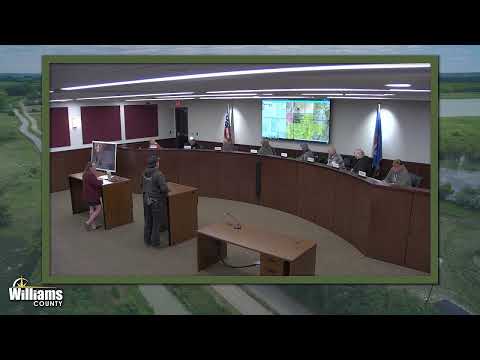
Planning commission denies Wickham sand-and-gravel mine after heavy public opposition
Summary
Williams County Planning and Zoning Commission denied a zone change, variance and conditional-use permit for a proposed sand-and-gravel mine on land owned by Roger and Rita Wickham after extensive public comment and concerns about dust, traffic and groundwater.
The Williams County Planning and Zoning Commission denied a trio of applications from Diamond Bee Companies and Basin Sand that sought a zone change, variance and conditional-use permit to expand sand-and-gravel mining on land owned by Roger and Rita Wickham northeast of Williston.
The denial came after more than an hour of presentation and public comment on the series of related applications, which the applicant described as a plan to mine sand in five-acre working faces, convey product by a slurry system to a nearby processing facility and average about 80 truck trips per day once operating.
The commission’s decision matters because the projects would have changed land currently mapped commercial/rural into agricultural zoning to allow open-pit mining in an area that has experienced new residential development. Neighbors, township officials and several commissioners raised concerns about dust (including silica exposure), truck traffic on County Road 9 and Cartwright Loop, water-table impacts and long-term effects on property values.
Representatives for the applicant described the operation and mitigation measures. Chris Selsley, a land and legal contractor appearing for Basin Sand and Diamond Bee, said, “This project proposes to supply sand to the oil and gas industry using local resources as an alternative to the sand that's imported right now from Minnesota and Wisconsin.” Blaine Mosby of Basin Sand and Roger Wickham, the landowner, answered technical questions about equipment, reclamation and depth. Wickham said the company would “strip the topsoil with a paddle scraper, pile that, and then come back and then strip the clay pile that. And then and then mine the mine the sand.”
Residents disputed key points in the presentation. Speakers said they had differing accounts of operational hours (the applicant’s materials referenced 24/7 capacity while presenters later emphasized limited hours), questioned truck volumes and routes, and warned that area wells ranged from about 16 to 88 feet deep. Several speakers asked the county to consider potential declines in home values and long-term public-safety impacts from added heavy truck traffic.
County staff said the proposed mining on county-jurisdiction parcels would be limited to extraction; the processing plant would sit inside the Williston extraterritorial jurisdiction (ETJ) and require separate city permits. The applicant noted the State Department of Environmental Quality had issued an air-permit determination and that a stormwater plan would be required before activation; the applicant also described a closed-loop water wash system and said reclamation would follow mining operations.
After public comment, a motion to deny the county zone-change and variance applications passed on a roll call vote. Commissioners then voted to deny the conditional-use permit for the county portion of the operation. The board’s final motions carried; the county will not issue the requested approvals for the parcels before it.
The applicants may pursue City of Williston processes for any activities in the city ETJ, and the record shows the city has a separate hearing on related parcels scheduled. The Williams County denials mean the county portion cannot proceed without a future successful application or changed circumstances.
The commission thanked speakers and closed the agenda items; commissioners and staff emphasized the need to coordinate jurisdictional permitting when projects cross city and county boundaries.