Get Full Government Meeting Transcripts, Videos, & Alerts Forever!
Get email alerts on the Tax Abatement Manufacturing topic
No spam. Unsubscribe anytime.
Ravalli County approves partial tax abatement for Corixa (GlaxoSmithKline), excludes solar farm and three key-card items
Summary
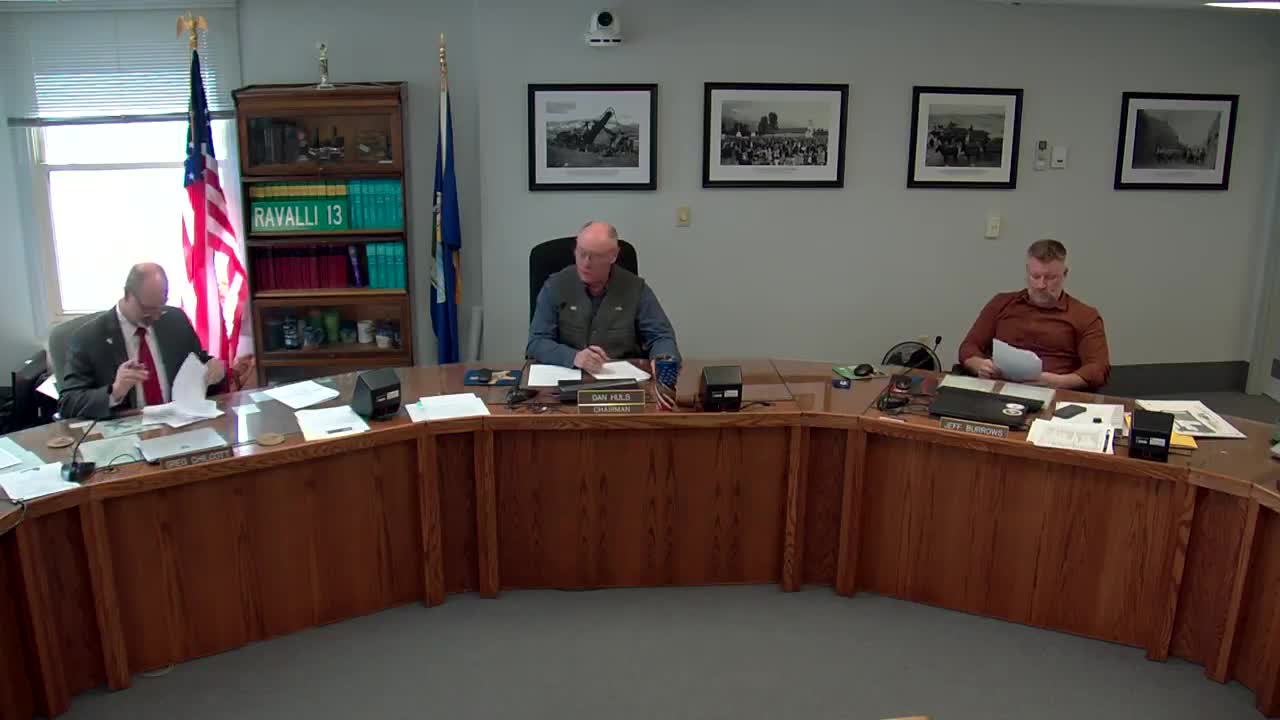
On April 10 the Ravalli County Board of County Commissioners approved a manufacturing (Class 8) property tax abatement for Corixa Corporation (doing business as GlaxoSmithKline) at 80% but removed the company's solar farm and three key-card access items from the exemption after questioning whether they qualify as manufacturing machinery.
The Ravalli County Board of County Commissioners on April 10 voted to approve a Class 8 manufacturing tax abatement for Corixa Corporation, doing business as GlaxoSmithKline, but narrowed the exempted property by excluding the company’s solar farm and three key-card access items and adopting the abatement at an 80% level.
The action followed a public hearing that included explanations from company representatives about why the listed items are necessary to their manufacturing operation and a line-by-line review by county commissioners of which assets meet the statutory definition of manufacturing machinery, fixtures and equipment.
The county’s planning and tax staff noted that Corixa’s application originally listed multiple asset groups; the company’s representatives said the full asset list totaled $3,438,948 for the Class 8 request (the solar farm was listed separately and is being pursued under a different solar exemption). Commissioners questioned whether security items such as key-card readers and an uninterruptible power supply (UPS) feed line should be treated as manufacturing equipment under state law.
Mike Kauffman, site financial controller at GlaxoSmithKline (identifying that the company does business as Corixa Corporation), told the board the secure access systems and UPS equipment are integral to controlling manufacturing areas and maintaining processes that handle regulated materials. “We have to maintain secure areas because of what we’re doing,” Kauffman said, describing the key-card readers and access controls. Mike McGraw, representing Dushar McMillan & Associates (tax advisors), supported that characterization and provided technical details about the assets on the submitted list.
Commissioners pressed for statutory text and definitions. The transcript record shows county discussion citing statutory provisions (read aloud during the hearing as “7 6 dash 3 dash 201 section 1 subsection c” and related citations) and a statute reference read as “15 6 1 38” while the board debated whether the items transform materials or are facility infrastructure. One commissioner said he could accept the UPS feed line as tied to manufacturing continuity but expressed hesitation about card readers and other security fixtures, calling them “stretching the definition” of manufacturing equipment.
After discussion, a motion passed to approve the abatement at 80% while striking the solar farm from the Class 8 request and removing three specific key-card related line items (the motion referenced three item identifiers and a combined value stated in the hearing). Commissioners voted in favor (recorded as Greg — aye; Jeff Burrows — aye; and a third commissioner — aye). The board also adopted Resolution 4705 to implement the action and requested that staff deliver the signed resolution to the state liaison by the following day for the state’s administrative processing.
Company representatives emphasized Corixa/GlaxoSmithKline’s local economic role during the hearing: Kauffman noted the Hamilton site employs roughly 300 people and said the company expects to remain long-term in the valley. The board acknowledged those comments but reiterated the need to apply statutory definitions consistently.
Per the exemption rules discussed during the hearing, approved Class 8 exemptions phase back in at a rate of 20% per year (the board and applicant discussed the statutory phase-out schedule for multi-year abatements). The solar farm remains on the applicant’s broader asset list but will be pursued separately through the state’s solar exemption process rather than through this Class 8 manufacturing abatement.
The board’s action on April 10 is recorded as Resolution 4705; county staff said they will finalize and transmit the signed resolution to the state liaison promptly.
Ending: The Corixa representatives thanked the board for its time. County staff will finalize the resolution and forward it to the state as requested.