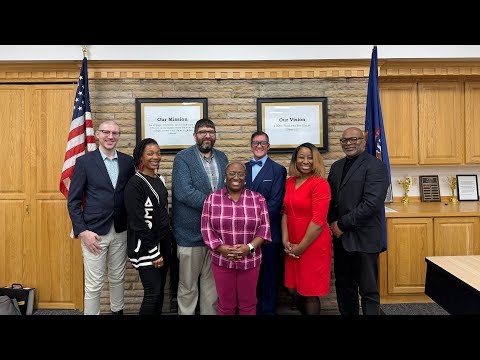
Battle Creek Public Schools previews six-year strategic plan emphasizing equity, student voice
Loading...
Summary
At a May 12 work session, district staff presented a draft 2025–2031 strategic plan developed with roughly 900 participants; the board discussed implementation steps but took no vote.
The Battle Creek Public Schools Board of Education on May 12 reviewed a draft six-year strategic plan that district consultants and staff say was co‑created with about 900 participants and centers student voice, equity and a narrowed set of district goals.
Doctor Tammy Campbell, who presented the plan, told board members that the planning process produced a vision of the student experience, three core values — “academic excellence, community and equity” — and a “profile of a graduate” that lists capabilities such as critical thinking, creativity and collaboration. Campbell said the plan pairs four goal areas with district “foundations” that the central office would lead over the next six years.
The plan’s four goal areas are: a whole‑child goal called “positive school experience,” an elementary goal (early learning/building foundations), a middle‑grade goal (grade‑level competency) and a high‑school goal (career, college and community ready). Campbell said schools would keep two goals each school year (the whole‑child goal plus the grade‑level goal appropriate for that school) and would use a practices document — an internal playbook still being finalized — to show how schools should implement the goals.
Board members asked about how the mission statement was drafted and whether it added distinct meaning beyond the vision and values. Trustee discussion focused on alignment versus repetition; Campbell and other staff said the mission was drafted from board and district team input and could be revisited later.
Campbell recommended several next steps for implementation: align the district’s school improvement planning template to the new goals, pull principals and school teams together before the 2025–26 year to orient them to the two‑goal structure, and require at least biannual school‑level progress monitoring so schools and the board can track outcomes. She said the internal version of the plan will include six to eight specific practices per outcome and that district staff will finalize the graphic design of the public document before publication.
Board members generally praised the inclusion of student voice and the plan’s emphasis on equity, but some trustees pushed staff to ensure the mission statement adds unique purpose rather than repeating vision language. No action or vote on adoption occurred at the May 12 work session; staff said they will finalize internal implementation documents and return with follow‑up materials for the board.