Get Full Government Meeting Transcripts, Videos, & Alerts Forever!
Get email alerts on the Budget Finance topic
No spam. Unsubscribe anytime.
Lapeer school officials warn of roughly $5 million shortfall and shrinking fund balance as enrollment falls
Summary
District finance staff told the board they expect continued enrollment declines, revenue uncertainty and a roughly $5 million deficit for 2025–26 absent further state action; staff have begun reductions and will engage budget managers and stakeholders to close gaps.
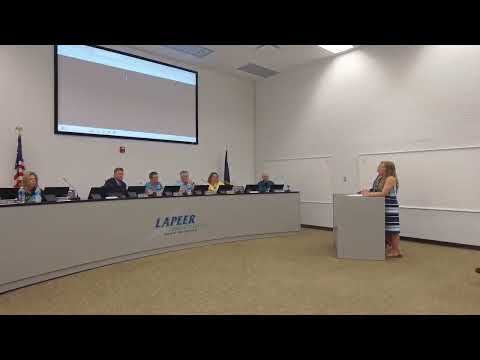
At the May Lapeer Community Schools Board of Education meeting, Erica Ingalls of the district business department presented a financial forecast that projects roughly a $5 million operating deficit for the 2025–26 fiscal year and a notable decline in the district's fund balance if current conditions persist.
"We're we're looking at about a $5,000,000 deficit this year," Ingalls told the board, adding that staff are preparing a preliminary budget for the June board meeting and will hold budget-manager sessions next week. Ingalls said district leaders have already implemented reductions that will affect next school year, including elimination of a secretary position, a building dean position, and 5.6 full-time equivalent teacher positions.
Ingalls and other staff highlighted two structural pressures: declining enrollment and revenue uncertainty at the state and federal level. The district reported current enrollment at about 4,033 full-time-equivalent (FTE) students; Ingalls said losing 100 FTE at the district's approximate $10,000 per-pupil foundation rate would reduce revenue by about $1 million. She also noted that state-level proposals for 2025–26 vary: the governor proposed approximately a $392 per-pupil increase, the senate proposed $400 and the house proposed about $417 in different draft budgets, while the House also has a separate joint resolution (H.R.) being tracked that would amend the state constitution to bar use of the School Aid Fund for public university operating expenses.
Board members and staff discussed the district's fund balance history and the effect of one-time federal COVID-era funds. Ingalls said the district's audited 2023–24 fund balance was about 16.5%, but that figure includes ESSER and other one-time federal categoricals; removing those one-time dollars brings the comparable percentage closer to the district's long-term pre-COVID levels (roughly 8–11%). Ingalls said the district has about $10 million in ESSER funds overall and that federal categoricals had temporarily bolstered the fund balance.
Other budget pressures noted included rising inflation, potential changes to federal programs such as Medicaid and school meals, upward pressure on wages and benefits (including retirement and FICA/Medicare contributions), and projected utility-cost increases. Ingalls warned the board that staff will continue scrutinizing expenditures and working with employee groups; multiple bargaining contracts are open and set to expire June 30, 2025.
The district plans additional budget-manager meetings and a preliminary budget presentation in June, followed by a final adoption later in June and a public hearing as required. Ingalls urged the board to expect further difficult conversations about staffing, operations and program evaluation as the district closes a projected funding gap.
No formal budget resolution for the district operating budget was adopted at the meeting; the board received the forecast and committee recommendations and approved a separate ISD general fund operating budget resolution later in the meeting.