Get Full Government Meeting Transcripts, Videos, & Alerts Forever!
Get email alerts on the Education Math Problem Solving topic
No spam. Unsubscribe anytime.
Stricker Elementary teachers use monthly 'Problem of the Month' and PLCs to boost K–5 math problem solving
Summary
Stricker Elementary staff told the Lapeer Community Schools board that a monthly, grade-level problem set, guided PLCs and a math-focused interventionist helped teachers target gaps in problem solving and student perseverance across K–5.
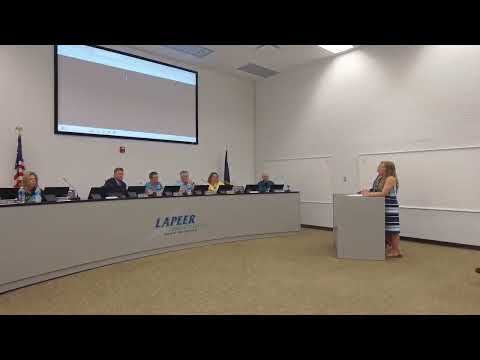
At the May Lapeer Community Schools Board of Education meeting, Michelle McKendree, principal of Stricker Elementary, and Amy Duncan, the school's learning coach, described a new K–5 initiative that gives teachers a common problem set each month and structured professional learning community (PLC) time to teach deeper problem solving.
McKendree said the work is tied to a board goal for teacher participation in PLCs and the four PLC questions: "What do we want students to learn? How are we going to assess them? What are we going to do if they aren't learning? And what will we do if they are able to be taught?" She told the board Stricker serves about 487 students, 20.8% of whom receive special education services, and employs more than 50 staff, including a math-focused interventionist and shared behavioral supports.
Duncan said the Problem of the Month gives K–5 teachers a common language and a set of five related word problems that increase in difficulty across a monthly topic. "This resource is to provide K–5 teachers with the support to teach really in-depth problem solving in a way that we could all talk around from our youngest mathematicians," she said. Teachers pick one problem each month for instruction and one for a short assessment the next day; grade-level teams then review results in PLCs to identify trends and next steps.
Presenters said the program produced two consistent findings: students were generally comfortable "making mistakes" but struggled to explain their solution process and to persevere on multi-step problems. Duncan showed a schoolwide problem-solving report sheet that prompts students to identify what they need to find, make a plan, and decide what to try if they get stuck. Third-grade teachers also used student self-assessments to help students reflect on strengths and areas for growth; a third-grade teacher reported that students commonly rated themselves as able to get answers but had difficulty explaining their reasoning.
Staff described next steps as refining and streamlining the materials, preserving structured collaboration time for teachers, and continuing to use formative assessments to guide instruction. "We definitely want to continue having that, to add things — we thought it was really beneficial," McKendree said.
The board received the presentation; no formal board action was taken on the classroom pilot during the meeting. Presenters said they will keep the board updated as the PLC work and assessments continue.