Get Full Government Meeting Transcripts, Videos, & Alerts Forever!
Get email alerts on the Affordable Housing topic
No spam. Unsubscribe anytime.
Rutherford consultant says DCA fourth‑round calculation drops prospective need to 210 units; council to consider next‑phase study
Summary
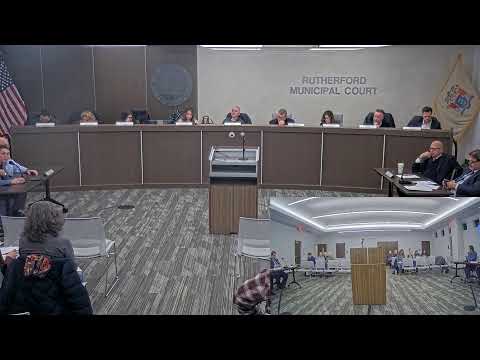
Rutherford officials heard a consultant's presentation on Jan. 27 that recalculated the New Jersey Department of Community Affairs' (DCA) fourth‑round affordable‑housing ‘‘prospective need’’ and outlined a second phase of study that will examine actual developable parcels.
Rutherford officials heard a consultant's presentation on Jan. 27 that recalculated the New Jersey Department of Community Affairs' (DCA) fourth‑round affordable‑housing ‘‘prospective need’’ and outlined a second phase of study that will examine actual developable parcels.
The council was told the consultant’s parcel‑by‑parcel review reduced the DCA figure from 223 prospective units to 210 and that a follow‑up vacant‑land analysis and housing‑element work will be delivered in June; council members and residents pressed for more public education and clarity about how the new number fits with prior rounds.
Lindsay, a planner working with the consultant team, told the council she and her colleagues ‘‘checked their math’’ and used the state’s published factors to re‑examine parcel suitability. ‘‘So the process that we were able to remove some parcels to bring your unit count for prospective need to 210 units in lieu of the 223 units that DCA had calculated,’’ Lindsay said. She described the state’s three equally weighted factors (nonresidential valuation, median income compared to the lowest median in the housing region, and a land‑capacity mapping layer) and said some mapped areas were removed because they were right‑of‑way or adjacent to the turnpike and therefore appeared not developable.
Bob, speaking after public questions, said the borough does not yet know whether the fourth round will supersede prior rounds. ‘‘We were told that they would be in addition to. We were at $4.77 after the third round. Now, we're at hopefully 210. But now we're also hearing that on July 1 there's going to be a ruling issued that will give clarity,’’ he said, indicating the borough is waiting for statewide guidance.
Council President McGowan stressed the cumulative effect of multiple rounds of state requirements: ‘‘It is cumulative. It is not, we are not just talking about 200 in a snapshot,’’ she said, urging transparency for residents. Residents at the meeting described the potential scale and local impact: Katie Marshall said the topic ‘‘is the biggest thing that has ever happened to this town’’ and called for a town hall; David Labrino asked who would make the July 1 ruling and requested public links to the DCA worksheets.
Council members were told the borough currently has 16 rehabilitation (existing) units counted toward need that could be addressed with the borough’s affordable‑housing trust fund, and that the consultant’s second phase (described on the agenda as authorization for phase 2 work for Niglia) will produce a vacant‑land analysis and a housing element amendment in June that could change the prospective total further.
At the meeting the consultant recommended adoption of a resolution documenting the recalculation and presenting the parcel‑by‑parcel findings to the state; the transcript records the presentation and discussion but does not record a formal council vote on the resolution or on authorization for phase 2 during the items shown. Council members said they plan further review and public engagement before adopting zoning or ordinance changes, and one council member asked officials to time any town hall to maximize available technical information.
Taxonomy and process details cited by the consultant included: the DCA fourth‑round methodology uses three 33.33% weighted factors (tax assessor nonresidential valuation change, median‑income comparison, and mapped land‑capacity parcels); Housing Region 1 (Paterson) data and census figures feed the calculations; parcel‑level removals were made where aerial imagery and mapping suggested parcels were right‑of‑way or adjacent to limited‑use corridors. Lindsay said the June housing‑element adoption will include a fuller vacant‑land analysis and realistic development potential assessment.
Public speakers asked for clearer statewide documentation and links; Lindsay said the DCA has a publicly downloadable Excel workbook and a report that explain the calculations and that searching ‘‘New Jersey DCA fourth round affordable housing’’ should surface the materials. Council members also flagged a July 1 statewide ruling and a 2026 deadline for adopting ordinances, map amendments or other legal changes tied to the process.
The council also received a brief engineer’s report on a separate construction project (Diamond 4) and ceremonial proclamations for local green‑leaf businesses, but the meeting’s substantive policy discussion centered on the DCA fourth‑round recalculation, the consultant report, the planned vacant‑land analysis and requests from residents for a town hall and more public information.
Looking ahead, the council will consider the consultant’s written report and the proposed resolution (to document the recalculation and submit findings to the state) and will take up the phase‑2 authorization on the agenda; the transcript for the meeting segment does not show a final vote on either item.