Get Full Government Meeting Transcripts, Videos, & Alerts Forever!
Get email alerts on the Mobile Integrated Health topic
No spam. Unsubscribe anytime.
Mobile integrated health program credited with fewer repeat 911 calls, city hears
Summary
The Fire Department reported declines in repeat nonemergency 911 calls after adding a mobile integrated health specialist; staff said the program reduced calls from an initial cohort and produced roughly 300 avoided EMS calls in its first year, saving an estimated $240,000 in transport costs.
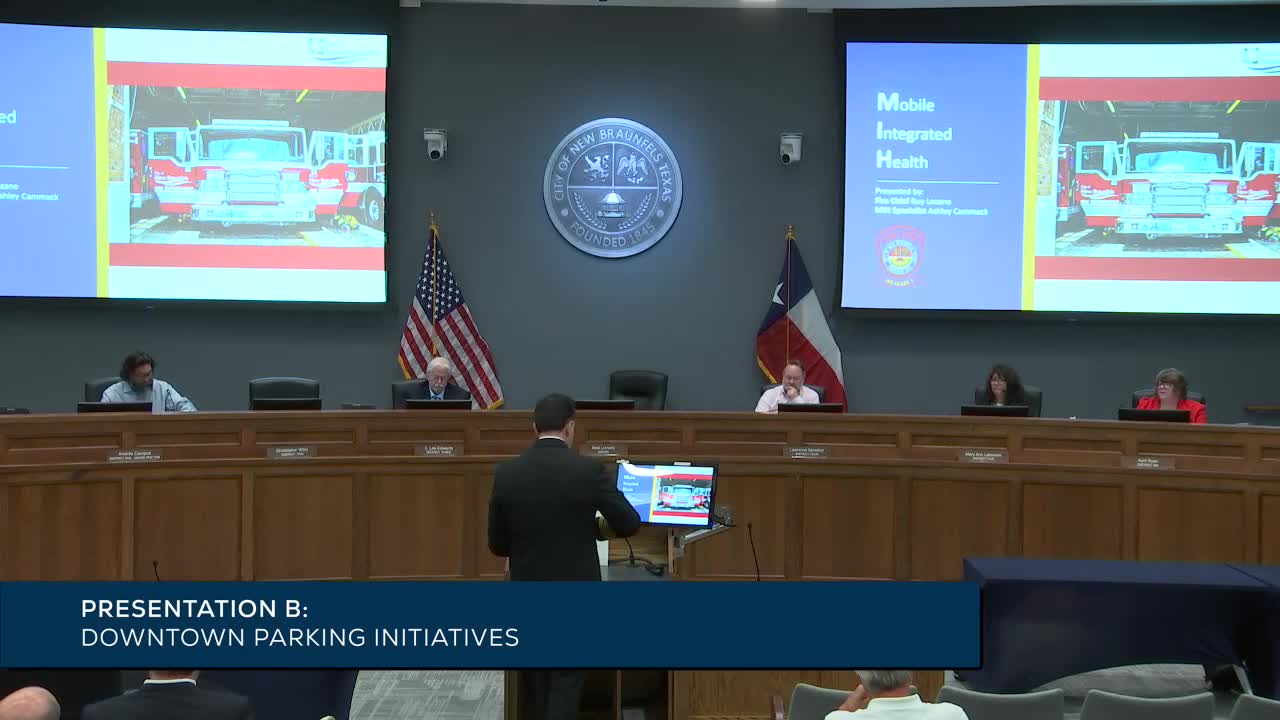
The New Braunfels Fire Department told the City Council it has substantially reduced repeat, nonemergency 911 calls after launching a mobile integrated health (MIH) program that assigns a specialist to high‑use callers.
Fire Chief Lozano reported the program began in earnest about a year ago and targeted “super utilizers,” callers who used EMS frequently. The department initially set a working threshold of 10 or more 911 calls in a year to identify the population for the program; that cohort numbered 32 people and accounted for more than 500 calls for service in the baseline year, Lozano said. “When we first identified those that only had 4, there was so many, we really didn't have the capacity to respond to that demand. So we decided to up our threshold to 10,” he said.
Chief Lozano and Ashley, the MIH specialist, said the program helped connect people to primary care, medication support, case management and other community resources. Ashley told council she completed 391 MIH visits during the program period, often meeting patients nonemergently to build care plans and connect them with local agencies and providers. She said those visits are logged into the department’s charting system so firefighters can see whether an address is associated with a known MIH client.
City presenters attributed a measurable drop in repeat calls to the MIH work. Lozano and Ashley said the original 32 patients made 524 EMS calls in fiscal year 2023 and 294 calls in fiscal year 2024, a roughly 44 percent reduction for that baseline group. Separately, staff estimated the program produced approximately 300 avoided EMS calls overall and an estimated cost avoidance of about $240,000 in transport and consumable expenses; the department uses an average nonrecoverable per‑transport cost of $800 in its calculations.
Funding for the MIH specialist’s salary came from opioid‑settlement funds, while the McKenna Foundation provided capital support for vehicle and equipment costs, Chief Lozano said. Council heard that four patients have ‘‘graduated’’ from the program and several others are nearing graduation. Staff also said they are adding an intern and contracting with a behavioral analyst to address patients who are resistant to case management. Lozano said staff are evaluating whether to add a second MIH specialist as demand and geography (including expanding ESD coverage) require.
Council members praised the program’s outcomes and encouraged continued expansion and coordination with local transportation resources. No formal council action was required; members thanked the fire department and MIH staff for reducing strain on EMS resources and improving patient outcomes.