Get Full Government Meeting Transcripts, Videos, & Alerts Forever!
Get email alerts on the Parking Managed Downtown topic
No spam. Unsubscribe anytime.
Council holds first reading on paid downtown parking plan as public reaction splits
Summary
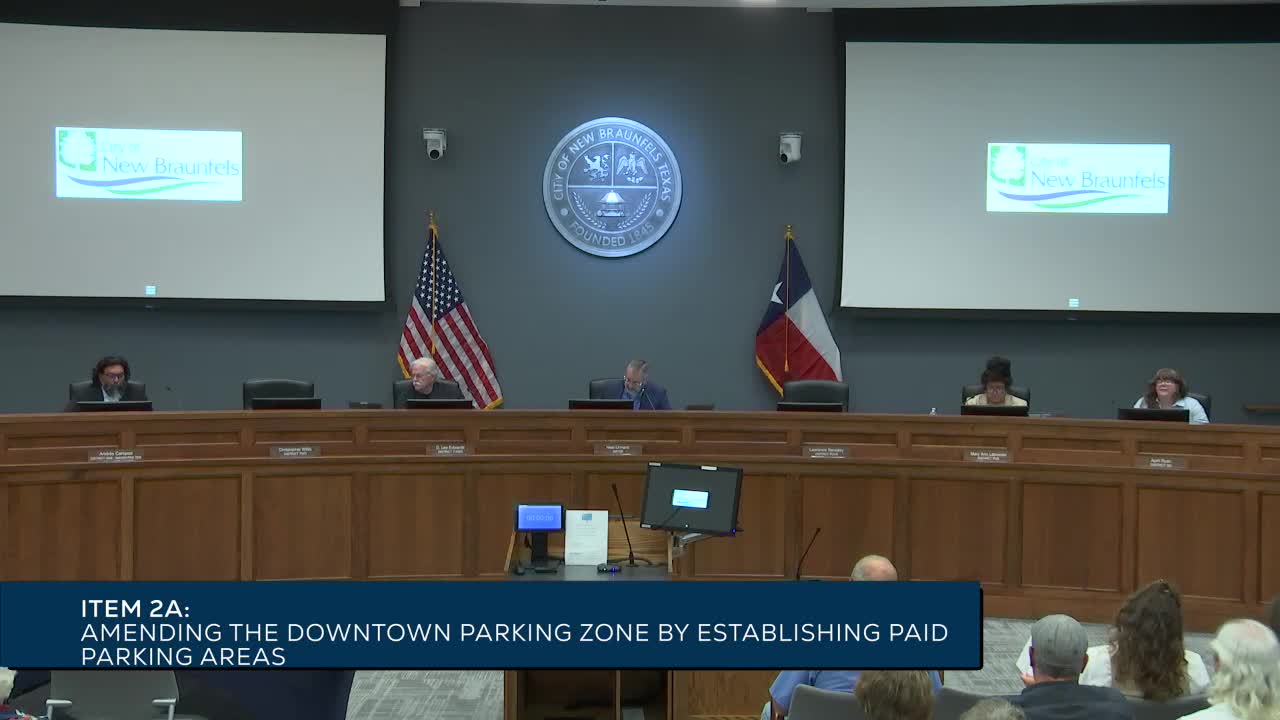
The New Braunfels City Council on May 12 heard the first reading of an ordinance to amend the city code to establish a managed, paid-parking program for much of the downtown two‑hour zone and held a public hearing that produced mixed reactions from business owners, residents and the New Braunfels Chamber of Commerce.
The New Braunfels City Council on May 12 heard the first reading of an ordinance to amend the city code to establish a managed, paid-parking program for much of the downtown two‑hour zone and held a public hearing that produced mixed reactions from business owners, residents and the New Braunfels Chamber of Commerce.
The measure under consideration would convert a third of downtown on‑street spaces that are currently in a two‑hour zone into a managed system with a first hour free, $2 per hour thereafter and an all‑day cap of $10; an expanded employee permit program; an opt‑in program for private off‑street lots; and a high‑visibility customer‑service ambassador program operated by the city’s vendor, Interstate Parking. City staff recommended the ordinance for a first reading; council did not record a final vote on adoption during the meeting.
Why it matters: Council members and staff said the program is intended to increase turnover for short‑term parking in front of businesses, reduce congestion from cars circling for spaces, and channel fees into a downtown parking fund to pay for operations and future investments such as property leases or a parking structure. Opponents warned that charging for prime spaces could push long‑term parkers into nearby residential neighborhoods and reduce convenience for customers and residents.
Jeff Jewell, the city’s economic and community development director, opened the presentation by describing the item as the ordinance’s first reading and putting the change in historical context: “Tonight is the first reading of a series of changes to the code of ordinances establishing, some changes in the downtown parking zone,” he told council and the public.
Tony (first name used in presentation) Janowick, an Interstate Parking representative, described how the system would function. He said the pricing structure would be “a first hour free and then a simple $2 an hour thereafter with an all day max of $10.” He also described the vendor’s customer‑service model, including high‑visibility ambassadors on ebikes to assist visitors and a soft rollout in which initial noncompliance would generate informational notices rather than citations.
The city and contractor stressed enforcement would focus on education. Janowick said the vendor does not profit from citations and that immobilization or towing is rare: under the proposed enforcement rules, a vehicle with multiple unpaid citations could eventually be immobilized, but Interstate has moved away from towing in most operations and described immobilization as an uncommon outcome.
Public testimony split along business and residential lines. Jonathan Packer, representing the New Braunfels Chamber, supported the city’s effort, telling the council: “Change is not easy. But it’s often essential.” Downtown business owner Kat Kyle Balmus, who operates The Local on Castell Avenue, said maintaining turnover is critical for shop and restaurant traffic and added she is prepared to adopt business‑level measures such as paying for customer parking when helpful.
Several residents voiced concerns that the new system would push parkers into adjacent neighborhoods, reduce access for elderly visitors and workers, and add costs for downtown employees. One resident asked whether fees would first pay contractor costs; staff said parking fees would first cover contractor payments and that remaining revenues would be deposited in a downtown parking fund for reinvestment. Another frequent concern was how disabled veterans or temporary hang‑tag users would be accommodated; staff said vehicles displaying disabled‑veteran plates would be exempt once registered in the vendor’s system.
City staff said the rollout would include public outreach, two community open houses and education at major downtown events; staff and the vendor also said they would monitor neighborhood spillover and recommend residential permit expansions if problems appear. Jewell noted the council in April had already approved converting enforcement of parking citations from the prior criminal process to a civil one, which staff says makes enforcement and collection more administrable.
The ordinance was presented as a first reading; staff said a second reading was planned for a later May meeting and that the city would target a July 7 activation date if the council approves the change. The council did not record a final adoption vote on the ordinance at the May 12 meeting.
The council asked staff to continue public outreach and to return with data after the soft launch so the program can be adjusted.
Ending note: If adopted, the program will route parking revenues to a dedicated downtown parking fund intended to support enforcement, operations and potential future parking projects.