Get Full Government Meeting Transcripts, Videos, & Alerts Forever!
Get email alerts on the Emergency Management topic
No spam. Unsubscribe anytime.
Emergency management coordinator tells council North Richland Hills maintains an all‑hazards, multi‑department approach
Summary
Emergency Management Coordinator Raelynn Darnell briefed council on the city’s all‑hazards emergency preparedness program, citing the hazard mitigation plan renewal, water system resilience requirements from state and federal law, EOC activation protocols and community CERT volunteer work.
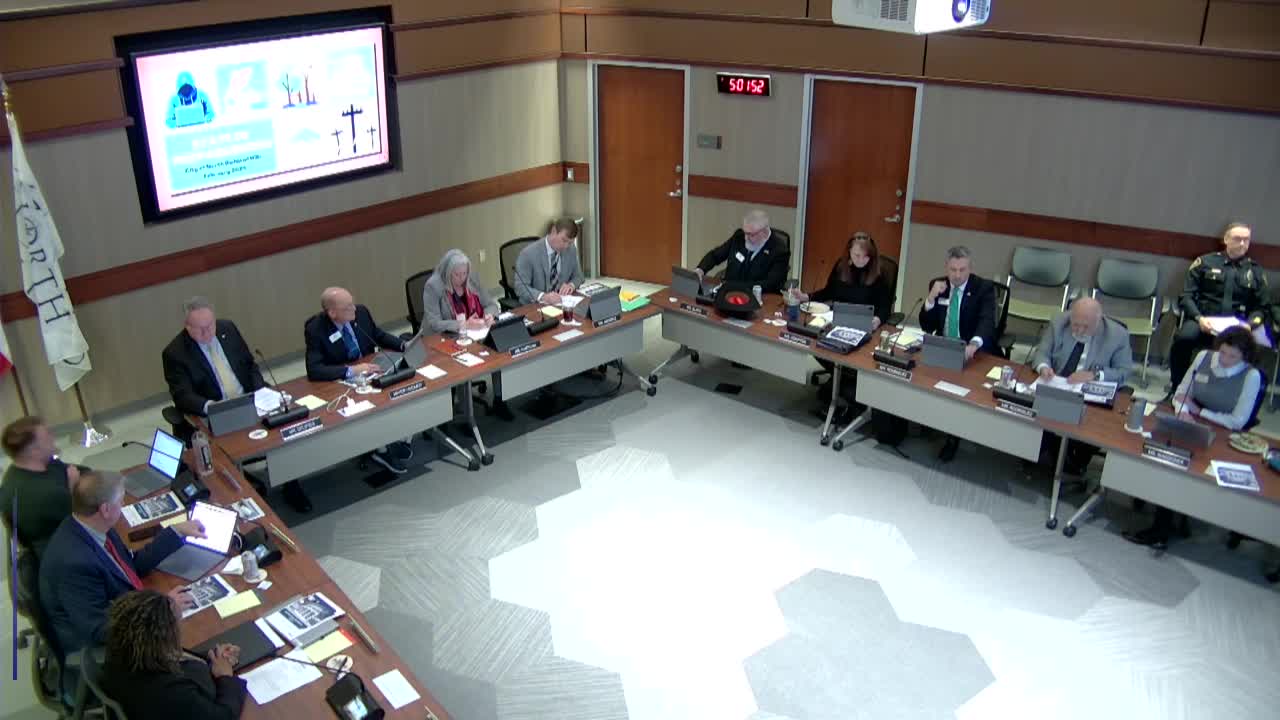
Raelynn Darnell, the city’s Emergency Management Coordinator, presented an overview of North Richland Hills’ emergency preparedness program on Feb. 10, telling council the city takes an ‘‘all‑hazards’’ approach and regularly coordinates prevention, preparedness, response and recovery activities across departments and with external partners.
Lede: Darnell said the city operates multiple phases of emergency management at once and highlighted the city’s hazard mitigation plan—currently undergoing its 5‑year renewal—water‑system protections and the role of the Emergency Operations Center (EOC) when local capabilities are or may be overwhelmed.
Nut graf: The presentation emphasized that the city coordinates across fire, public works, police, utilities, communications and external stakeholders; the EOC is staffed with key functions when activated and mutual‑aid and county/state/federal escalation exists in that order. Darnell cited several statutes and federal requirements that shape utility resilience planning, including the Stafford Act, Texas Government Code chapter 418, the America’s Water Infrastructure Act of 2018 and state laws following Winter Storm Uri (e.g., Senate Bill 3) that require utility winterization and emergency response planning.
Supporting detail: Darnell said the city maintains roughly 2,500 hydrants, uses SCADA for water lift‑station monitoring and conducts routine inspections and relationship building with non‑profits and neighboring jurisdictions. She reported the EOC was formally activated for roughly 90 hours in 2024 for events including planned incidents such as the solar eclipse and unplanned events. Darnell and public‑works leaders described manual operations performed during Winter Storm Uri—staff physically monitoring lift stations and manually operating valves to maintain service when systems and remote monitoring failed.
Council Q&A: Council members asked how the city would respond to catastrophic single‑events (an EF‑5 tornado scenario) and continuity of operations if the EOC were hit. Darnell and other staff said the city has a continuity plan and a backup EOC at the public‑safety training center; staff practice tabletop and full‑scale exercises that sometimes include randomized “curveball” scenarios. Council discussion touched on cybersecurity exercises and coordination with utilities partners (TRWA/Trinity River Authority) when large supply lines are impacted.
Ending: Darnell said the hazard mitigation plan renewal will return to council in coming months with updated community risk profiles and mitigation actions. Council thanked staff and asked for the plan and additional details at the next presentation cycle.