Get Full Government Meeting Transcripts, Videos, & Alerts Forever!
Get email alerts on the Compensation Pay Plan topic
No spam. Unsubscribe anytime.
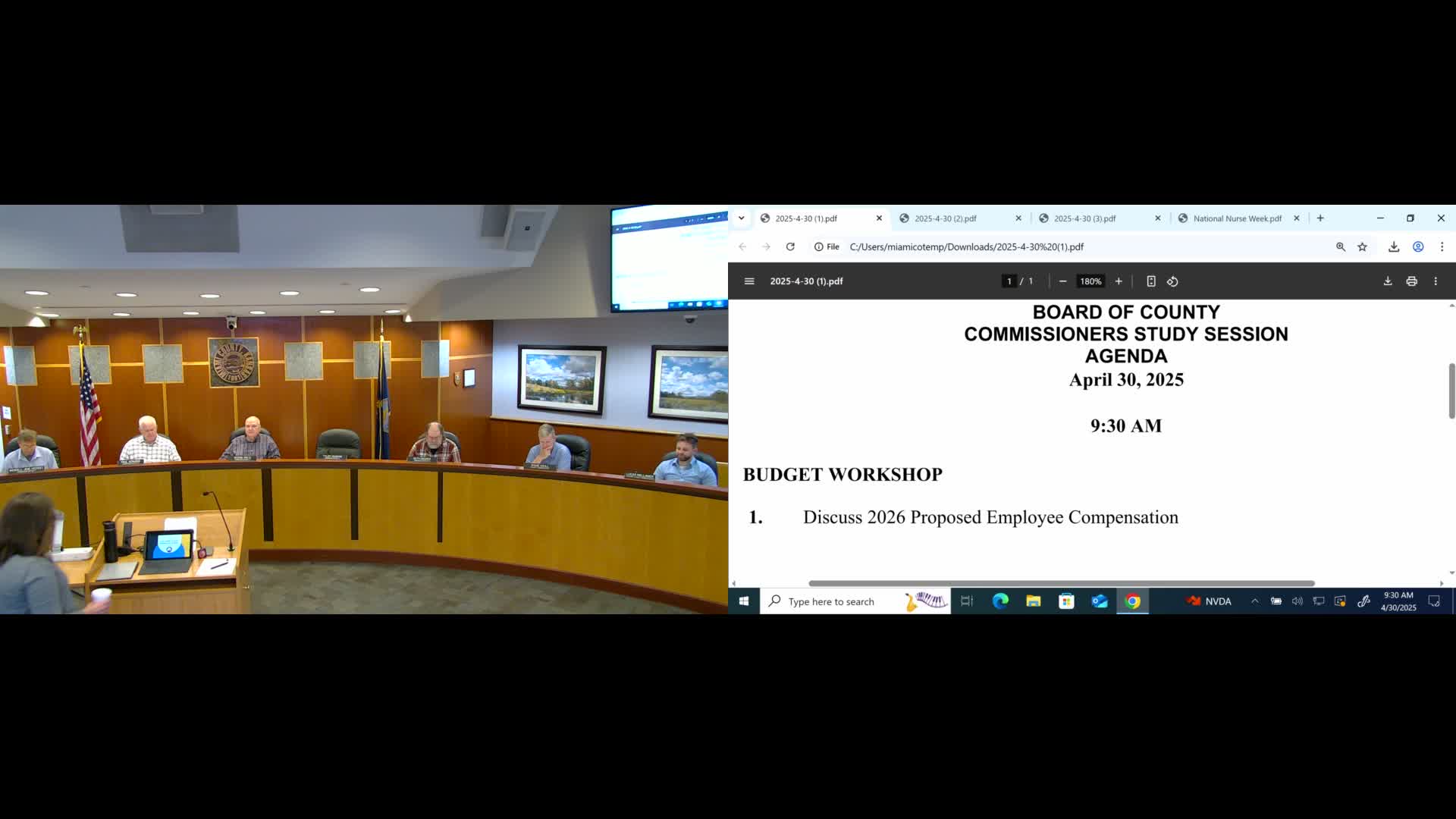
Miami County commissioners review pay plan options, weigh $15 base-rate goal versus phased or flat-dollar raises
Summary
Miami County staff presented options for raising the county's pay scale to reach a $15-an-hour Grade 1 base by 2026 or 2027, outlining budget impacts, pension contribution changes and alternatives such as a flat-dollar raise or a phased approach; commissioners asked staff to return with firmer numbers and suggested workshops later in the year.
Sarah Denny, interim human resources director for Miami County, told the commission the county's current position classification and pay plan (effective Dec. 28, 2024) governs wages for non-elected county employees and that any change to one part of the plan affects the whole pay structure.
Denny said getting Grade 1 to a $15-an-hour base by 2026 would require a 9.3% overall increase (a 7.8% cost-of-living adjustment and 1.5% merit), with a budgetary impact she estimated at about $2.2 million total: roughly $1.6 million in salaries and $600,000 in benefits. She presented turnover and hiring data showing 62 separations in 2021, 79 in 2022, and a 2024 year-end with 72 hires and 56 separations that reduced vacancies from 38 to 15.
Why it matters: county wages and benefits are the largest recurring expense in Miami County's general fund, and commissioners framed pay decisions as the single biggest budget choice they face. Commissioners also noted that pay strategy affects recruitment, retention and internal promotion incentives across public-safety and non-public-safety departments.
Options and trade-offs
Denny offered a phased alternative that would reach the $15 target by 2027 instead of 2026: splitting the required increase over two years (a 3.85% COLA in 2026 plus 1.5% merit), which she estimated would cost about $1.5 million in the first year. She also described how a flat-dollar increase (for example, $0.50, $0.75 or $1.00 per hour across the board) differs from percentage-based raises by narrowing gaps at the bottom more quickly while compressing mid- and upper-range differentials.
Commissioners discussed both approaches. Some argued a flat-dollar increase helps lower-paid employees catch up, while others warned it could compress pay at supervisory levels and blunt incentives to advance. Several commissioners said they were not ready to overhaul the pay plan in time for the 2026 budget but want a deliberate process to consider a longer-term redesign.
Pension, benefits and other costs
Denny reviewed employer pension and benefit impacts included in the cost estimates. She said the county's contribution to the county retirement program (presented in the meeting as the county's pension contribution rate) was about 10.71% of payroll in the current year and was projected to drop to 10.59% in 2026; she also cited a separate public-safety pension contribution of about 24.62% that was projected to decline to about 24.00% in 2026. (These figures were presented by staff during the meeting as the county's current employer contribution rates.)
Denny noted that benefits included retirement, payroll taxes, workers' compensation and unemployment; health insurance costs were treated separately in the county's budget modeling.
Performance-pay tools
Commissioners and staff raised the need for a reliable performance-evaluation tool if Miami County moves toward a merit- or performance-based pay system. Denny said the county has evaluated NeoGov as a performance-management option and estimated it at about $15,000 annually (about $60 per full-time employee per year). She said a system like NeoGov would make performance reviews trackable, allow timely corrective actions and support any merit-pay program.
Next steps and timeline
Commissioners agreed they were not prepared to rework the entire pay plan for the 2026 budget cycle but expressed clear interest in studying changes. Staff said they will return in a few weeks with firmer numbers for the commission's consideration and recommended a longer, late-summer or fall series of workshops that would include department heads to identify goals and impacts before any structural overhaul.
Unresolved questions and constraints
Commissioners repeatedly emphasized revenue constraints (including the option of remaining revenue-neutral, drawing on reserves, or raising taxes) and the recurring nature of wage increases. Staff reminded the commission that one-time funds should not be used for recurring salary increases and that the county must balance competitiveness with budget sustainability. Several commissioners also raised concerns about maintaining pay differentials for supervisory and specialized roles if bottom-range pay increases are compressed.
Ending
Staff left the commission with two practical items: run the numbers for a $1-per-hour across-the-board scenario and return with updated cost estimates for the percentage-based and phased approaches; and plan workshops after the immediate budget timeline so department heads can be included in designing any structural changes to the pay plan. No formal motions or votes on salary increases were taken during the session.