Get Full Government Meeting Transcripts, Videos, & Alerts Forever!
Get email alerts on the Roads And Bridges topic
No spam. Unsubscribe anytime.
Miami County staff recommends using surplus from low bid on 2025 asphalt maintenance to add resurfacing work
Summary
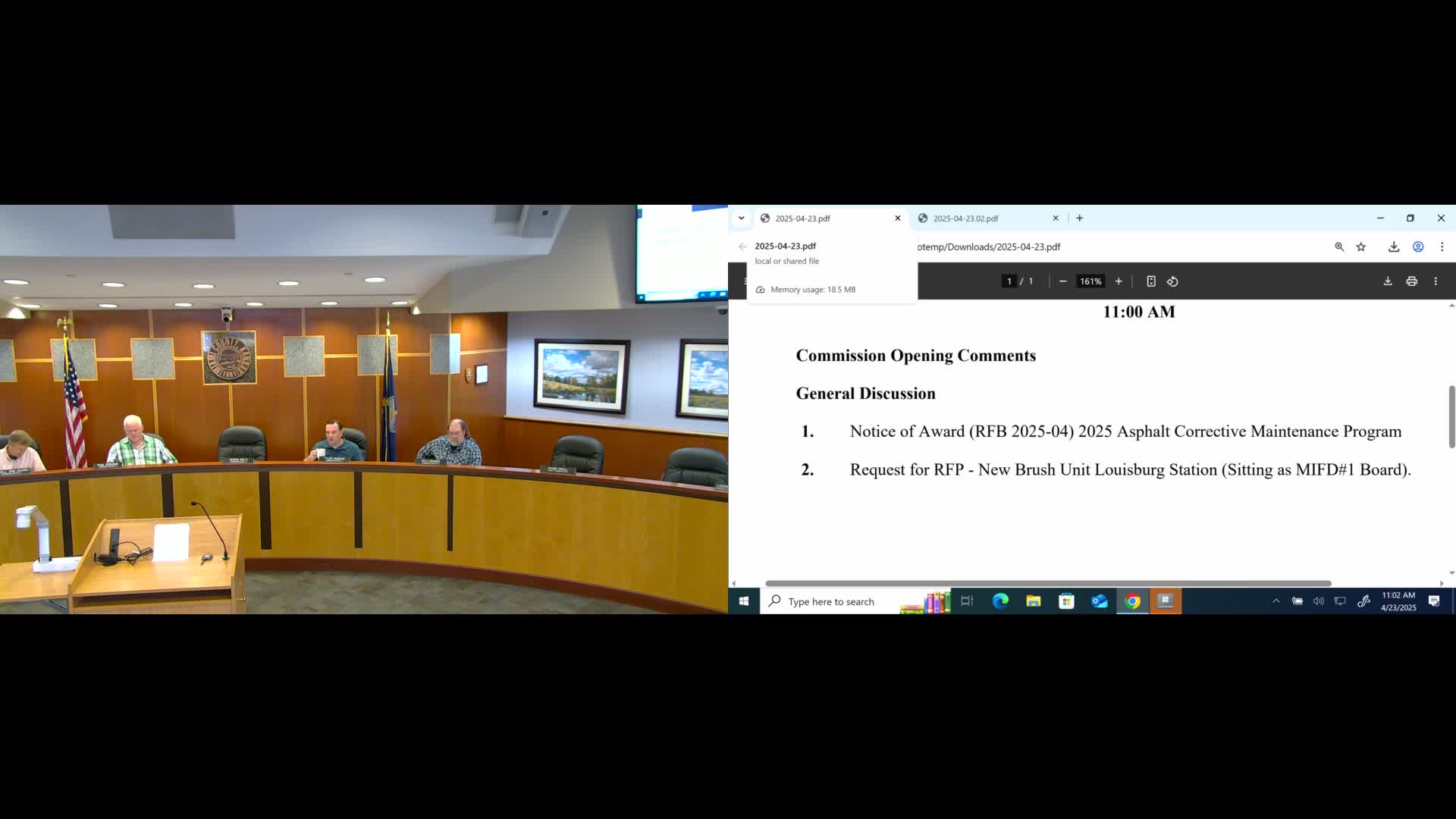
Miami County Project Manager Matt Oler presented bid results for project 2407STCO702 (RFB 2025-04), the 2025 asphalt corrective maintenance program, saying Superior Bowen was the apparent low bidder at $3,481,694.35 and that the county’s project budget is approximately $5.6 million.
Miami County Project Manager Matt Oler presented bid results for project 2407STCO702 (RFB 2025-04), the 2025 asphalt corrective maintenance program, saying Superior Bowen was the apparent low bidder at $3,481,694.35 and that the county’s project budget is approximately $5.6 million.
Oler said the project budget includes $1.6 million from court and sales tax and about $4.0 million from a road and bridge asphalt line item. He told the commission the low bid would leave roughly $2,118,305.65 before contingency and other set‑asides. After subtracting an estimated $100,000 for construction engineering and a $300,000 hold by Road and Bridge for additional crack sealing, overlays or subdivision work, Oler said about $1,718,305 would remain in the corrective maintenance CIP project.
Why this matters: Oler recommended using part of that remaining balance to increase the mill depth on 220 Third Street (from Metcalfe to the state line), add a 1‑inch leveling course where wheel‑run and dynamic loading are causing uneven pavement, and possibly perform a separate mill-and-overlay on a Metcalfe segment while contractor mobilization is already on site. "If you have the funding now it would really be, in my opinion, your best interest cost of benefit to hit that section while you can," Oler said.
Commissioners asked detailed questions about the bid spread and price assumptions. Oler explained several unit‑price differences between the apparent low bidder, Superior Bowen, and a second bidder identified as Kilo. He said mobilization by Superior was listed at $30,100 versus $353,700 for Kilo, and that hauling and location explain much of the variation. Oler also cited different approaches to patching and compaction that produced large differences in per‑unit estimates.
Oler compared the bids to the engineer’s prior estimate and his own. He said the engineer’s estimate was $6,432,986, his internal estimate had been $5,600,000 and Kilo’s bid was $5,943,062.20. He reiterated that Superior Bowen’s $3,481,694.35 bid created the surplus in the record project budget.
On pricing risk, Oler reminded the commission that the county’s construction contracts include an asphalt indexing clause that adjusts pay based on commodity price changes. "Of the eight years that we’ve done the mill and overlay program, there’s only been one year that we’ve ever paid money into the indexing and not gotten a return from it," he said, noting past years typically returned savings to the county and that indexing can produce either additional cost or reductions depending on the June index.
Oler recommended that staff issue the award to the apparent low bidder and then, if the commission directs, negotiate supplemental line‑item prices with that contractor so staff can bring back firm costs to add the 1‑inch leveling course and the Metcalfe-to-state-line mill/overlay. He emphasized he would not ask the commission to make final commitments on supplemental work until staff verifies final prices from the apparent low bidder.
Commission remarks and next steps: Commissioners asked the county finance director (referenced in the discussion as Lucas) whether unused savings could be returned to the sales‑tax program or reallocated inside the CIP; Oler said that question was for finance staff to confirm. Several commissioners asked staff to wait for the contractor’s final numbers before committing surplus funds and requested that all commissioners be present for any decisions that would reallocate millions inside projects.
Proposed changes Oler described included: increasing a planned 2‑inch mill to a 3‑inch mill on a local segment, adding a 1‑inch leveling course to improve ride and reduce dynamic loading, and possibly having Road & Bridge crews perform overlay work if contractor prices made that more cost‑effective.
No formal award or vote was recorded in the study session transcript. Commissioners and staff agreed to proceed with staff follow‑up: complete the award paperwork for the apparent low bidder so staff can enter negotiations, obtain firm supplemental prices for the specific additional work, and return to the commission with those numbers before committing surplus funds.
Ending: Staff will return with contractor pricing and finance guidance; no final binding award or reallocations were recorded in the transcript of the study session.