Get Full Government Meeting Transcripts, Videos, & Alerts Forever!
Get email alerts on the Drainage Watershed Evans 354 topic
No spam. Unsubscribe anytime.
Delaware County commissioners dismiss Evans 354 drainage petition after contested hearing; order costs distributed to landowners
Summary
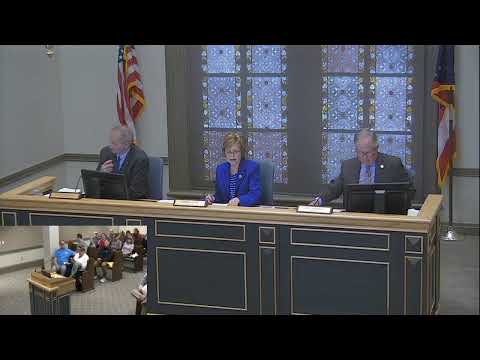
Delaware County commissioners on March 10, 2025 dismissed a petition to construct the Evans Number 354 Watershed Drainage Improvement Project in Harlem Township and ordered that costs already incurred be distributed to landowners after a contested public hearing where numerous property owners opposed the assessments.
Delaware County commissioners on March 10, 2025 dismissed a petition to construct the Evans Number 354 Watershed Drainage Improvement Project in Harlem Township and ordered that costs already incurred be distributed to landowners, after a contested public hearing in which multiple property owners opposed the work and questioned individual assessments.
The petition covered the Evans Number 354 watershed, roughly 317 acres and 51 parcels, and proposed two construction sections (Main 1 and Main 2) of open-channel restoration, rock-lined channels, subsurface drain tile and related work. County and Soil and Water staff presented a final engineering report estimating a total project cost of about $370,524.93 and sample parcel assessments averaging roughly $7,000; commissioners said testimony at the hearing did not show that benefits exceeded costs and moved to dismiss the petition.
Why it matters: the project would have been funded by special assessments placed on benefited parcels or paid up front by landowners. Approving the petition would have initiated public bidding, construction and a perpetual drainage maintenance assessment; dismissing it leaves landowners responsible only for costs already incurred and stops further work unless a new petition is filed.
County and Soil and Water presentation
Brett Bacon, deputy administrator for the Delaware County Soil and Water Conservation District, summarized the petition’s scope and the engineer’s findings. He described Main 1 as open-channel and rock-lined channel work with surface drain and tile replacement and Main 2 as upstream subsurface tile and related work. Bacon said the petition, originally filed May 26, 2021 and amended July 19, 2021, followed prior view and hearing steps (view 08/16/2021; first hearing 10/28/2021). He told the board the watershed is roughly 317 acres (55% agricultural, 32% residential, 11% woods, 2% road/commercial) and that the engineer found the project technically feasible.
Bacon presented line-item estimates: Main 1 construction $166,713.62; administration, engineering and inspection $9,360.88; contingency $25,000; drainage maintenance pay-in $8,803.72 for a Main 1 subtotal of $209,878.22. Main 2 construction was listed at $130,048.12; administration/engineering $8,263.03; contingency $15,000; drainage maintenance $6,935.56, for a Main 2 subtotal of $160,646.71 and a combined project estimate of $370,524.93.
He described the assessment formula required by the Ohio Revised Code, explained landowner payment options (pay in full within 30 days or place as a special assessment on property tax rolls, with borrowing interest and fees if bonded) and gave an example repayment: an average sample assessment of about $7,000 would produce semiannual payments of about $476.44 on an eight-year schedule or about $254 on a 15-year schedule, and a sample annual maintenance collection at about 3% would be roughly $241.20.
Public testimony and main concerns
The hearing drew many landowners and residents. Several speakers who said they live in or own parcels inside the watershed urged commissioners to deny the petition, citing these recurring concerns: the petition lacked broad support (petitioners represented a small share of parcels), assessment allocations appeared uneven between residential and agricultural parcels, individual assessment amounts seemed excessive for some homeowners, and some residents argued they had not experienced the kind of persistent flood damage described and were unwilling to take on multi‑year assessments.
Teresa Rakosi, a landowner who identified two parcels and a Robbins Road address, told the commissioners she opposed the proposal and said the petitioners represented less than 4% of watershed parcel owners. "I urge you to vote against the proposal," Rakosi said, adding that the estimated $20,000 assessment on her two parcels (roughly 3.899 acres) and perpetual maintenance charges were not justified by demonstrated benefits.
Other speakers described a mix of technical and equity concerns: several questioned how benefit acres were calculated (woodlands, wetlands and parcels with partial wetland constraints were raised repeatedly), asked which hydrologic design assumptions were used, and requested clearer, parcel-by-parcel explanations for why adjacent properties received very different assessment totals.
Technical responses from staff
Rob Riley, chief deputy engineer with the county engineer’s office, and Bacon answered technical questions. Riley said the district’s designs follow Natural Resources Conservation Service specifications and use a drainage coefficient methodology rather than a single “design storm” frequency; the design used a one‑inch drainage coefficient to size subsurface tiles for surface flow. He said the proposed plan satisfied the petitioners’ requests and could accommodate future lateral extensions if additional petitioners sought them, but the current design did not add laterals where no petitioners had requested them.
Riley and Bacon also explained that the Ohio Revised Code treats a parcel as “benefited” when runoff from that parcel enters the proposed improvement, which can include woodlands or wet areas even if landowners cannot legally drain a wetland. They reiterated that assessments reflect acres considered to benefit under state code and acknowledged that growth or future development would change the land-use picture but cannot be precisely predicted for the assessment calculation.
Board action and votes
After hearing testimony and staff answers, commissioners said they were not convinced the benefits exceeded the costs, particularly given how assessments were allocated to residential parcels. The board approved the following resolutions by recorded vote:
Votes at a glance
- Resolution 25-186 (dismiss petition): "Setting aside the order for and dismissing the petition for the Evans Number 354 Main 1 watershed drainage improvement project due to the cost equal to or exceeding the benefits." Motion passed. Vote record: Commissioner Merrill — yes; Commissioner Benton — yes; Commissioner Lewis — yes. Outcome: approved (petition dismissed). (Main 2 was not considered because Main 2 requires approval of Main 1.)
- Resolution 25-187 (distribute incurred costs): "Ordering that the cost of the proceedings of the Evans Number 354 Main watershed drainage improvement project, including costs incurred by the Board of Commissioners, the County Engineer, and the Delaware County Soil and Water Conservation District, be distributed to the landowners in the same ratio as the final estimated assessments presented at the final hearing." Motion passed. Vote record: Commissioner Lewis — yes; Commissioner Merrill — yes; Commissioner Benton — yes. Outcome: approved (costs to be distributed to landowners).
(For record: earlier procedural motions on acknowledgements were also passed during the hearing, including Resolution 25-185 acknowledging receipt of written objection and rejecting an untimely exception to the assessment filed by Mike Montana Pritchard; that motion passed by voice vote.)
What the decisions mean
By dismissing the petition for Main 1, the board stopped the project from proceeding to public bid, prevented the issuance of construction contracts tied to this petition and avoided the creation of new long‑term special assessments tied to the proposed improvements. The separate order to distribute costs means landowners in the watershed will share the expenses the county and Soil and Water have already incurred in surveying, engineering and preparing reports; the board directed that distribution be in proportion to the final estimated assessments presented at the hearing.
Next steps and context
Commissioners and staff noted property owners may petition again or seek future extensions if a different set of landowners chooses to pursue improvements. Staff also said if parcels are later developed to smaller, engineered lots with on‑site stormwater infrastructure, those developments are subject to separate engineering review and drainage standards. Several residents raised the prospect of road or regional projects (including potential future sanitary or roadway work) that could affect watershed drainage patterns; staff said such developments could change the local drainage picture but would not retroactively alter assessments already imposed under this proceeding.
The record from the hearing remains part of the county’s file; residents who submitted written testimony were acknowledged on the record. Commissioners closed the public hearing at 11:33 a.m. and later returned to the matter to record the two resolutions described above.