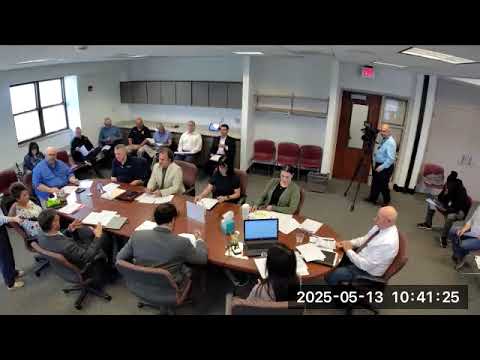
Trumbull County discusses phased study to relocate 911 dispatch; commissioners debate funding
Loading...
Summary
Trumbull County commissioners on May 14 discussed a phased plan to study and design a relocation or renovation of the county 911 dispatch center, with consultants estimating roughly $93,000 for an initial package and engineers warning full relocation or major renovation could cost millions.
Trumbull County commissioners on May 14 discussed a phased plan to study and design a relocation or renovation of the county 911 dispatch center, with contractors proposing an initial package of structural review, renderings and testing to produce cost estimates that could be used for grant applications.
County staff presented a Phase 1 scope from NCM Consulting Group and associated technical work from MCM/Phillips Mechanical and an outside structural-testing contractor. The presenters described the Phase 1 budget as roughly $18,300 for initial work, $45,561 for consulting/renderings and up to $30,000 for structural testing — a combined initial estimate county staff repeatedly summarized as about $93,000. Bruce Schneck, who joined commissioners for the briefing, said the structural testing could be the largest element: “Most of the other costs that we have in here for the 14,000 plus on there is for our structural engineer to go in, determine what testing needs to be done on the building for each of the areas.”
The consultants said the county-owned health department building in Cortland is the likeliest candidate for conversion, but noted that moving a building to a higher “risk category” for emergency operations requires a full structural analysis and possible retrofits. The team described specific engineering work: assessing load paths and connections across mixed building types (wood framing, steel, masonry), targeted testing at multiple joints, and design for an on-site or adjacent storm-shelter area. The structural engineer said testing might show fewer locations need work than the worst-case estimate, and that in some cases the testing budget could drop substantially: “they may only say, well, we only need tests in 10 places and it might be 12,000.”
Commissioners pressed staff on affordability and next steps. Commissioner (Mister) Malloy and others warned the county could spend the study funds and still face a multi-million-dollar bill to complete the move or build a new facility. One commissioner said the initial package totals — about $18,300 + $45,561 + $30,000 — amount to roughly $93,000 and asked, “Where do we get a hundred thousand? We don't have that.” Another commissioner responded that the study was necessary to produce the clear cost figures that grantmakers and the state will expect: “they wanna give money on things that are already ready to go. This is gonna prepare us for that.”
Commissioners and staff discussed options for paying for the study and the longer-term project. Suggestions included using leftover ARPA funds, issuing bonds, taking loans, or placing a local sales-tax increase before voters. Several commissioners noted the county could borrow to proceed and pay over time; others urged caution, saying they wanted a clear source identified before authorizing additional spending. Commissioners also asked staff to coordinate the structural work with the health department’s planned roof replacement to reduce redundant costs.
No formal vote to obligate the initial study funds was recorded in the public transcript during the presentation. Commissioners instructed staff to provide additional budgeting detail and to return with financing options and a more explicit multi‑phase plan before committing major sums.
If the board authorizes Phase 1, staff said the resulting engineering reports and renderings would be used to support grant applications and to set firm cost estimates for any required retrofits or a new build.