Get Full Government Meeting Transcripts, Videos, & Alerts Forever!
Get email alerts on the Secondary Redesign topic
No spam. Unsubscribe anytime.
Highline board hears secondary redesign plans tied to postsecondary credentials and enrollment
Summary
District leaders told the board that redesign pilots at the district’s four comprehensive high schools aim to increase students’ industry-recognized credentials and direct college enrollment; staff shared baseline and recent outcome data and described school-level plans such as a four-period day, a health-care pathway and expanded IB access.
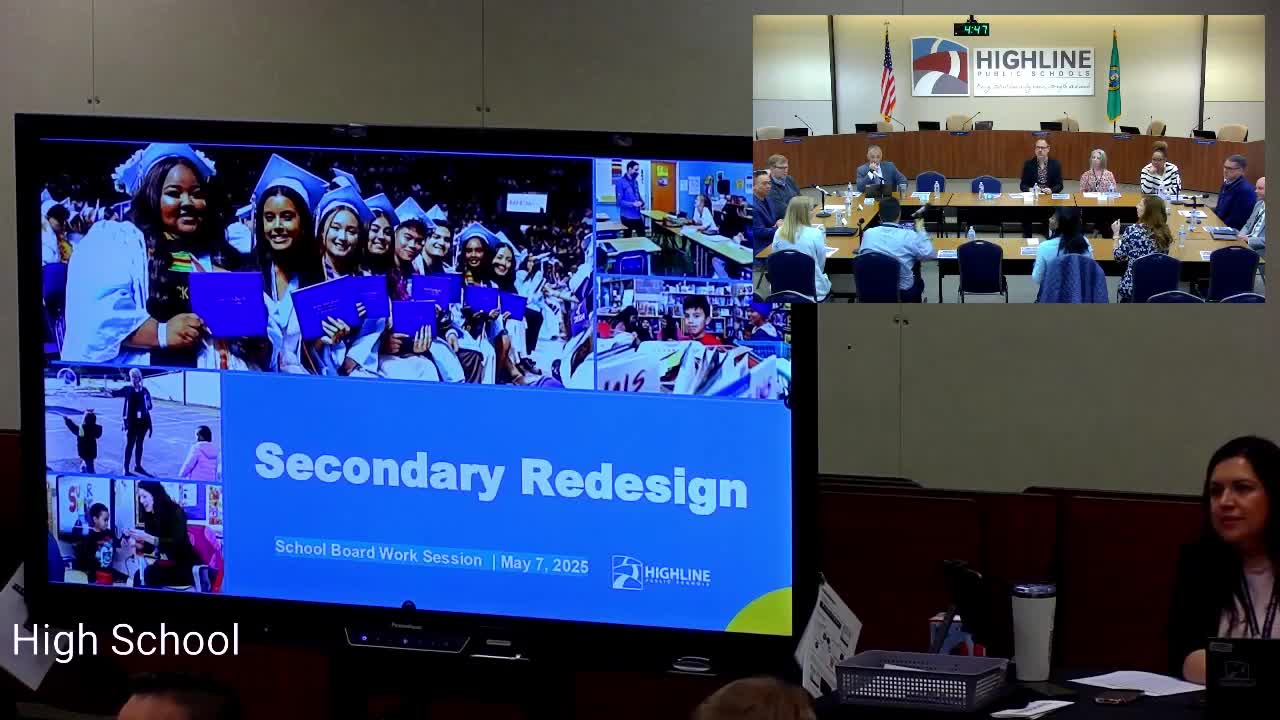
At a special Highline Public Schools board work session, district staff outlined the district’s secondary school redesign work and how it connects to postsecondary outcomes such as industry-recognized credentials and direct college enrollment.
The board was asked to consider redesign as part of the district strategic plan’s “future ready” goal and measures. Andrew Benitez, executive director in Student Learning, described the work as community driven and said each comprehensive high school has developed a “Case for Change” and a Journey Plan to guide pilots and implementation.
Benitez said the redesign effort is not top-down: “Our secondary redesign work is designed not to be top down, but really driven by the voices of our community, including our students, including our educators, and including our families,” he said. He tied the redesign to strategic-plan measures labeled in the presentation as Key Result 3 (measures 3A and 3B) and Key Result 6 (measures 6B and 6C).
District staff presented outcome data the board can use to judge progress. For students who took industry-recognized-credential (IRC)–eligible courses, the district reported a baseline of 15.9% earning an IRC in the year ending 2023 and said that figure rose to 30.4% the following year. Jeannette Blandford, director of Secondary Success, framed that work alongside student-reported measures of hope and confidence: she said the district’s baseline on the Panorama survey was 81.4% of 11th-graders answering favorably on hope-and-confidence questions, and that figure rose by about 4.9 percentage points the next measurement period.
Blandford and Sativa Jones, assistant director of college, also reviewed longer-term enrollment data from the National Student Clearinghouse used to track direct postsecondary enrollment. The presentation showed statewide direct-enrollment for the class of 2022 at about 52% (32% into four‑year institutions and 20% into two‑year/community and technical colleges). The board was told Highline Public Schools’ class of 2022 direct-enrollment rate is about one percentage point higher than the statewide figure.
Principals described different school-level redesign approaches being piloted. Joe Boyer, principal at Evergreen High School, is piloting expanded dual-enrollment and a “Wolverine Success Period” tier‑2 support. Highline High School is transitioning to a four‑period day and associated graduation-requirement amendments to allow more instructional time and deeper project-based learning. Tyee High School is opening a Health Professions Pathway in CTE health sciences that staff said offers opportunities to earn industry-recognized credentials. Mount Rainier High School is expanding access to International Baccalaureate courses and diploma pathways.
Benitez and Blandford emphasized that the district is using multiple measures to track impact: engagement and family participation (measure 3B), credential attainment (measure 6B), and student self-reported readiness (measure 6C). They said the district’s comprehensive high schools completed Cases for Change and Journey Plans during the 2023–24 school year and are carrying pilots into implementation and scale decisions this year. Staff noted ongoing family engagement work; a stated target for family participation in redesign processes is 50% or higher, and staff said that target remains a work in progress.
Board members recessed the meeting briefly for a facilities issue; the recess was approved by unanimous voice vote and the work session resumed in the district’s north classroom.
District staff said the next steps include additional principal convenings (a final convening was scheduled for the end of May), continued pilot implementation and monitoring of credential and direct-enrollment metrics to inform scale-up decisions.