Get Full Government Meeting Transcripts, Videos, & Alerts Forever!
Get email alerts on the Septic Systems topic
No spam. Unsubscribe anytime.
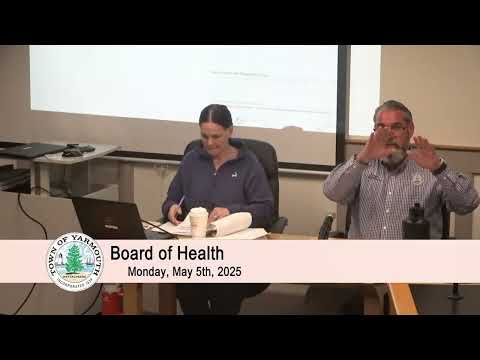
Yarmouth Board of Health approves one annual test for homeowner’s innovative septic system, will revisit in two years
Summary
The Yarmouth Board of Health on May 5 approved a variance to reduce required testing of an innovative/alternative septic system at 25 Hawkswink Road from quarterly to once a year, with a two‑year review.
The Yarmouth Board of Health on May 5 approved a request from homeowners John and Linda Hughes to reduce the required testing of an innovative/alternative (IA) septic system at 25 Hawkswink Road from quarterly to once a year, with the board to reassess the change in two years.
The board’s action followed a presentation from the homeowners and technical comments from town staff. The applicants said the Singulair-brand system was installed with the house about 15 years ago and that wastewater testing over multiple years shows sustained reductions in measured contaminants. “Our preference would be, if you folks agree, would be to test it once a year,” John Hughes told the board.
Health department staff and the homeowners discussed test results and monitoring needs. Barry (health department staff) reviewed recent laboratory numbers, noting the system’s biological oxygen demand (BOD) and nutrient readings showed consistent reductions over several sampling rounds and that the system includes audio/visual alarms. “State regulations say four times a year,” Barry said, referring to Title 5-style IA testing requirements for IA systems, but added in his professional opinion semi‑annual testing was common and that the board could consider extending intervals if monitoring data support it.
After discussion about cost—Hughes told the board the lab charges about $310 per test and the contracted company bills roughly $570 annually for other services—the board member moved to accept one inspection per year for the property, with the opportunity to revisit the schedule in two years. The motion was seconded and approved by voice vote.
The board’s decision separates discussion from action: staff and the homeowners presented monitoring data and system features (alarm, recirculation/aeration, UV light features noted in some IA brands), the board gave direction by approving the reduced schedule, and the formal action was the vote to accept annual inspections with a two‑year reassessment. The board also asked the homeowners to ensure inspection reports are sent to the county and to the Yarmouth health department and to notify their testing company of the new schedule.
The hearing record shows the system is located in a Zone 2 area (a designated public drinking‑water protection zone). The board discussed Zone 2 status during the hearing and confirmed the town/county receives inspection reports under the county’s Title 5/IA monitoring program. The board did not change its requirement that IA systems include functioning alarms and that owners ensure timely maintenance.
The board’s motion did not specify an exact written amendment to the town’s IA testing rule; instead the vote applies to this property as a variance/approval to the board’s standard testing schedule, subject to review. The board and staff noted that if monitoring results degrade or alarms indicate failure, more frequent testing and enforcement steps would follow.
The Hugheses and the health department agreed to provide the town with dates of the most recent inspections and to coordinate future reports with the county program.
What happens next: the inspection schedule for 25 Hawkswink Road will be annual with required reporting to the county and Yarmouth; the board will revisit the property’s monitoring after two years. If data show declining performance at any time, staff may return the item to the board for additional action.