Get Full Government Meeting Transcripts, Videos, & Alerts Forever!
Get email alerts on the Coastal Resilience Great Island topic
No spam. Unsubscribe anytime.
Yarmouth commission approves conditional protocol for Great Island shoreline protections, allows multi‑year fiber-roll permit with conditions
Summary
The Conservation Commission approved a geotextile replacement protocol and granted a conditional permit allowing an as‑needed fiber‑roll array and beach nourishment over 3,400 linear feet on Great Island, subject to Natural Heritage time‑of‑year restrictions and post‑construction reporting.
The Yarmouth Conservation Commission on May 1 approved a two-part plan to manage erosion and protect Great Island Road: a protocol to replace exposed geotextile bags and a conditional five‑year authorization to install a four‑tier fiber‑roll array and nourish vulnerable sections of coastal dune and beach on an as‑needed basis.
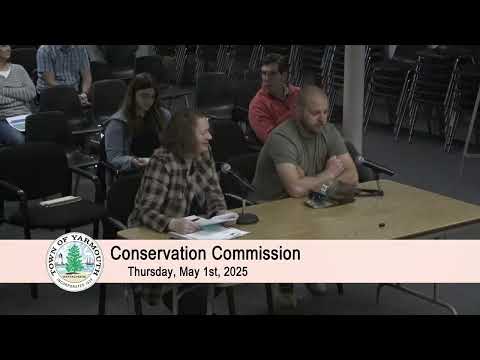
Leslie Fields of the Woods Hole Group, representing the Greater Island Road/Great Island Homeowners Association, presented both items to the commission, describing emergency repairs after storm damage in February 2023 and a proposed method to trigger future work when dunes erode to a critical threshold.
Nut graf: Commissioners approved a protocol for when geotextile bags should be replaced and voted to grant an order allowing installation and limited nourishment of fiber rolls across 3,400 linear feet of dune and beach with special conditions, including Natural Heritage time‑of‑year work restrictions and requirements for on‑site notification and post‑construction reporting.
Fields told commissioners the geotextile array installed after the 2023 storm covers two areas — a short southern section and a longer northern section — and the commission’s prior order required replacing the southern geotextiles with fiber rolls. For the northern geotextiles, the applicant proposed objective triggers to require replacement: either four consecutive bags showing tears of 24 inches or more, or four consecutive bags having lost half or more of their sand fill. If a trigger is met, the applicant would replace at least 50 feet or 50% of the array and meet with the commission on‑site before work.
Fields then described a separate, proactive notice of intent: an as‑needed permit for a four‑tier fiber‑roll array and limited beach nourishment across 3,400 linear feet in areas where dune width is 75 feet or less. The homeowners association requested a five‑year order with the ability to add up to 4,000 cubic yards of beach‑compatible material and to re‑nourish up to three times per year as needed, with no work allowed between April 1 and Aug. 31 to avoid impacts to nesting birds.
Commissioners asked several questions about the 5‑foot trigger distance from the road — Fields said that when the remaining dune width next to the road reaches roughly 5 feet, ‘‘there’s a high likelihood that that 5 feet of dune is gonna be gone and there’s a good chance that there’s gonna be damage to the road. So we’re trying to prevent that.’’ Commissioners also discussed minimum project lengths (Fields said installations would likely be at least 50 feet), staging areas, and the expected 3‑ to 5‑year time window for completing longer‑term alternatives identified in the feasibility study.
A motion to approve the geotextile replacement protocol carried unanimously. The board then voted to approve the larger notice of intent for the fiber‑roll array and nourishment with special conditions that incorporate Natural Heritage comments; the chairman registered a nay and the motion nevertheless carried.
Ending: The approvals include reporting requirements and on‑site notification to the commission before work. The homeowners association and consultants must follow the town’s special conditions and comply with any final Natural Heritage determinations before work begins.