Get Full Government Meeting Transcripts, Videos, & Alerts Forever!
Get email alerts on the Invasive Species Hydrilla topic
No spam. Unsubscribe anytime.
Yarmouth commission continues hearing on chemical treatment plan to control hydrilla in Elisha’s Pond
Summary
Crawford Land Management proposed treating invasive hydrilla in Elisha’s Pond with the herbicide fluridone; the Conservation Commission continued the hearing pending Natural Heritage review and additional monitoring details.
Crawford Land Management told the Yarmouth Conservation Commission on May 1 that it plans to chemically treat an infested portion of Elisha’s Pond with fluridone to reduce invasive hydrilla and protect recreation and wildlife.
The application, presented by Angela Tanner of Crawford Land Management, covers Elisha’s Pond, a 10.3-acre freshwater pond the company said is up to 20 feet deep at its deepest point and ‘‘currently has a population of hydrilla verticillata, an invasive species which has been increasing rapidly over the past few years,’’ posing safety concerns for swimmers and boaters and threatening native aquatic plants.
Tanner said the team consulted the Massachusetts Department of Conservation and Recreation rapid-response guidance and other Cape Cod ponds where fluridone products have been used. ‘‘Based on their recommendations, we are proposing to chemically treat Elisha’s Pond with fluridone,’’ she said, adding that the proposed product is Sonar 1, a slow‑release pellet form manufactured by SEPRO and applied three times over the summer.
Nut graf: The commission did not vote on the plan. Commissioners said they need Natural Heritage & Endangered Species Program (NHESP) review and additional monitoring details — including transect design, pre‑ and post‑treatment vegetation metrics, and a disposal plan for dead vegetation — before acting. The hearing was continued to May 15 so the applicant can submit the requested information.
Tanner described the proposed treatment and monitoring steps in detail. She said the first application would be around 20 parts per billion (ppb) of fluridone, with lower subsequent doses, and that water testing would occur two weeks after each treatment. She also said vegetation surveys would be performed before the initial treatment and after the final treatment each year to measure treatment success and adjust strategy if needed. "The application will be done from a lightweight john boat launched from the swimming area at Camp Wingate," Tanner said, and the boat would be cleaned before leaving the site.
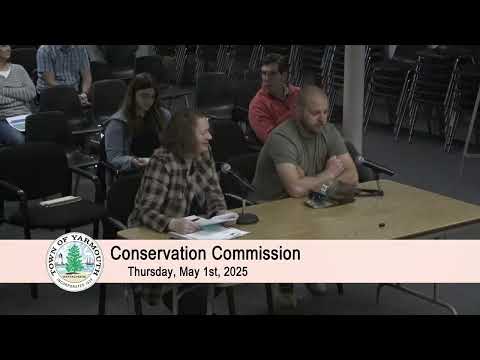
Camp Wingate Kirkland representative Will Rubinstein and consultant Nick Crawford joined Tanner at the meeting. The presenters told the commission the pond’s hydrilla is mostly in shallow areas used for swimming and boating and that mechanical removal alone is not recommended because tubers remain in the sediment and live fragmentation can increase spread.
Commissioners and staff raised multiple technical and ecological questions. A commissioner asked for numerical evidence from other Cape ponds where fluridone was used; Tanner said those treatments date to the early 2000s and ‘‘it is showing a reduction’’ but that exact figures were not on hand and that most of the other ponds are larger than Elisha’s Pond. The applicant said it would supply more detailed monitoring metrics before the next hearing.
Concerns also included potential impacts on non-target vegetation and any species protected by Natural Heritage mapping. A commissioner asked whether NHESP had identified listed species on site; the presenters said they had submitted the site to NHESP and were awaiting a determination and that once the agency’s findings were known, the project team would work to address any conflicts.
Public comment included a question about using grass carp; Tanner replied that grass carp are not allowed in Massachusetts at this time. Another resident asked whether the pond is publicly owned; the presenters confirmed Elisha’s Pond is a great pond and that Camp Wingate and neighboring residents are funding the proposed work.
The commission requested that the applicant provide additional written material within a week so commissioners would have time to review it before the continued hearing. The board then voted to continue the hearing to May 15; the motion passed by voice vote.
Ending: The commission will reconvene on May 15 to review the applicant’s additional monitoring details and the pending Natural Heritage response before considering any permit decision.