Get Full Government Meeting Transcripts, Videos, & Alerts Forever!
Get email alerts on the Town Meeting Procedures topic
No spam. Unsubscribe anytime.
Concord committee keeps one‑minute speaker suggestion in report after debate
Summary
The Town Meeting Study Committee voted to approve its Version 8 report, including a contested recommendation that would give moderators a one‑minute pro/con default as a deliberation tool; members stressed the suggestion should be discretionary and asked for clarifying language before publication.
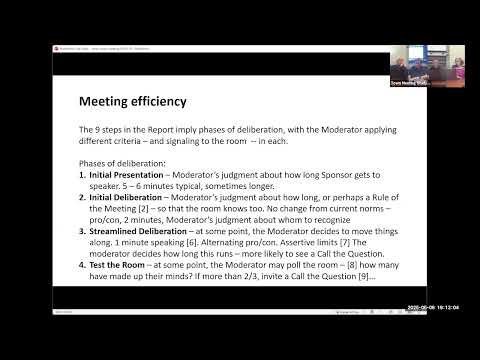
At its May 6, 2025 meeting, the Town Meeting Study Committee approved Version 8 of its final report, including a set of nine procedural recommendations that ask the Select Board to consider rules limiting time for initial discussion of warrant articles and—controversially—a suggested one‑minute default for pro/con remarks as a tool moderators might use.
The committee’s vote followed an extended discussion of Recommendation 6, which would make one minute the default speaking time for pro/con remarks during a streamlined phase of deliberation. Committee member Carmen said she had presented the idea to the Select Board and that the language in the report had been read there as a recommendation rather than a possibility, prompting the group to clarify intent. “I was surprised by Carmen’s speech. I thought, well, if she’s gonna take it as a recommendation, we should make sure that we’re all on board,” Eric Moore said.
Supporters said the proposed limit is a default tool moderators could use to shorten meeting length and encourage focused remarks. “This is the recommended for consideration default,” Eric Moore said, describing one minute as a default the moderator could expand when needed. Opponents warned a strict one‑minute cap could be unfair to speakers and reduce the quality of deliberation. “I feel that the one‑minute limitation has the effect of being unfair,” one committee member said, adding that it is difficult for many speakers to make a substantive point in 60 seconds.
Several members sought language changes that would make clear the measures are suggested tools rather than mandatory constraints. Phil Swain moved to approve the full set of nine recommendations as written; the motion was amended on the floor to adopt the entire nine‑item list. The motion passed. Committee members instructed the report author to add clarifying language ahead of publication to emphasize moderator discretion and the balance between “full and fair deliberation” and streamlining techniques.
The committee also agreed that the report should include explicit direction to consult the Select Board about a possible rule of the meeting that would set time expectations (for example, a 15‑ to 20‑minute presumptive limit for initial discussion of an article), while preserving the ability of the meeting itself or the moderator to extend deliberation when warranted. Eric Moore said he would prepare revised wording for the briefing book and suggested the paragraph introducing the nine suggested tools should more clearly say they are possibilities the moderator might consider, not mandatory rules.
What happens next: the committee will incorporate the requested wording changes and publish the report; the recommendation to consult the Select Board remains part of the adopted text and is intended to start that conversation, not to impose an immediate rule at Town Meeting.