Get Full Government Meeting Transcripts, Videos, & Alerts Forever!
Get email alerts on the Capital Facilities Impact Fees topic
No spam. Unsubscribe anytime.
District details 6-year capital facilities plan, warns impact fees won’t cover full school costs
Summary
Facilities staff presented the district’s six-year capital facilities plan May 8, describing prioritized rebuilds and expansions, impact-fee methodology and why higher construction costs and state policy limits mean impact fees cover only a fraction of project costs.
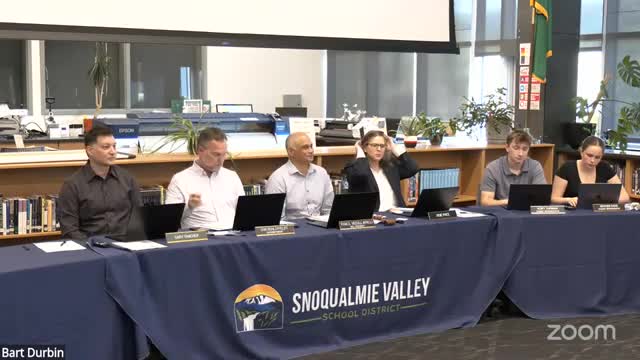
On May 8, 2025, the Snoqualmie Valley School District Board of Directors heard a presentation on the district’s six-year capital facilities plan from facilities staff (Ryan). The plan identifies priority projects, explains how impact fees are calculated and outlines next steps for local adoption.
Ryan said the plan’s near-term priorities include a rebuild and expansion of Fall City Elementary, a rebuild/expansion of North Bend Elementary and a proposed new Snoqualmie Ridge elementary school; only North Bend falls inside the six-year window used to calculate impact fees. "Impact fees again are a proportional share of those future costs. And so, impact fees will never fund a school," Ryan said.
The presentation laid out how impact fees are computed: the estimated construction cost divided by the building capacity produces a per-pupil facility cost; that cost is multiplied by a student generation rate for new dwellings; then statutory and local credits/discounts are applied (tax credits, local-share discounts). Ryan said the district’s single-family student generation rate is 0.281 for K–5—about 2.8 elementary students per 10 single-family homes—and noted that multifamily developments show very different student-generation patterns. Using a high multifamily rate would produce an $11,000-per-dwelling multifamily fee in draft calculations; staff said legal counsel is reviewing defensibility because a small number of atypical developments (for example an affordable complex) can distort multifamily averages.
Ryan told the board that the district has a substantial share of elementary capacity in portables and that the state formulas limit eligibility for state matching funds. He said about 36 percent of elementary capacity is currently in portables; the state matching formula, he said, produced roughly an 11 percent match on some prior projects but is insufficient to cover rising construction costs. "If we wait that long for a hundred million dollar building, the cost escalation, and inflation will far outpace the $6,000,000 that we might qualify for in state matching funds," Ryan said.
Staff described the process and timeline: staff will finalize draft impact fees, present the plan to King County’s technical review committee in June, provide the plan to local cities for their ordinances by Aug. 1, and the cities would adopt fees that could take effect Jan. 1, 2026. Ryan said the district will continue to refine single-family and multifamily rates and work with legal counsel to ensure the fee schedule is defensible and consistent with county and city rules.
Board members asked for notice of city presentations and cautioned that fluctuating assessed valuations and construction-cost estimates have caused year-to-year fee changes. No formal action was taken; the presentation was an information item and staff said they would return with final draft fees and adoption materials.