Lifetime Citizen Portal Access — AI Briefings, Alerts & Unlimited Follows
Snoqualmie Valley board hears Future Ready update: preschool expansion, construction surprises and literacy gains
Loading...
Summary
Board received an update on the district's Future Ready strategic plan, including an Early Learning Center construction report that has required change orders, a planned expansion that will add full-day preschool for rising 4-year-olds, rising enrollment figures, and reported gains in K-2 literacy.
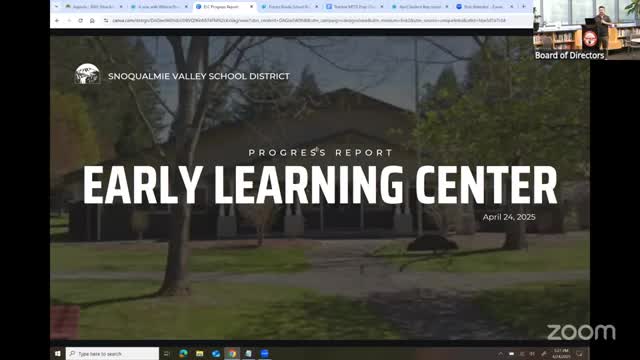
The Snoqualmie Valley School District board of directors on Thursday heard an update on the district's Future Ready strategic plan that combined a construction status report for the new Early Learning Center with program changes that the district said will expand full-day preschool, add classroom capacity and increase early literacy supports.
District facilities staff reported that unexpected site conditions discovered after work began required several change orders, including rerouting and upsizing sewer and storm lines and removing buried concrete, and said those items have been covered within contingency funds. Preschool leaders described program changes for next school year: five full-day, five-days-per-week classrooms for rising 4-year-olds, extended-care hours, a plan to shift student ratios toward more typically developing peers, and expanded staffing.
Why it matters: The physical modernization and program expansion are intended to increase access to preschool and align early-learning experiences with the district's K-2 literacy work. That includes a multi-year literacy initiative the district credits with rising screening scores and an enrollment surge that officials said triggered the staffing and space increases.
Facilities update and costs
District construction staff said the Early Learning Center project reuses the old Two Rivers building and adds six classrooms, shared restrooms, a nurse's office, a covered play area and a bus lane. Work uncovered several conditions not shown on drawings: a sewer line routed differently than expected that required upsizing and rerouting under planned classroom footings; a longer-than-anticipated stormwater connection to the city system that required an 8-inch pipe to be upsized to 12-inch; and buried concrete blocks found under the future bus lane.
"Once we get out of the ground, some of those surprises become less and less," a district construction presenter said, noting the stormwater reroute alone added roughly "$70,000 to $80,000" to change-order costs but that the items were within budget and contingency. Staff also said the city's as-built stormwater drawings proved inaccurate and that connecting to the city system required additional trenching and pipe work across adjacent property and under the street.
Staff said the bus lane subgrade had to be reworked after crews discovered buried concrete blocks and called that removal and additional fill another unexpected cost and schedule factor. The district told the board it expects the contractor's revised completion date to remain on track for substantial completion by July (enough time to occupy the building for the start of the next school year), with punch-list work extending into September or October.
Program changes and enrollment
District early-learning staff described programmatic changes tied to the new facility. For the first time, officials said, the district will recommend a full-day, five-day-per-week schedule for all 4-year-olds rising to kindergarten for the 2026-27 school year; historically the district ran half-day sessions Monday through Thursday. The district also plans four half-day sessions for younger three-year-olds and those not yet age-ready for kindergarten, and will offer extended care from 7:30 a.m. to 9:30 a.m. and 3:30 p.m. to 5:00 p.m.
Enrollment figures presented to the board showed a substantial demand rebound: developmental preschool enrollment rose from 50 students at the start of the year to 73 currently, and staff said they are scheduled right now to start next year with 42 confirmed developmental preschool students but with about 20 evaluations still pending and another outreach event planned; staff estimated they could start next fall closer to 60 developmental preschool students once pending evaluations are completed. For paid peer slots (typically developing peers who pay tuition), staff reported 34 current placements and 49 peers scheduled to start next year; they said all peer seats are filled with five scholarship slots still open and 15 children on a wait list.
Staffing changes include hiring two additional teachers and expanding paraeducators from 12 (with a 13th added midyear) to a plan to start next year with 16 paraeducators. Classroom maximums were described as 15 students per room with a target ratio over time of about nine typically developing peers to six students with IEPs in full-day classrooms, a gradual shift from the district's current mix.
Program funding and dependencies
The board heard that a separate Transition-to-Kindergarten (T2K) funding stream is uncertain; staff said existing T2K students will progress to kindergarten under current funding but that the district has not committed a new T2K cohort because the state funding picture is unsettled. Staff described the Early Learning Center expansion as a mix of district budgeting and programmatic adjustments rather than a reliant single external grant, and said continued occupancy depends on finishing site work and final permits.
Early literacy and readiness progress
District literacy leaders told the board they are seeing measurable gains in early-reading screeners since creating a coordinated K-2 literacy program: the presenter reported kindergarten students meeting the district's screening benchmark rose from 66% to 74.9%, first grade from about 67% to nearly 80%, and second grade from about 75% to roughly 82% since the program's start. Staff said about 20% of the district's Win-reading intervention population has exited intervention this year and that about 75% of students receiving Win supports are in kindergarten through third grade.
Career and postsecondary planning, technology and UDL
The Future Ready presentation also covered the district's secondary work: the college-and-career team described moving from a locally hosted tool to the state's School Links platform so student High School and Beyond Plan activities are preserved in a state-supported system and can be accessed post-graduation. Staff described new classroom-based lessons for seventh and eighth graders, a switch to more in-class delivery for certain high school lessons, and a phased rollout to fully adopt School Links next school year.
District digital-learning staff outlined professional development and building-level supports for integrating technology and artificial intelligence. The district reported using vetted platforms (examples given: Brisk for feedback, Canva for image generation, Copilot and district-oriented education tools where age-limits and privacy controls allow) and said it is evaluating school-focused AI platforms under district procurement and approved-data-protection review. Staff described layered professional learning: a district summer workshop (BLAST), follow-up cohorts (AI Explorers and AI Adventurers), and a network of building Digital Learning Leaders that provide localized support.
Universal Design for Learning (UDL) and algebra readiness
Board members were shown an implementation plan that asks teachers to select two evidence-based UDL (Universal Design for Learning) practices to refine collaboratively next year, with the district providing one-page guides that include student-facing questions for classroom walkthroughs and examples of evidence-based practices. Work on algebra readiness was described as ongoing K-12, with classroom strategies including whiteboard formative checks and targeted small-group interventions. Staff said they are planning MTSS (multi-tiered systems of support) work to develop secondary-tier interventions.
What the board decided
The board did not adopt new policy or award contracts at the presentation; staff asked for the board's continued support to complete construction and to approve previously proposed change orders, which staff said are within budget contingencies.
Ending note
District leaders told the board the Early Learning Center is still projected to reach substantial completion in time to occupy classrooms for the fall start of school, and that program and staffing decisions are proceeding to meet the higher-than-expected enrollment demand. Officials asked the board to expect additional operational details and final permit updates in coming weeks.