Get Full Government Meeting Transcripts, Videos, & Alerts Forever!
Get email alerts on the Zoning Enforcement topic
No spam. Unsubscribe anytime.
Walworth County corporation counsel outlines complaint‑driven zoning enforcement, cites lengthy court timelines
Summary
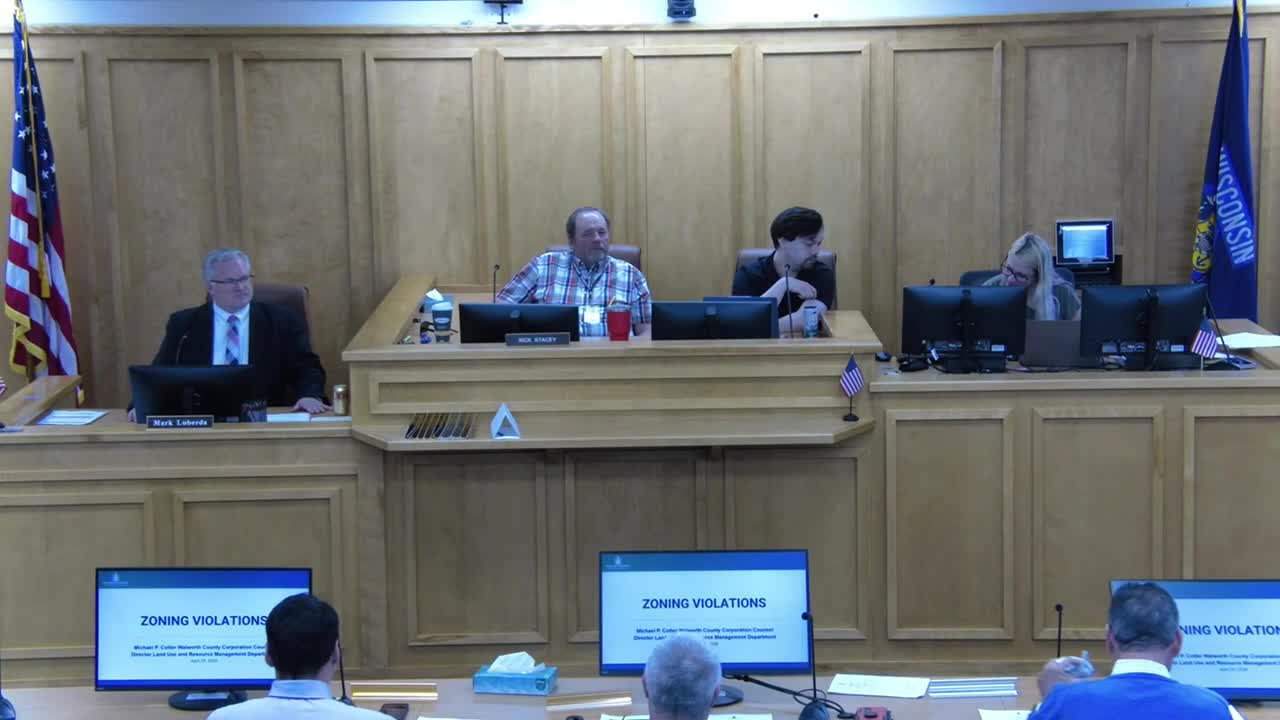
Michael Cotter, Walworth County corporation counsel, told the intergovernmental group the county’s zoning enforcement is complaint‑driven, often resolved informally, but can take years in court; he gave examples including a 40‑year junkyard cleanup and a recent fence citation set for trial.
Michael Cotter, Walworth County corporation counsel, told an intergovernmental meeting that zoning enforcement in unincorporated areas is largely complaint‑driven and that the office’s principal objective is compliance with the Walworth County Zoning Ordinance.
Cotter described a stepped enforcement process: informal contact, a written notice, a formal violation letter (typically allowing 30 days to comply), a citation or stop‑work order, and, if necessary, court action. He said the majority of cases resolve after simple outreach, but some disputes progress to long court proceedings.
Why it matters: zoning enforcement affects neighbors, public health and safety, property values and municipal code compliance, and the process can place significant burdens on staff and local court dockets.
Cotter told the group, “Our biggest departmental goal is to achieve compliance with the Walworth County Zoning Ordinance. That's it.” He explained anonymous complaints are accepted by county staff because many disputes involve immediate neighbors and can become volatile; however, if a case goes to trial a witness who wants enforcement must be willing to testify.
Cotter described an ongoing fence case where county staff measured a fence at “7 feet, 7 inches” in an area where the ordinance allows 6 feet; after initial letters and a citation the matter was set for trial. He used the case to illustrate how straightforward violations can nevertheless require court time when property owners refuse voluntary compliance.
He also presented a decades‑long junkyard cleanup in the Town of Walworth. Cotter said county contractors removed roughly one million pounds of scrap during a cleanup operation conducted from April 26, 2021, to Sept. 20, 2022; after expenses were paid, the property owner received a county check for $49,000 as surplus from the sale of scrap. Cotter described the timeline for that property beginning with zoning designations in the 1960s, multiple notices and citations dating from the 1980s through the 2010s, a 2019 complaint filing, and summary judgment in 2020 before final cleanup work was completed.
Cotter urged townships and municipalities to call the county zoning office to report potential violations and to work through jurisdiction questions. He said zoning officers are assigned by geographic areas and that staffing shortages have caused a backlog—he estimated permit review at about four weeks behind schedule at the time of the meeting.
Cotter also promoted the Clean Boats, Clean Waters outreach and training event scheduled for May 16 in Room 214 and invited attendees to contact county staff for involvement.
He closed by reminding attendees that while staff will follow up on anonymous complaints, witnesses who wish to see enforcement through trial must be prepared to testify in court.