Get Full Government Meeting Transcripts, Videos, & Alerts Forever!
Get email alerts on the Ordinance Amendments Agritainment Meatpacking topic
No spam. Unsubscribe anytime.
County holds public hearings on meat-packing definition and new agritainment rules; decisions deferred
Summary
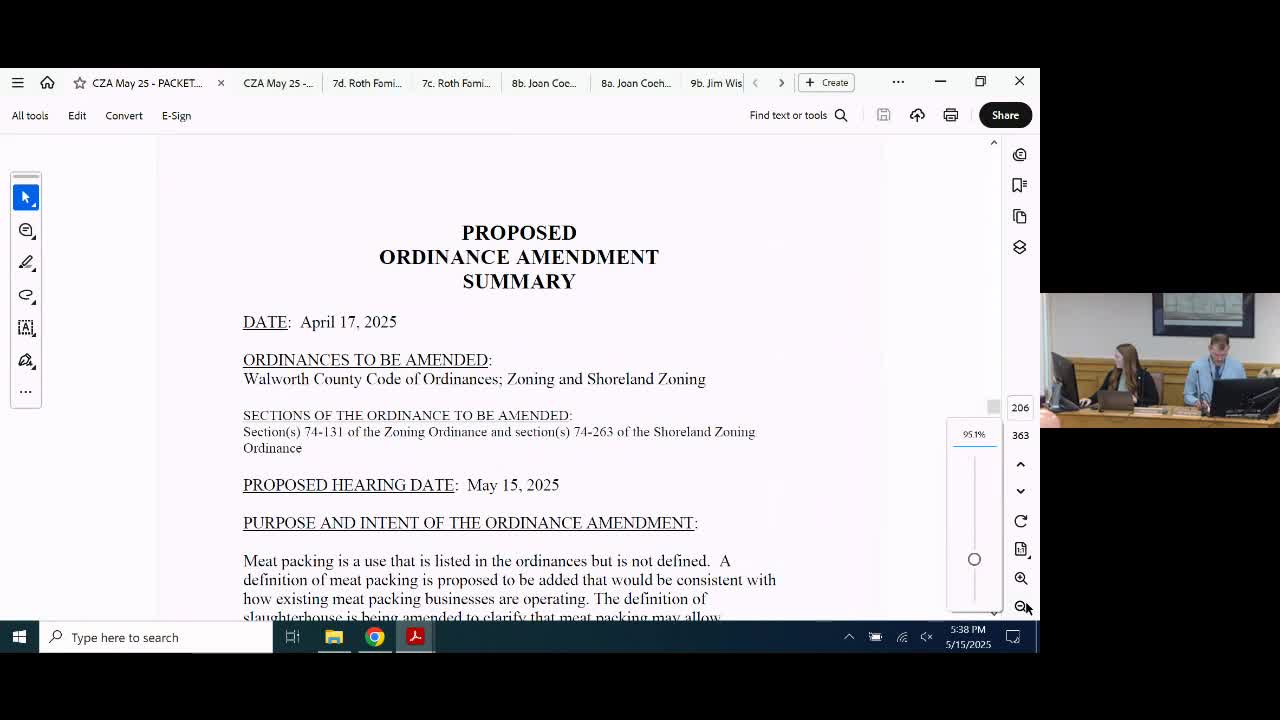
Walworth County planners presented proposed ordinance amendments to define "meat packing" for A-4 zoning and to add agritainment and commercial stables language for A-1 zones. The committee took public input and asked staff to gather additional operational data before making decisions next month.
Walworth County staff presented two linked ordinance amendments at the May 15 meeting: (1) a definition for "meat packing" to clarify conditional uses allowed in the A-4 agricultural-related district, and (2) a broader set of proposed uses including "ag retainment"/agrutainment (corn mazes, pick-your-own, petting zoos) and commercial stables in A-1 prime agricultural districts.
Staff said the meat-packing definition codifies how the county has historically treated small-scale processing and custom slaughter operations; several committee members said they supported a definition but asked staff to collect data on operational scale — for example typical daily slaughter volumes at local processors (Sorg’s, Wilson’s Meat Market, Lake Geneva Country Meats) — so the committee could distinguish small custom processors from larger slaughterhouses that have different neighborhood impacts.
On agritainment, staff explained the goal is to allow seasonal agricultural tourism activities as conditional uses in A-1 and A-1NC without forcing frequent rezonings to A-4. DATCP (Department of Agriculture, Trade and Consumer Protection) had required language limiting permanent new buildings for A-1/A-1NC agritainment uses; staff incorporated that language for A-1 districts.
The ordinance draft also carried existing thresholds for food trucks tied to parcel size: 1 truck for parcels smaller than 0.5 acre, 2 trucks for 0.5–1.0 acre, and 3 trucks for parcels larger than 1.0 acre. Several committee members asked staff to recheck those caps and gather examples from local agritainment venues where more trucks have been permitted.
Committee members asked staff to reach out to local meat processors to provide numbers on typical daily throughput, and to bring back additional framing language on the distinction between a "slaughterhouse" (industrial-scale) and small meat-packing or custom-processing that serves local customers. No votes were taken; the committee closed the public hearing and will decide on the ordinance amendments at its June meeting.