Get Full Government Meeting Transcripts, Videos, & Alerts Forever!
Get email alerts on the Tijuana River Pollution topic
No spam. Unsubscribe anytime.
Imperial Beach council adopts resolution pressing federal, state action on Tijuana River pollution
Summary
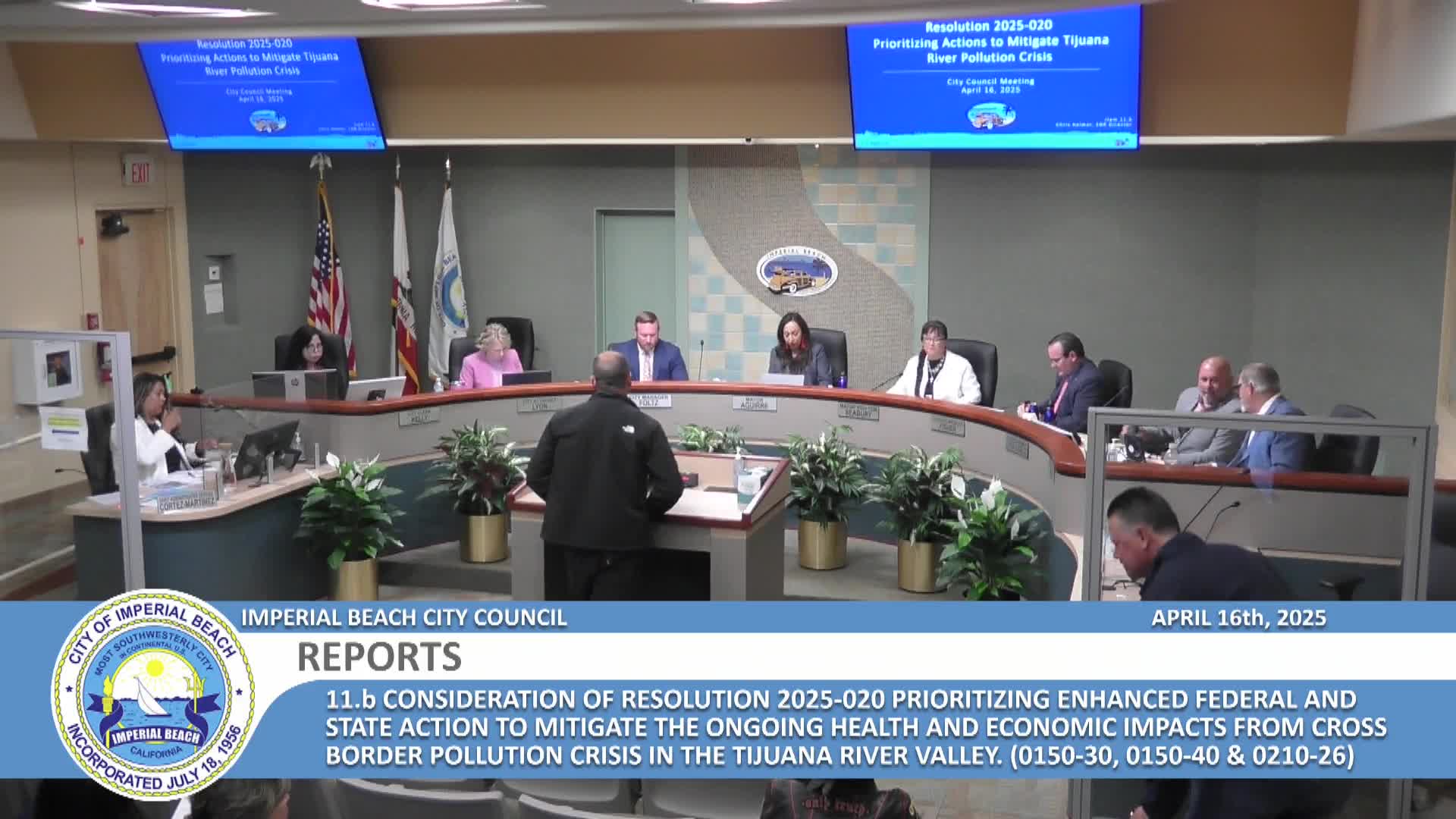
On April 16, 2025 the Imperial Beach City Council unanimously approved Resolution 2025‑20 urging accelerated federal and state action — and added language to allow targeted commercial crossing measures — to address ongoing cross‑border sewage and pollution from the Tijuana River Valley.
The Imperial Beach City Council on April 16 unanimously adopted Resolution 2025‑20 calling on federal and state officials to accelerate projects and funding to address the ongoing cross‑border sewage and pollution crisis in the Tijuana River Valley.
The resolution asks federal and state agencies to speed implementation of projects by the International Boundary and Water Commission (IBWC) and other partners, urges Congress to fully fund construction and ongoing operation and maintenance, opposes construction of a desalination plant in Rosarito absent conditions, and expresses support for Senate Bill 10 (SB 10). Council members amended the draft to add language authorizing the city to advocate for limited, targeted measures affecting commercial crossing activity, and to explicitly request state and federal emergency declarations and funding to accelerate work and ensure operation of Mexican wastewater infrastructure referenced in the resolution. Council Member McKay moved the item; the council voted to approve the substitute motion and final resolution.
Why it matters: Officials and residents said the pollution has health, economic and environmental impacts across the South Bay, affecting beach access, tourism and outdoor recreation. Public commenters and regional business organizations urged the council to balance environmental remedies with the region’s binational economy.
What the resolution says and what changed The proposed resolution lists steps the city wants prioritized, including faster design and construction by the IBWC for diversion and trash‑capture infrastructure, and direction to pursue federal and state funding streams (including references to EPA and California bond funding). In debate, Council Member McKay and other supporters described the measure as a stronger, more urgent push intended to spur federal leverage and accountability from the Mexican government and regional partners.
Several public commenters and business groups raised concerns about one line in the draft that said restrictions might include limiting crossing activity at U.S. ports of entry during declared health threats. Marcy Weaver, CEO of the Chula Vista Chamber of Commerce, told the council, “Limiting cross border activity even temporarily would have serious impact repercussions for our region,” citing workforce and commerce ties across the border. Lauren Casares of the San Diego Regional Chamber provided numbers in the record, saying the region handles substantial daily crossings and trade volumes.
Council members negotiated changes before the final vote. The council adopted a substitute amendment that (1) narrowed the possible restriction language to reference commercial crossing activity rather than all pedestrian or personal crossings, (2) added explicit requests that the governor and the president declare state and federal emergencies as appropriate, (3) urged Congress to reallocate and fully fund construction and ongoing operation and maintenance of transboundary wastewater projects, and (4) asked that any existing Mexican infrastructure referenced in the resolution (for example, pump stations tied to the San Antonio de los Buenos facilities) be operated consistently and that accountability measures be pursued.
Public comment and regional actors Public comment included a range of voices. Resident Carl Bradley said he supports urgent action but asked that the city avoid substituting specific design choices for the EPA and IBWC engineers. Marcy Weaver and Lauren Casares urged removal of the sentence about limiting crossings, citing economic impacts. Other speakers — including community advocates and environmental groups who have campaigned for years on the issue — told the council the crisis poses ongoing public‑health risks and urged the city to press for immediate enforcement and funding.
Votes at a glance - Resolution 2025‑20 (Tijuana River): Adopted (motion moved by Council Member McKay; second not specified in the record). Vote: Aye — Mayor Paloma Aguirre; Mayor Pro Tem Seaberry; Council Member Fisher; Council Member Leiba Gonzalez; Council Member McKay. Outcome: approved. Notes: substitute motion adopted to add commercial‑crossing language, emergency‑declaration requests, funding language for operations and maintenance, and language seeking consistent operation of Mexican pump/diversion infrastructure. - Proclamation recognizing Municipal Clerks Week (May 4–10, 2025): Adopted unanimously (motion moved by Council Member Fisher). Outcome: approved. - Special event application, Old Plank Inn Changing of the Guard Summer Kickoff (street closure, 5/31/2025): Approved unanimously (motion moved; seconded by Council Member Fisher). Outcome: approved. - Resolution 2025‑19 (1300 Block Elm Avenue utility undergrounding — SDG&E Rule 20A credits): Adopted unanimously. Outcome: approved; $2,197,966 in SDG&E Rule 20A credits allocated to the Elm Avenue project. - Consent calendar items (8A–8E, with 8D pulled for later consideration): Items 8A, 8B, 8C and 8E approved unanimously. Outcome: approved.
Council comments and next steps Several council members emphasized the nonpartisan, public‑health focus of the motion and said the city is trying to use messaging tools to spur federal action and accountability. Supporters pointed to recently renewed federal attention and funding discussions as reasons to press for accelerated implementation. Opponents or cautioning voices — including business representatives — urged the council to avoid language that could harm cross‑border commerce or essential workers.
The record shows a range of requests to regional and federal partners (IBWC, EPA, SANDAG, Congress, and California officials). The council passed the resolution as amended; the motion and final text will be part of the official minutes and the city record. The resolution is messaging to state and federal agencies and regional partners rather than an exercise of local jurisdiction to compel foreign infrastructure changes.
Ending Council members said the vote is intended to increase urgency and press for accountability at higher levels of government. Supporters said the amended resolution keeps multiple tools available to pressure governments to act while clarifying that any restriction language is targeted at commercial crossing activity, not routine pedestrian crossings.