Get Full Government Meeting Transcripts, Videos, & Alerts Forever!
Get email alerts on the Marijuana Regulation topic
No spam. Unsubscribe anytime.
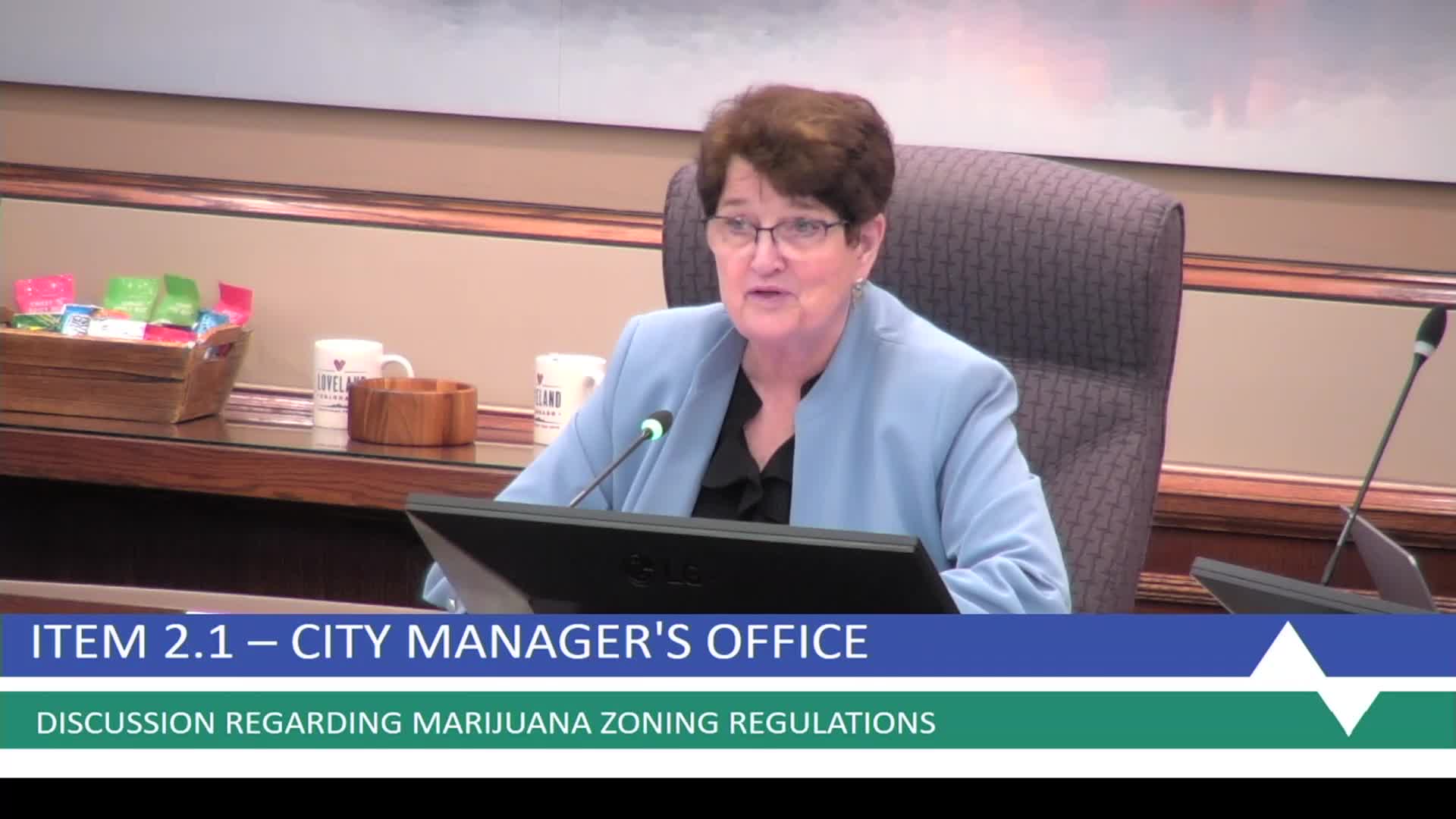
Loveland council and staff lay out options for marijuana dispensary rules, timeline and caps
Summary
City staff presented draft regulatory choices for retail marijuana after the November 2024 ballot measures; council members favored public outreach, 8 a.m.–10 p.m. hours and limits on locations and license counts while asking staff to return with draft ordinance language and fee analysis.
Loveland — City staff briefed the Loveland City Council at a study session April 22 on draft zoning and operational rules for retail marijuana dispensaries, seeking direction on five policy choices including public engagement, hours of operation, allowed locations, license caps and the selection process for limited licenses.
The presentation was an information-only item; staff said they will return with ordinance language for council review. “Tonight is our first touch point discussion on possible rules and regulations for the city of Loveland on marijuana dispensaries,” Brett Stewart, assistant to the city manager, told the council.
Why it matters: Voters approved local retail marijuana measures in November 2024 that require the city to adopt local rules. The council’s decisions will shape when stores can open, how many may operate, where they may locate, and how the city enforces state and local licensing standards.
Staff overview and timeline Staff said they assembled an interdepartmental team after the election and have consulted neighboring jurisdictions and the Colorado Marijuana Enforcement Division (MED). Zachary Taylor, senior budget and policy analyst, said staff declined to put specific revenue numbers in the packet because several variables remain unknown, including the number of stores, but staff “expect to collect enough tax revenue to cover the cost of implementation in 2026.”
Staff proposed a timeline that would bring ordinance language to the planning commission and then to council for two readings over the summer; staff suggested a tentative first application date in January 2026, with at least 90 days between second reading and accepting applications.
State rules and local options City Attorney Michael Bailey summarized state licensing law under Title 44, Article 10 and related MED rules, including statutory authority for local distance setbacks from schools and treatment facilities and requirements for security, video surveillance, limited‑access areas and background checks. “Title 44, article 10 is where the state has housed its marijuana licensing codes,” Bailey said.
Loveland staff asked five specific questions to guide drafting: (1) the degree of public and community outreach; (2) hours of operation for retail stores; (3) where stores should be allowed (zoning/location); (4) whether to set a license cap and how to calculate it; and (5) which application-selection method to use if demand exceeds available licenses.
Key staff recommendations and data points - Public outreach: staff offered two options — proceed primarily via the ordinances/public hearings (faster) or add one or more community informational sessions (slower). - Hours: staff recommended 8 a.m. to 10 p.m. as a compromise; the MED allows 8 a.m. to midnight. Brett Stewart said the “state average for hours of operation range from 9 a.m. to 9 p.m.” - Zoning: staff proposed limiting locations to nonresidential zones and suggested industrial zones as a starting point; planners noted industrial areas are more separated from residences but less visible from major corridors. - License cap: staff described several approaches — zoning-driven limits, fixed caps (example: Longmont’s four licenses), population ratios (e.g., 1 license per 10,000 residents) or geographic distribution (per ward). Staff reported about 16 parties had expressed interest in applying: eight “old applicants” (the ballot’s first‑120‑day group) and eight potential new applicants. - Application selection: staff presented two options — first‑completed‑application/first‑issued (fast, similar to liquor/tobacco) or a qualified lottery/selection committee (slower, committee-based review used by some cities).
Enforcement and local capacity Officer Emily De Lima, Loveland Police Department alcohol, tobacco and marijuana compliance officer, described inspections, annual renewals and compliance checks including underage sting operations. “I will be doing inspections of the premises,” De Lima said, adding that enforcement also emphasizes education and warnings prior to formal penalties.
Ashley McDonald, city clerk, said the city clerk’s office could absorb about four to six licenses with current staffing and that more licensing requirements increase review time; she also said licensing fees should be set to recover administrative costs and noted the clerk is time-tracking to support a cost‑benefit fee analysis.
Council discussion and informal directions Councilors and public commenters offered mixed preferences: several councilors supported more public outreach and the staff-recommended 8 a.m.–10 p.m. hours; many rejected industrial‑only zoning and favored allowing commercial locations (including major corridors) as well as industrial in some cases. Suggested license caps ranged from four to eight, with multiple councilors favoring a limit in the 4–6 range or one license per 10,000 residents.
On selection, some councilors preferred a qualified lottery/committee review to limit concentration and weigh neighborhood fit, while others preferred first‑completed application for speed, so long as the city preserves the ballot measure’s provision giving the prior‑applicant (the “2010 group”) the first 120 days to apply. Brett Stewart told council the ballot measure’s timeline allows the “2010 group” a first application period and staff recommended honoring that provision.
Public comment Members of the public questioned industrial‑only siting, urged robust security and training, and asked how prior local business owners would be handled. Tom Walzinski, a former dispensary owner, told council “I would agree with keeping the stores limited to four to six facilities here” and urged commercial siting and preference for experienced operators. Trudy Bauer urged continued law enforcement coordination: “Training for owners and staff, including background checks, training to identify counterfeit IDs… is an essential part.”
Next steps Staff said they will compile council feedback and return with draft ordinance and code language, a fee recommendation (cost‑benefit analysis or market comparison), and language for zoning and selection procedures. The item was an information item only; no formal votes were taken.
Ending note Council members emphasized balancing public safety, administrative capacity and voters’ intent. Several asked staff to return with draft code language, fee estimates and a public outreach plan before final readings this summer.