Get Full Government Meeting Transcripts, Videos, & Alerts Forever!
Get email alerts on the Livestock Traceability topic
No spam. Unsubscribe anytime.
Bennett County commission adopts resolution opposing federal mandatory electronic livestock ID
Summary
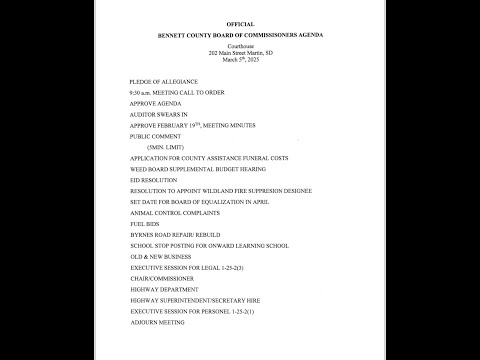
On March 5, 2025, the Bennett County Board of Commissioners adopted Resolution 2025-02 formally opposing a USDA-APHIS rule requiring mandatory electronic identification (EID) tags for certain cattle and bison, citing cost and privacy concerns for independent producers.
The Bennett County Board of Commissioners voted March 5, 2025, to adopt Resolution 2025-02 opposing a federal rule that requires electronic and visual EID (electronic identification) tags for certain cattle and bison.
The resolution cites the United States Department of Agriculture Animal and Plant Health Inspection Service (USDA-APHIS) rule published Nov. 5, 2024, and expresses concern that the cost and implementation burden could disproportionately affect small and independent producers. The text in the meeting packet said the rule requires intact cattle and bison over 18 months of age, dairy cattle, and animals used in certain events to be tagged with visual and electronic EID tags when moved across state lines.
The resolution notes local stakeholders’ concerns that the federal mandate could impose costs on small- and medium-sized independent producers, and it cites elected opposition from South Dakota’s U.S. Sen. Mike Rounds as part of its justification. A commissioner moved to accept the resolution; a second followed and the motion carried.
Commissioners and staff did not record a roll-call vote in the public minutes excerpt available; the clerk announced the motion carried after the voice vote. The resolution language in the packet states that Bennett County “formally opposes the mandatory EID requirement implemented by USDA APHIS” and is dated March 2025.
The resolution is advisory (a county expression of opposition) and does not alter federal requirements. The packet and discussion noted concerns about implementation costs for small producers and the availability of voluntary options and funding; no specific funding or legal challenge was authorized by the commission during the meeting.
The county clerk recorded the adoption in the minutes.