Get Full Government Meeting Transcripts, Videos, & Alerts Forever!
Get email alerts on the Urban Transportation topic
No spam. Unsubscribe anytime.
Council directs staff to implement modified Phase 2 of Fourth and Fifth Street pilot, seeks short public engagement
Summary
Grand Junction councilmembers on Monday signaled general support for a near‑term, temporary Phase 2 modification to the Fourth and Fifth Street pilot that staff said could be implemented within weeks for roughly $40,000, and asked for a focused public engagement to weigh longer‑term options.
Grand Junction councilmembers on Monday signaled general support for a near‑term, temporary Phase 2 modification to the city’s Fourth and Fifth Street pilot project — a striping and parking reconfiguration staff said can be implemented within weeks for roughly $40,000 — while directing a short period of additional community engagement to weigh longer‑term alternatives.
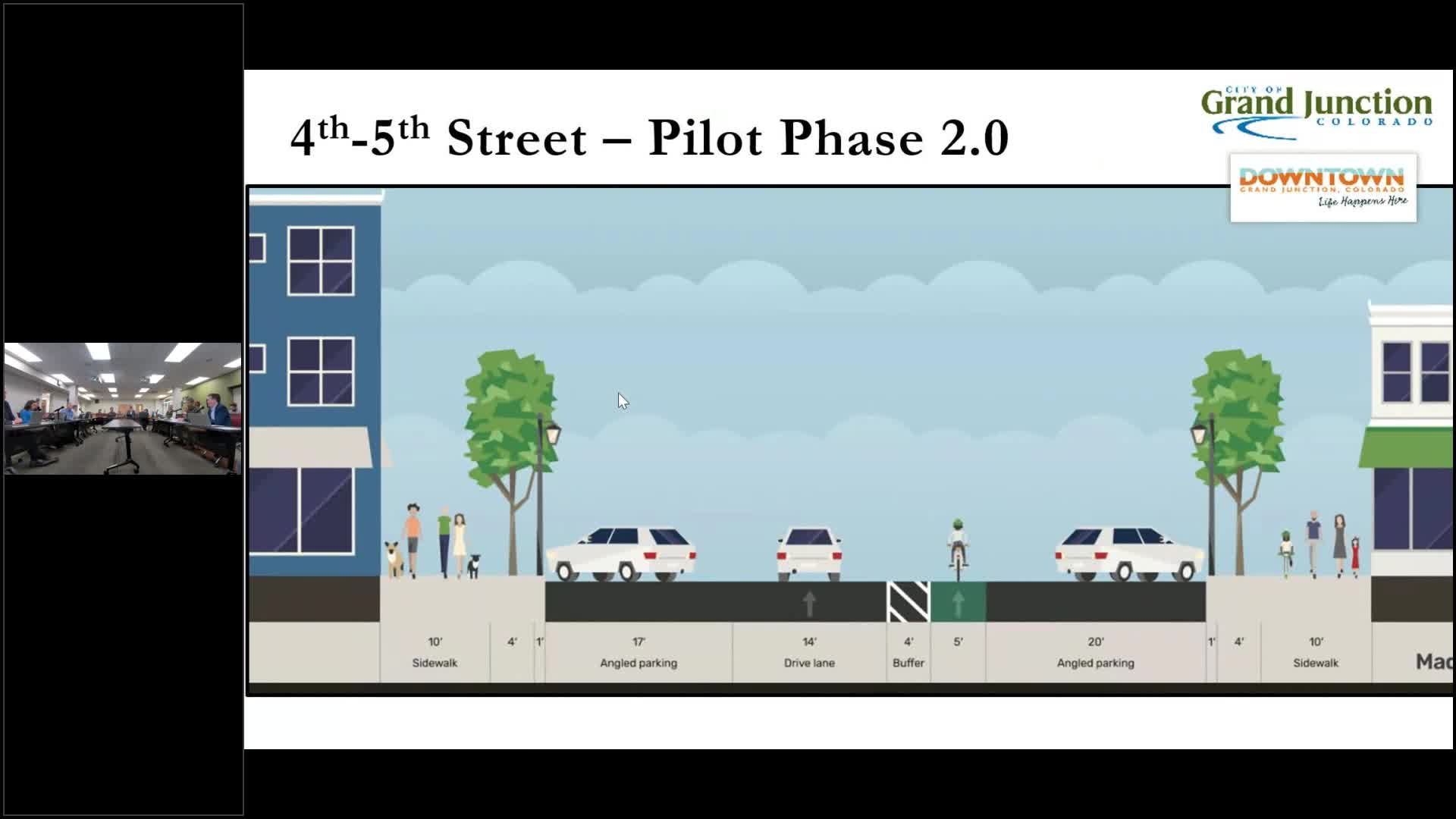
Trent Kral, the city’s engineering and transportation director, outlined Phase 2 changes that would restore some parking, move the bike lane adjacent to traffic with a painted buffer, and narrow driving lanes to slow vehicle speeds. Kral said the striping work for the Phase 2 modifications could be installed within about two weeks once materials arrive and that the configuration is reversible as staff develops longer‑term designs.
The workshop featured more than two hours of public safety, engineering and council discussion. Councilmember Robert, citing feedback gathered downtown, said, “the public wants Fourth And Fifth Street to be back to the way they were before the pilot project.” Other councilmembers — including Ben and Jason — and staff described a range of views from downtown merchants, multimodal advocates and residents. Public safety staff, including Interim Chief Hendrix and other emergency services representatives, said they remain concerned about clearance for ladder trucks and outriggers and want any lane geometry to accommodate emergency apparatus.
Kral said current traffic volumes are relatively low compared with lane capacity — about 2,000 vehicles per day on Fourth Street and about 5,000 per day on Fifth — and that narrow lanes, parallel parking and a painted buffer can create the “friction” that reduces travel speeds. Police data presented in the meeting showed selective enforcement has been complaint‑driven; staff reported limited speeding ticket history on the corridors and higher speeds in some phases of the pilot when lane widths were expanded.
Multiple councilmembers urged robust outreach before permanent changes. Several suggested alternatives to test or study: reverting entirely to the pre‑pilot configuration, converting corridors to two‑lane two‑way sections, or implementing targeted traffic calming measures such as raised crosswalks, signal timing changes and limited enforcement. Staff recommended a two‑track approach: (1) implement the Phase 2 striping to address immediate concerns and relieve downtown merchant pressure; and (2) conduct a community engagement and design exercise over roughly two months to develop and vet longer‑term options.
Councilmembers expressed differing priorities. Some said the short‑term striping would help businesses and provide immediate safety improvements; others worried about ongoing pilot costs and urged returning to the original design. City staff and the Downtown Development Authority’s director, Brady Stan, suggested the Phase 2 changes would also improve eligibility for grant matches if council chooses to pursue larger capital projects.
By the end of the workshop the group indicated enough agreement to have staff place the Phase 2 modification on the council’s regular agenda for formal direction and to schedule a focused public engagement process; staff said they would bring detailed design alternatives, estimated costs and a proposed engagement plan back to council for a vote.
Why it matters: Fourth and Fifth Streets are a key downtown circulation and commercial corridor. Street configuration decisions affect business access, parking, pedestrian crossings, multimodal connections and emergency response operations.
What’s next: Staff will prepare designs and a public engagement plan and bring a resolution to a regular council meeting (staff indicated the item can be scheduled quickly). The Phase 2 striping can be implemented within weeks after materials arrive and will be used while the city tests longer‑term alternatives.