Get Full Government Meeting Transcripts, Videos, & Alerts Forever!
Get email alerts on the Public Transit topic
No spam. Unsubscribe anytime.
Fort Collins transit team outlines three constrained scenarios to address $13 million funding gap
Summary
City transit staff presented findings from a transport optimization study, saying ridership remains below pre‑pandemic levels and describing three scenario approaches — travel‑pattern, rider‑demand and condensed fixed‑route with microtransit — to shape a fiscally constrained system within current budgets.
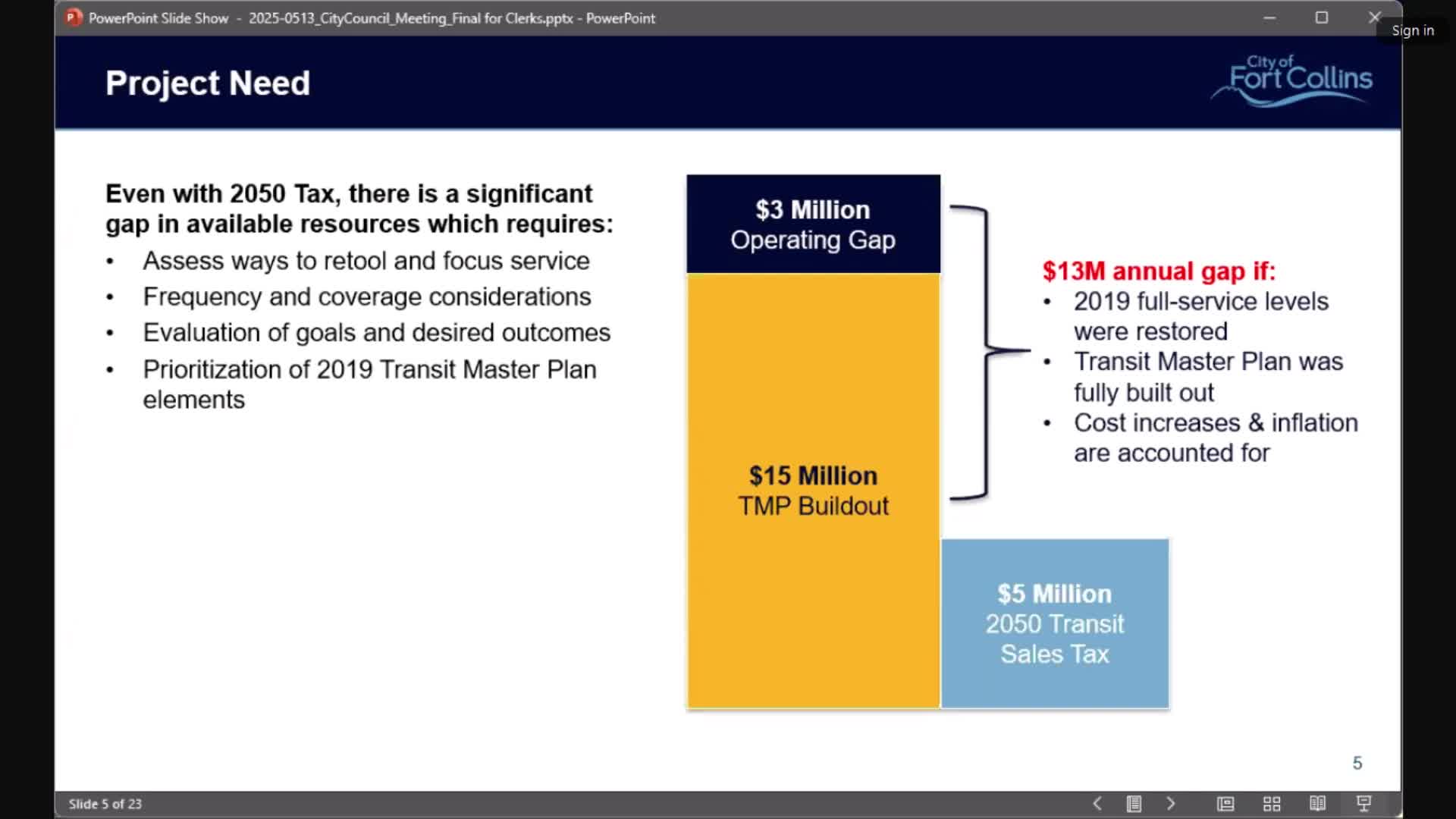
City transportation staff and consultants told the City Council that Fort Collins faces an annual transit funding gap of about $13 million after passage of a dedicated transit sales tax, and presented three high‑level service concepts to shape future, fiscally constrained transit scenarios.
Kaylee Bridal, transport director, and Karen Champine (PDT) presented the report and Jason Miller, the consultant, summarized peer agency lessons. The 2019 Transit Master Plan’s full build‑out target was described as a long‑term vision; staff said achieving that vision would have required roughly $15 million per year in additional funding above 2019 needs and that restoring 2019 service levels today would add roughly $3 million more, producing an $18 million gap that the 2023 dedicated transit sales tax reduced by about $5 million to a remaining $13 million shortfall.
Staff said ridership hit a pandemic low in 2021 (about 33% of pre‑pandemic levels), climbed to about 59% in 2024 as service was reinstated and reached nearly 70% year to date in 2025, while service levels have returned to about 86% of pre‑pandemic service. A travel‑demand analysis showed trip‑origin concentrations around Colorado State University, Harmony Road, College Avenue and southeast Fort Collins and found that median trip lengths have shortened (from about 15 minutes in 2019 to about 8 minutes in 2024) and that fewer trips are commuting to work.
The team described three concepts that will be developed into full, mappable scenarios for summer public engagement: (1) Travel Patterns — prioritize direct, high‑frequency corridor service where overall travel is greatest; (2) Rider Demand — prioritize equity and access to serve populations most likely to use transit, with an emphasis on frequent fixed routes; and (3) Condensed Fixed‑Route with Microtransit — concentrate fixed routes on high‑demand corridors and use microtransit (small‑vehicle, zonal on‑demand service that connects riders to the fixed network) to serve lower‑density areas.
Staff emphasized microtransit tradeoffs: zone size and reliability drive rider satisfaction, and microtransit is more expensive on a per‑ride basis (staff cited about $20 per microtransit ride compared with about $7 per fixed‑route ride). The typical microtransit zone size discussed was about three to five square miles served by one to three vehicles; target wait times cited were typically 15–20 minutes.
Council members asked whether scenarios would allow flexible responses to special events, how high‑frequency corridors compare to peer agencies that recovered ridership more quickly, whether microtransit would be fare‑free, and when a final recommendation will return to council. Staff said the scenarios will be refined into full service maps and brought to the public for engagement in June–July, with a final recommendation planned in the fall. Staff also said an advertising contract negotiation is near completion and that revenue from that contract has been included in current planning figures.
No formal policy decision was requested at the work session; staff sought council feedback and guidance on scenario evaluation criteria.