Get Full Government Meeting Transcripts, Videos, & Alerts Forever!
Get email alerts on the Poudre Fire Authority Annual Report topic
No spam. Unsubscribe anytime.
Poudre Fire Authority reports growth in EMS calls, capital planning and outreach; chief highlights training and new station
Summary
Fire Chief Derek Bergson presented Poudre Fire Authority's 2024 annual report, noting 248 full‑time positions, an emphasis on training, capital investments including apparatus and stations, EMS prevention work with UCHealth, and volunteer stations; councilors praised regional deployments and community programs
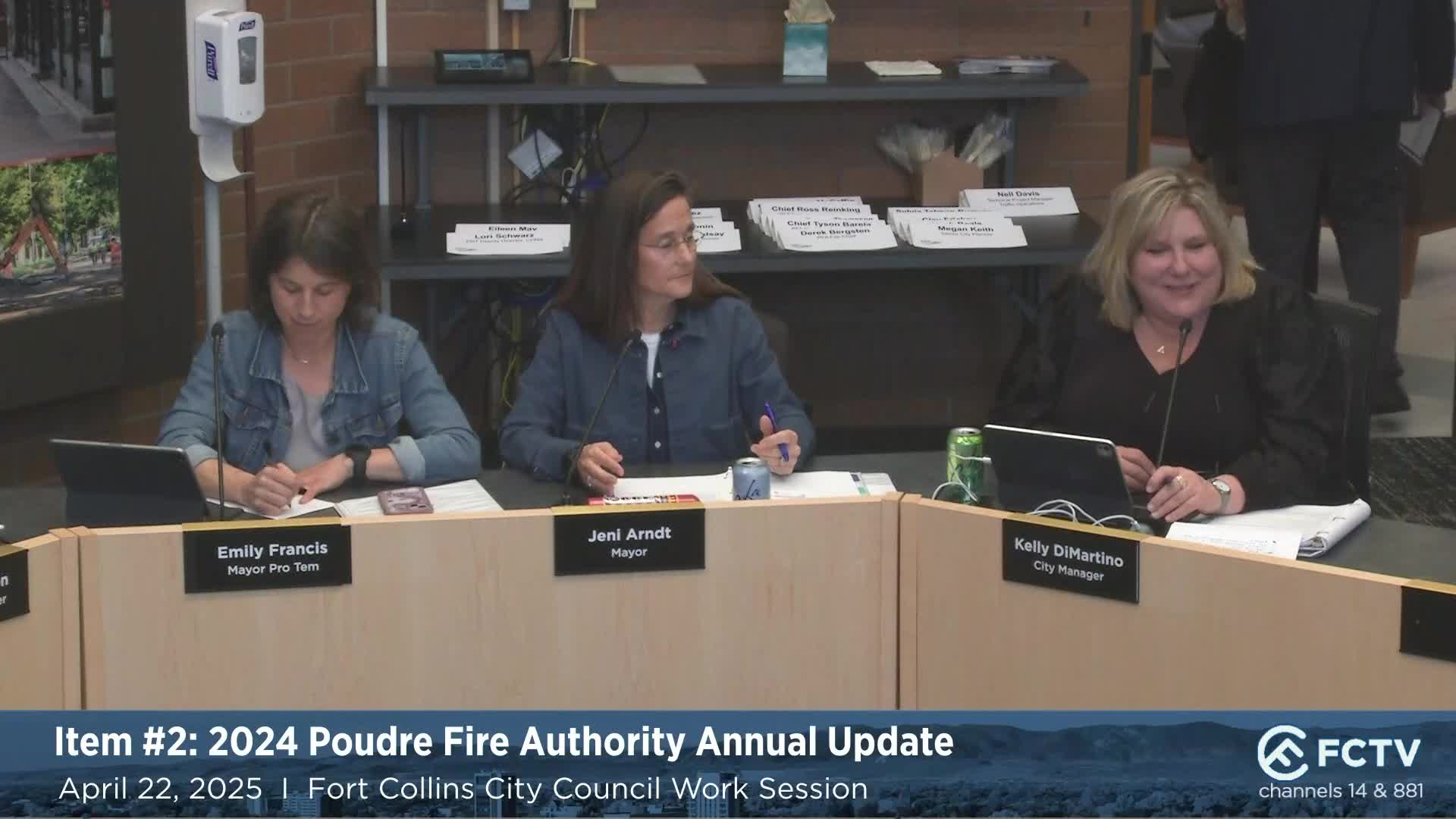
Poudre Fire Authority (PFA) Chief Derek Bergson told Fort Collins City Council the authority's 2024 annual report emphasizes training, capital planning and community health work while reporting that emergency medical services remain the largest call type.
At the start of his presentation, Bergson described PFA as an independent consolidated agency governed by multiple boards and funded jointly by the city and the Poudre Valley Fire Protection District. "We do not have taxing authority, and both governing entities provide funding that makes up our budget," he said.
What's in the report: Bergson said PFA employed 248 full‑time staff at the time of the report (207 uniformed personnel and 41 civilian positions), operates two volunteer stations (stations 9 and 11) and continues to use seasonal staff for peak holiday coverage. He told council PFA completed 44,000 hours of training during the prior year, ran regional programs including fire camp and Fire Ops 101 for elected officials, and deployed personnel on eight federal wildland and three federal urban search and rescue missions.
On incidents and prevention: The authority logged more than 17,000 EMS and rescue calls and an overall total near 21,000 incidents in the city portion of its service area; Bergson said the district accounted for roughly 4,000 incidents. He said the organization inspected roughly 57,800,000 square feet of buildings in its jurisdiction (figure supplied in the report) and that EMS prevention is a growing focus. Bergson described a community health program coordinated with UCHealth that seeks to identify and help high‑need patients through home visits and referral to primary care; he said 311 cases were closed last year and 17 exist as ongoing clients.
Capital planning and facilities: Bergson said the board has prioritized capital investments, including apparatus replacement (an item listed in the presentation as $2,800,000 for apparatus replacement) and facility work. PFA reported $16.3 million in reserves across funds to cover high‑cost capital items like radios and breathing apparatus; the chief listed new equipment on order including a new tower, engines and brush apparatuses and noted station 7 would open imminently with a community celebration planned.
Training and workforce development: Bergson highlighted training as a new division focus and said that PFA promoted 50 personnel the prior year, ran a recruit academy with 11 current recruits, and uses volunteer and seasonal positions as a recruiting tool that has led to internal promotions.
Council reaction: Council members praised PFA's regional deployments, training programs and community outreach events such as an EMS survivor celebration. Council questions focused on replacement cycles for apparatus (Bergson said engines have roughly a 10‑year frontline life followed by 3–5 years in reserve and ladders have ~15‑year frontline life) and the timeline for replacing white apparatus with red liveries; Bergson said replacement purchases now take 2.5–3 years from order and that a full fleet transition to red livery is expected around 2029–2030.
Ending: Bergson thanked council and acknowledged long‑serving staff due to retire, and council members expressed continued support for PFA's regional deployments, training and capital priorities.