Get Full Government Meeting Transcripts, Videos, & Alerts Forever!
Get email alerts on the School Traffic Safety topic
No spam. Unsubscribe anytime.
Fort Collins expands systematic school traffic inspections; city estimates full cycle by 2034
Summary
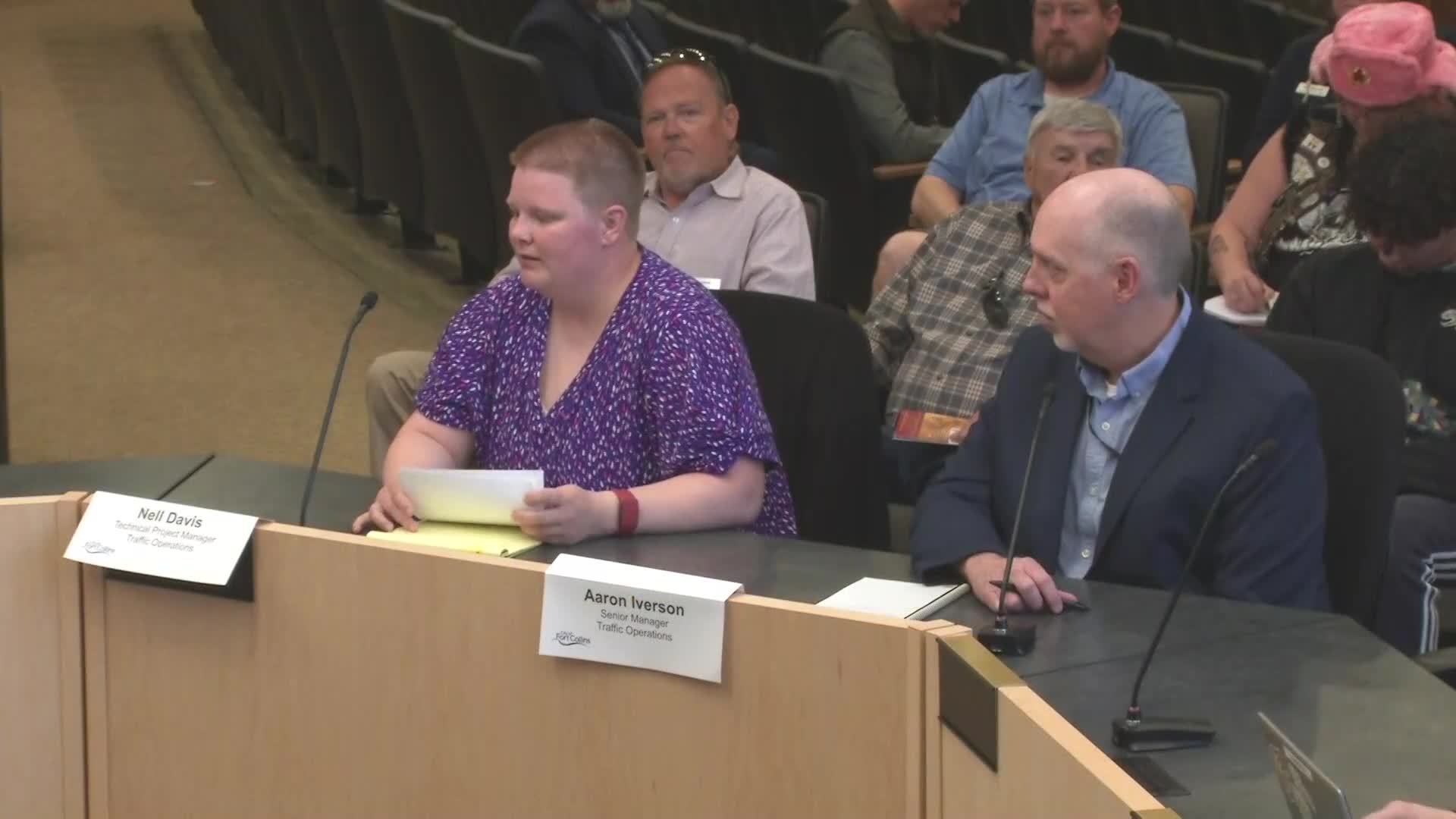
Nell Davis, technical project manager in Traffic Operations, told the Fort Collins City Council the city has launched a systematic school traffic safety inspection program that combines field observations, local outreach and engineering studies to recommend safety improvements around schools.
Nell Davis, technical project manager in Traffic Operations, told the Fort Collins City Council on the evening the city has launched a systematic school traffic safety inspection program that combines field observations, local outreach and engineering studies to recommend safety improvements around schools.
The program aims to standardize how the city evaluates pickup/drop‑off, pedestrian and bicycle routes, signage and driver behavior. "The goal of the program is to do a systematic inspection of all aspects of transportation around a school to look at every mode of travel and the behaviors of everyone involved," Davis said.
Why it matters: City staff told council the program replaces an older complaint‑driven patchwork approach so improvements are applied more evenly across schools. Staff described recommendations ranging from education and enforcement to small operational fixes and larger infrastructure projects that require grant funding or capital work.
Davis outlined the program steps: meet school staff and district leaders, station observers at arrival and dismissal times, conduct traffic counts and corridor studies, inventory signs and pavement markings, and survey parents and students. The city integrates education (for students, parents and school staff), enforcement coordination, maintenance, and operational changes; larger projects are pursued through grants.
The presentation included early results and examples. Davis said the program has completed studies at six elementary schools and one middle school so far. She described Zach Elementary as a relatively complex case; the report recommended converting two intersections to a full signal and installing a rapid rectangular flashing beacon. Staff said grant funding has been secured and construction is scheduled for the coming summer. By contrast, Davis said Lopez Elementary already used many good practices; staff supported smaller, lower‑cost measures such as speed humps and curb extensions and partnered with the Safe Routes to School coordinator on kindergarten walking education.
Council members asked about prioritization and pace. Davis said the city uses a simple scoring rubric that counts points for factors such as presence of younger students, schools near high‑speed roads, public or school district interest, and nearby scheduled resurfacing projects so improvements can be bundled with other work. Davis said the list is finalized each summer after consultation with the school district.
On timing and staffing, Davis said the program currently inspects roughly four schools a year with existing staff, and that a single project manager (Davis) currently leads the effort. "At a rate of about four schools a year, which is what I can sustain on my own, it'll take until 2034 to get through roughly 50 city schools," Davis said; Councilor Kelly Olsen later said that implied a first‑grader studied now would be a junior in high school when the city completes its first full cycle.
Council reaction and next steps: Several council members praised the program and urged staff to identify options to accelerate the work. Multiple councilors said they would support adding staff or contractor funding in midyear budget discussions to speed inspections and implementation. Councilors also emphasized pursuing grant funding for capital work and coordinating program timing with nearby resurfacing projects so infrastructure improvements can be bundled.
Davis said this school year the program is studying two elementary schools, two middle schools and, for the first time, a high school (Rocky Mountain High) to test lessons for high‑school contexts. Davis said staff plan to continue refining the prioritization criteria each summer with district input.
Ending: Staff did not present a final budget request at the session but said they will return with options if council wants to accelerate the inspection schedule. "We can look at that whole picture," the city manager said after council members requested alternatives to speed the program's rollout.