Get Full Government Meeting Transcripts, Videos, & Alerts Forever!
Get email alerts on the Elections And Ballot Policy topic
No spam. Unsubscribe anytime.
Severance council weighs November 2025 ballot items: sales tax to replace transportation fee, lodging tax, charter review
Summary
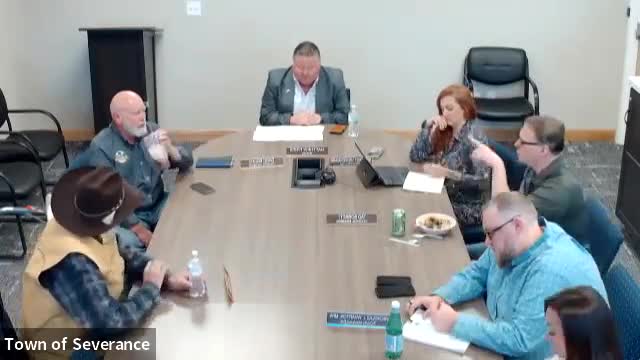
Severance Mayor Matthew Friess and town staff on April 22 opened a broad discussion about items the council might place on the November 2025 ballot, including a renewed sales‑tax measure intended to repeal the town’s temporary transportation utility fee, a lodging tax, and targeted charter clarifications.
Severance Mayor Matthew Friess and town staff on April 22 opened a broad discussion about items the council might place on the November 2025 ballot, including a renewed sales-tax measure intended to repeal the town’s temporary transportation utility fee, a lodging tax to capture revenue from hotels and short‑term rentals, and targeted changes or clarifications to the town’s home rule charter.
The council moved quickly from process and timing to policy. Town manager (Mr.) Wharton told the council the town must hold an election in November because of a two‑year term that will be filled by the candidate with the fewest votes; he said it costs the same to add ballot questions once the election is scheduled, which prompted the hour‑long discussion of what to include.
Why it matters: the transportation utility fee is a temporary charge created to fund immediate road work without drawing down the general fund. The fee is scheduled to sunset; staff said repeating the ballot ask could stabilize road funding long term if voters approve a permanent sales and use tax. Council members said a renewed campaign would require clearer ballot language and more public education than the prior campaign, which failed.
Legal and procedural points
Staff reported written legal guidance that the Severance charter, specifically Section 7.4, allows a home‑rule municipality to combine a proposal for a tax increase with repeal of an existing fee on the same ballot. Wharton summarized that advice: the town may present ballot language that both proposes a sales/use tax increase and provides that, if the tax passes, the transportation utility fee will be repealed. Councilmembers noted the requirement to include TABOR (Taxpayer’s Bill of Rights) disclosures where required and asked legal staff to refine language.
Timeline and next steps
Council and staff outlined a timeline: candidate packets and formal election finalization steps occur in August and September with county coordination in September; work with Weld County elections staff must begin in June and July. Council directed staff to engage the Citizen Advisory Board (CAB) at its June and July meetings and asked legal counsel to review the charter language before CAB begins public review. CAB chair Josh Green was named as available to lead that review.
Policy options discussed
- Sales/use tax to replace transportation fee: Several councilmembers expressed support for bringing the question back to voters, with an opening suggestion to keep the proposed rate at 1%. Councilmember Joseph suggested starting the ballot question with a straightforward phrase such as, “Shall the Town of Severance eliminate the transportation utility fee by adding this 1% sales tax?” Council members agreed they must balance accurate framing with TABOR requirements.
- Lodging tax: Councilmember Vandermark proposed studying a lodging tax (commonly 3% in nearby jurisdictions) that would apply to hotels and, if desired, to short‑term rentals such as Airbnb. Staff noted Severance currently has few short‑term rentals and no hotels, but council members said the lifting of the water moratorium and potential new commercial development made it timely to investigate.
- Recreation center funding: Councilmembers and residents have repeatedly raised the possibility of a recreation center. Council discussed funding options — bonds with a mill levy, a dedicated fee, or a phased approach. Several members warned prior cost estimates (which had been characterized as roughly $1,200 per household per year in a high‑end scenario) produced strong voter opposition; the council asked staff to research lower‑cost alternatives and to test public appetite before placing a binding measure on the ballot.
Public education, restrictions on municipal campaigning
Councilmembers and staff discussed communications limits and campaign rules: the town may not use public funds to advocate for a ballot measure after it becomes an official question, but individuals and private organizations can campaign, and the town can circulate informational materials up to specific limits. Staff recommended an early public education effort (before the ballot is finalized) to explain intent and fiscal impacts.
Direction to staff
Council directed legal staff to: (1) review the charter’s definitions (in particular the phrase “real property”) and suggest clarifications; (2) provide proposed TABOR‑compliant ballot language for a combined tax/repeal question; and (3) attend CAB’s June and July meetings to advise on legal constraints. Management was asked to research lodging tax options and to provide cost estimates and revenue projections for the recreation center scenarios.
Ending
Councilmembers agreed to pursue research and draft language over the summer, to use CAB for citizen review in June and July, and to aim for a September packet and ballot finalization with Weld County if the council elects to place measures on the November ballot.