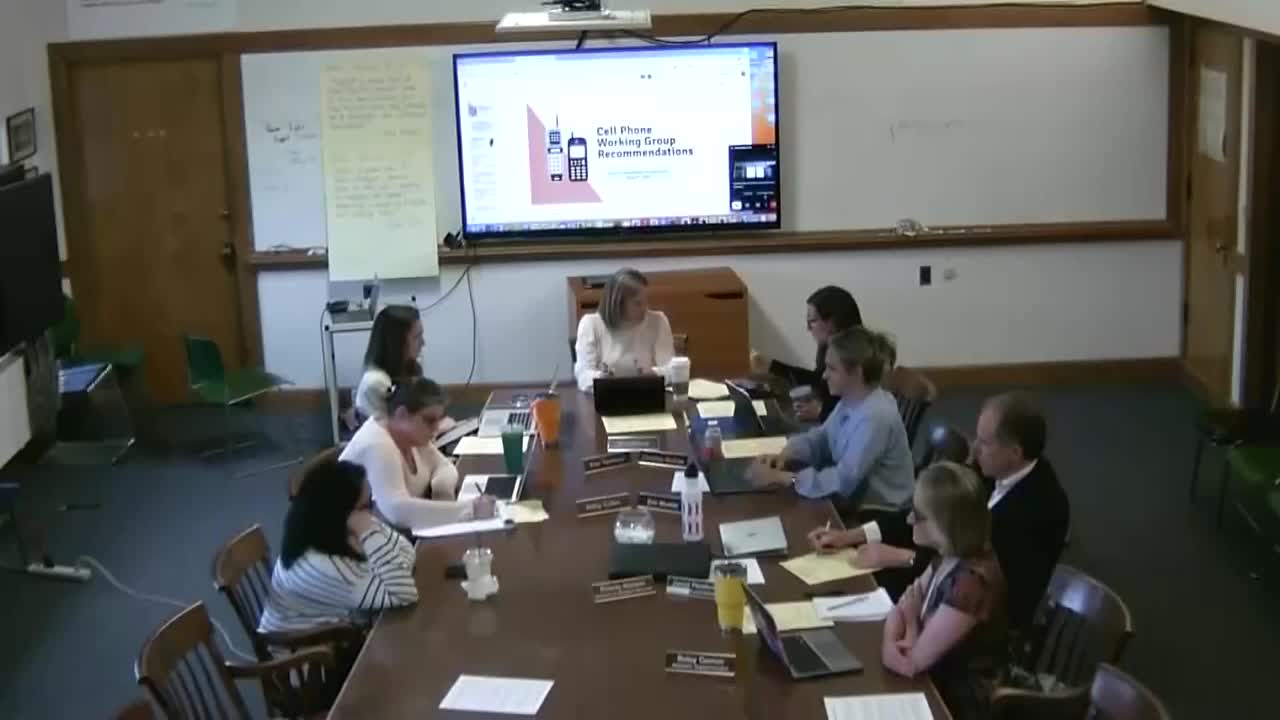
Wayland working group recommends phone-free learning spaces, Yondr pouches for middle school; high school policy to be tightened
Loading...
Summary
The Wayland School Committee on May 14 received a working-group plan calling for elementary students to be barred from bringing smart devices to school, a middle-school pilot using lockable pouches, and tightened enforcement at the high school with an option for phone-free library space if funding allows.
The Wayland School Committee heard a presentation May 14 from a multi-stakeholder cell phone working group that recommended restricting student access to smartphones during the school day and outlined next steps for implementation across elementary, middle and high school levels.
The working group recommended that elementary students not bring smart devices to school; for middle school, the group recommended a lockable pouch system (commonly marketed as "Yondr" pouches) placed in homeroom at arrival and unlocked at dismissal; and for the high school the working group recommended tightening enforcement of existing "phones away" classroom practices by requiring phone holders in every learning space and exploring options to reduce phone use in the cafeteria and make the library a quieter, phone-free study space if resources allow.
Ben Buffel, identified in the transcript as the high school counseling department head who joined remotely, summarized the high school proposals: "phone free learning environments, phones away in all learning spaces including the library and the SLC," and urged a tighter, consistently enforced practice across classrooms rather than a teacher-by-teacher approach.
The group presented local survey and research findings it used to frame recommendations. Wayland-adapted results from the districthigh school MetroWest survey (2023) were cited: 46% of high school students reported spending three hours or less per day on smartphones outside schoolwork; 51% said they check their phones several times an hour or more during school; 59% said they spent too much time on social media; 46% reported that digital media worsened their attention to school and 40% said it hurt their academic performance. The working group also cited regional examples and discussions with other districts (Wellesley, Westwood) and review of Jonathan Haidtresearch as context.
Practical concerns dominated the discussion. Middle school staff and teachers generally supported the pouch solution as a consistent, campus-wide, off-and-away approach, but presenters and committee members warned it is "a big lift" operationally: pouches must be purchased, magnets or unlocking stations installed at exits, homeroom routines set, and a plan made for loaner pouches and lost/damaged units. Budget estimates discussed in the meeting included an order-of-magnitude cost of roughly $20,000 for about 700 pouches (a per-pouch estimate cited in discussion was approximately $30 each), with additional costs for magnets and unlocking equipment; committee members asked staff to return with a detailed cost projection at the next meeting.
Library enforcement at the high school was repeatedly described as a resource-intensive challenge; presenters said classrooms could adopt shoe-holder phone storage relatively cheaply but that making a large, open library phone-free would require staffing and logistical changes. The working group recommended a multi-pronged communication and education plan (family outreach, student lessons during advisory/seminar, PTO sessions, and partnership with Wayland Youth and Family Services) and proposed a phased approach with ongoing monitoring and a three-year horizon to refine policy and implementation.
Next steps recorded in the meeting transcript: staff will meet with the town manager and school business official to explore funding and logistics; the middle school will be prioritized for near-term rollout; school leaders will return to the committee with budget and implementation timelines; the committee asked the working group to continue follow-up work and to develop options (including a more restrictive bell-to-bell option for ninth and tenth grades) and the pros/cons and resource requirements for each.
Why this matters: the committee framed the issue as balancing learning time, social engagement and student mental health against practical constraints of staffing and cost. Committee members emphasized that any policy depends on consistent enforcement and family partnership, and that the district will need measurable benchmarks if a pilot is launched.