
State chapter 70 formula, hold-harmless aid explained to Swansea school committee
Get AI-powered insights, summaries, and transcripts
Subscribe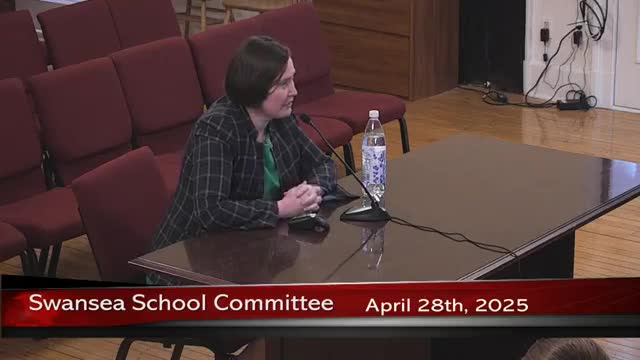
Summary
Tracy Novick, field director for Central Massachusetts for the Massachusetts Association of School Committees, explained how Chapter 70’s foundation budget, the Student Opportunity Act and the state’s hold‑harmless protections combined to produce an unexpected increase in state aid for Swansea in fiscal 2026 despite a drop in the district’s measured enrollment.
Tracy Novick, field director for Central Massachusetts for the Massachusetts Association of School Committees, told the Swansea School Committee on April 20 that Chapter 70 calculates a per‑student “foundation budget” and then assigns how much of that should come from local taxes and how much from state aid.
Novick said the Student Opportunity Act (SOA) — a multi‑year revision of the foundation budget that phases in higher per‑pupil amounts for low‑income and English‑learner students and for guidance and psychological services — is still being implemented and explains much of the change to district funding in recent years. “SOA focuses on the foundation budget: what it costs to provide a fair and adequate education per pupil,” Novick said during the presentation.
Why it matters: Novick used Swansea’s own numbers to show that the district’s calculated foundation budget fell for FY26 because of lower October 1 enrollment, while the state’s calculation of required local contribution and the law’s protections produced a net increase in state aid for Swansea through a hold‑harmless provision. That left the district receiving roughly the same state aid as the prior year even though the underlying foundation budget declined.
What the committee heard: Novick walked the committee through the two‑step Chapter 70 approach: (1) set a foundation budget made up of a base per‑pupil amount plus supplements for English learners and for concentrations of low‑income students; (2) apply a standard local funding effort formula that converts each town’s property and income capacity into a required local contribution. She showed how the state then fills the gap between local contribution and the foundation budget with foundation aid.
Novick also described the mechanics behind so‑called “hold harmless” aid and a minimum per‑pupil increase that the state has used in recent budgets. In Swansea’s case the district’s foundation budget dropped relative to the prior year, which would have reduced state aid; the state’s hold‑harmless rule instead kept the district’s state aid at the prior year’s level, producing an extra roughly $1.5 million in aid for FY26 that the committee should treat as not necessarily permanent.
Committee questions and context: School committee members and staff asked about the implications for the FY26 budget and for FY27. Novick cautioned that the single largest variables for future changes are enrollment and the inflation assumptions the state uses to update the foundation budget. “The inflation rate the state uses is based on state and local spending measures; right now it is not tracking like district costs,” Novick said, pointing out that the SOA includes a separate, higher inflation factor for health insurance.
Next steps and resources: Novick left her slides with the district and encouraged the committee to track three items for FY27 planning: enrollment trends (October 1 counts), the state inflation rates used in the foundation calculation, and whether the legislature changes the minimum per‑pupil amounts when it finalizes the budget. She also made herself available for follow‑up questions and district briefings.
Committee members praised the walkthrough as clarifying an otherwise complex set of calculations and asked administrators to use the presentation to inform community outreach and FY27 planning.