Get Full Government Meeting Transcripts, Videos, & Alerts Forever!
Get email alerts on the Student Discipline Restorative Practices topic
No spam. Unsubscribe anytime.
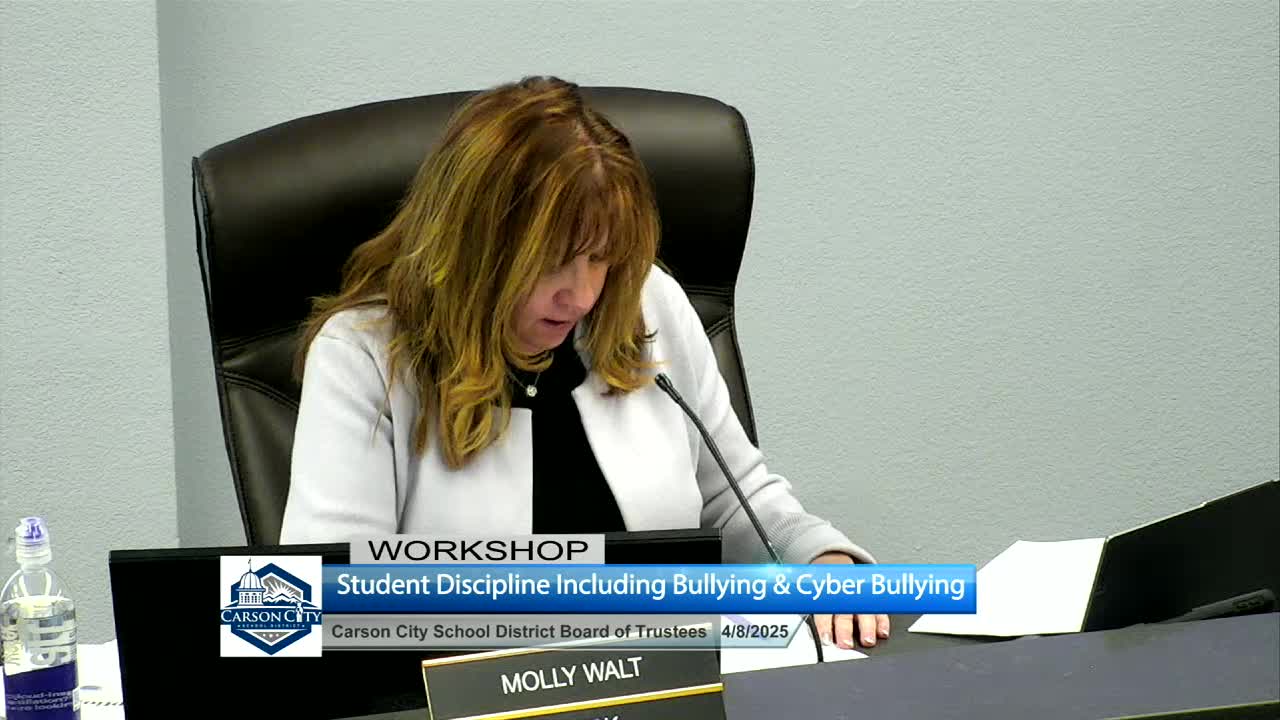
Carson City trustees hear overview of districtrestorative-discipline plan, timelines and limits
Summary
District staff reviewed the Carson City School Districtrestorative discipline regulation, bullying investigations, mandatory restorative plans after multi-day suspensions and legal limits including FERPA, McKinney-Vento and IEP safeguards. No action was taken; the document will return for board approval in September.
Christy Perkins, director of MTSS and student wellness for the Carson City School District, reviewed the districtrestorative-discipline regulation and the districtprocess for responding to student misbehavior, including bullying and cyberbullying.
Perkins told trustees the regulation is a required annual report and that "students have an opportunity to feel safe and at school to access their education." She said the document is intended as a guidance tool for administrators and that local teams at each school provide feedback during an annual August review before the plan returns to the board each September.
The presentation walked trustees through a tiered framework of behavior supports: Tier 1 universal supports for all students; Tier 2 targeted group- or small-group interventions; and Tier 3 individualized behavior and safety plans. Perkins said some students move quickly to Tier 3 because a single severe incident can trigger more restrictive responses. The regulation includes a multi-page matrix that maps conduct categories to required actions, optional interventions and the Infinite Campus codes administrators use to record incidents.
Trustees heard that state law requires schools to first evaluate incidents through a bullying-investigation lens when allegations involve harassment, bias or an imbalance of power. Perkins said administrators often open a bullying investigation early "when a student or an adult says my child is being bullied," which can produce many cases that later are classified as unsubstantiated after investigation. She said those reports are included in the districtannual state reporting of substantiated and unsubstantiated bullying incidents.
Legal and procedural safeguards were stressed. Perkins and Tasha Fuson, chief academic officer, told the board: - Schools must create a restorative plan for any student suspended out of school for three or more consecutive days or five cumulative days; the plan must include parents and relevant staff and parents sign to acknowledge the plan. If a family declines to participate, schools document the refusal but still develop steps to support the student. - Students on Individualized Education Programs (IEPs) who face suspensions over 10 days must have a manifestation determination review to decide whether the behavior was caused by the studentdisability. - Students experiencing homelessness under McKinney-Vento receive additional protections: the district said a McKinney-Vento student "cannot be suspended longer than five days" without further review. - For very young children (under age 6), the superintendent must approve any suspension and state law places further age limitations; a speaker said the district had not applied long-term suspensions to such young students in recent memory.
Board members asked how FERPA and privacy rules limit what the district can tell victim families about outcomes. Fuson said the district can confirm whether an investigation was founded or unfounded but cannot disclose specific disciplinary actions taken against another student. She said administrators try to mitigate victimssafety concerns by putting safety plans in place, identifying a safe adult on campus and arranging supervision while an investigation proceeds.
Trustees also discussed parentsconfusion about progressive discipline. The administration explained that progressive discipline today often means adding supports and interventions rather than increasing days of out-of-school suspension. Perkins and Fuson said the intent of recent state law changes is to reduce suspensions, require provision of educational services while a student is suspended, and emphasize restorative processes where appropriate.
Perkins and Fuson cited administrative tools and training the district has created: a Google Drive with school-specific folders, threat-assessment forms, site-level flowcharts, and a Google-form version of the staterestorative-plan form to simplify documentation. They also noted the district works with legal counsel on implementing recent legislative changes.
The workshop included several trusteesquestions about whether the board can make optional responses mandatory for issues such as truancy or possession of alcohol. Legal staff and Fuson advised that many actions are constrained by state and federal law and by individual student rights, and offered to provide a memo outlining the boardauthority and legal limits before the September review.
No formal action was taken during the workshop. Perkins and staff will bring the annual restorative discipline regulation back to the board for formal approval at the required September posting and adoption.
Ending: Trustees praised the packet of administrative tools and requested follow-up memos about board authority and specific requested language changes for the September adoption.