Get Full Government Meeting Transcripts, Videos, & Alerts Forever!
Get email alerts on the Interdepartmental Grants topic
No spam. Unsubscribe anytime.
Subcommittee hears explanation of interdepartmental grants that reimburse other state agencies for MDOT services
Summary
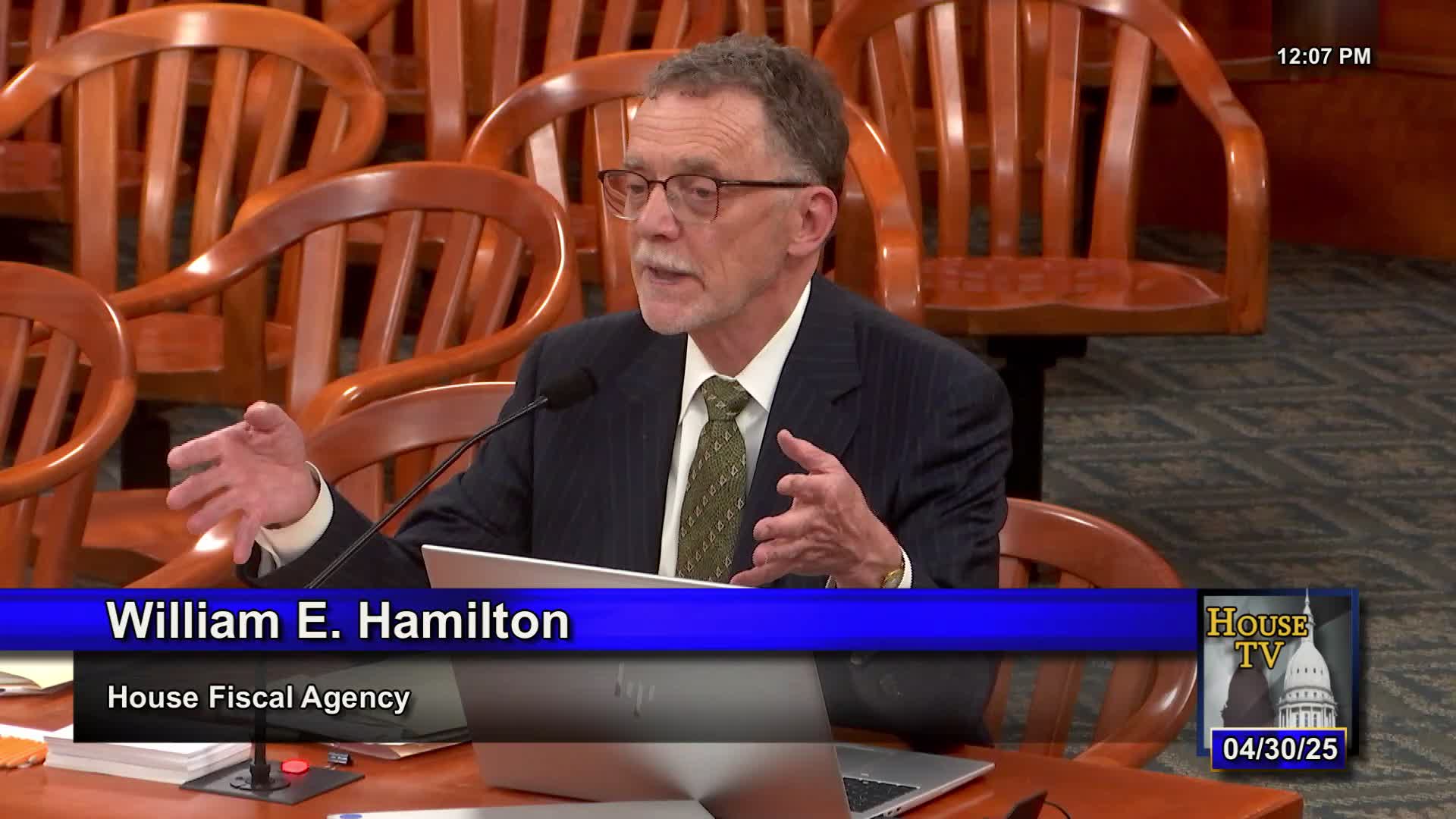
The Appropriations Subcommittee on State and Local Transportation was briefed on interdepartmental grants (IDGs) in the state transportation budget by House Fiscal Agency analyst William Hamilton.
The Appropriations Subcommittee on State and Local Transportation was briefed on interdepartmental grants (IDGs) in the state transportation budget by House Fiscal Agency analyst William Hamilton.
Hamilton told members the enacted transportation budget lists roughly $50.7 million in IDGs and about 20 separate line items that reimburse other state departments for services provided to MDOT or the transportation funds. "Interdepartmental grants are simply a budgetary tool that allow for one State Department to effectively reimburse another State Department for services performed," Hamilton said.
What the grants cover: Hamilton said the IDGs reimburse agencies such as the Attorney General, the Department of Technology, Management and Budget (DTMB), the Department of Treasury, the Auditor General, Environment, Great Lakes, and Energy (EGLE), the State Services Commission, and the Secretary of State. He highlighted the Michigan Transportation Fund (MTF) appropriation to the Secretary of State: the budget includes a $20 million MTF payment that partially reimburses branch operations for vehicle registration and title work; Hamilton said the total cost of those branch operations related to registration collection is closer to $90 million.
Hamilton explained why the appropriation appears in two places: the $20 million is shown in both the transportation budget as an IDG and in the Secretary of Stategeneral government branch-operations appropriation. When analysts report the total state budget, they use "adjusted gross appropriations" to avoid counting those dollars twice.
Audit and oversight: Hamilton said these IDGs are typically governed by contracts or agreements that set a not-to-exceed cost and that the Auditor General audits the costs periodically; he said the audit of these interdepartmental arrangements is performed every two years. Committee members asked how the actual cost is determined and whether the appropriated amounts match the underlying cost. Hamilton pointed to a cost allocation study for the Secretary of State branch operations that showed the actual registration-related costs substantially exceed the $20 million MTF IDG.
Administrative note: At the start of the meeting the committee adopted the minutes of its April 23 meeting by unanimous consent. "There being no objections, the motion prevails by unanimous consent," the clerk recorded.
Next steps: Hamilton offered committee members follow-up material, a deeper written explanation in the packet, and availability for one-on-one tutorials about IDG accounting and the flow of restricted transportation funds.