Get Full Government Meeting Transcripts, Videos, & Alerts Forever!
Get email alerts on the Cannabis Regulation And Taxation topic
No spam. Unsubscribe anytime.
Municipal leader and industry officials tell House panel proposed wholesale tax, enforcement are threatening Michigan cannabis businesses
Summary
Bangor Township supervisor and cannabis industry witnesses told a House Appropriations subcommittee that proposed wholesale taxes and heavy enforcement are damaging licensed businesses, while municipalities have relied on cannabis revenue for roads and services.
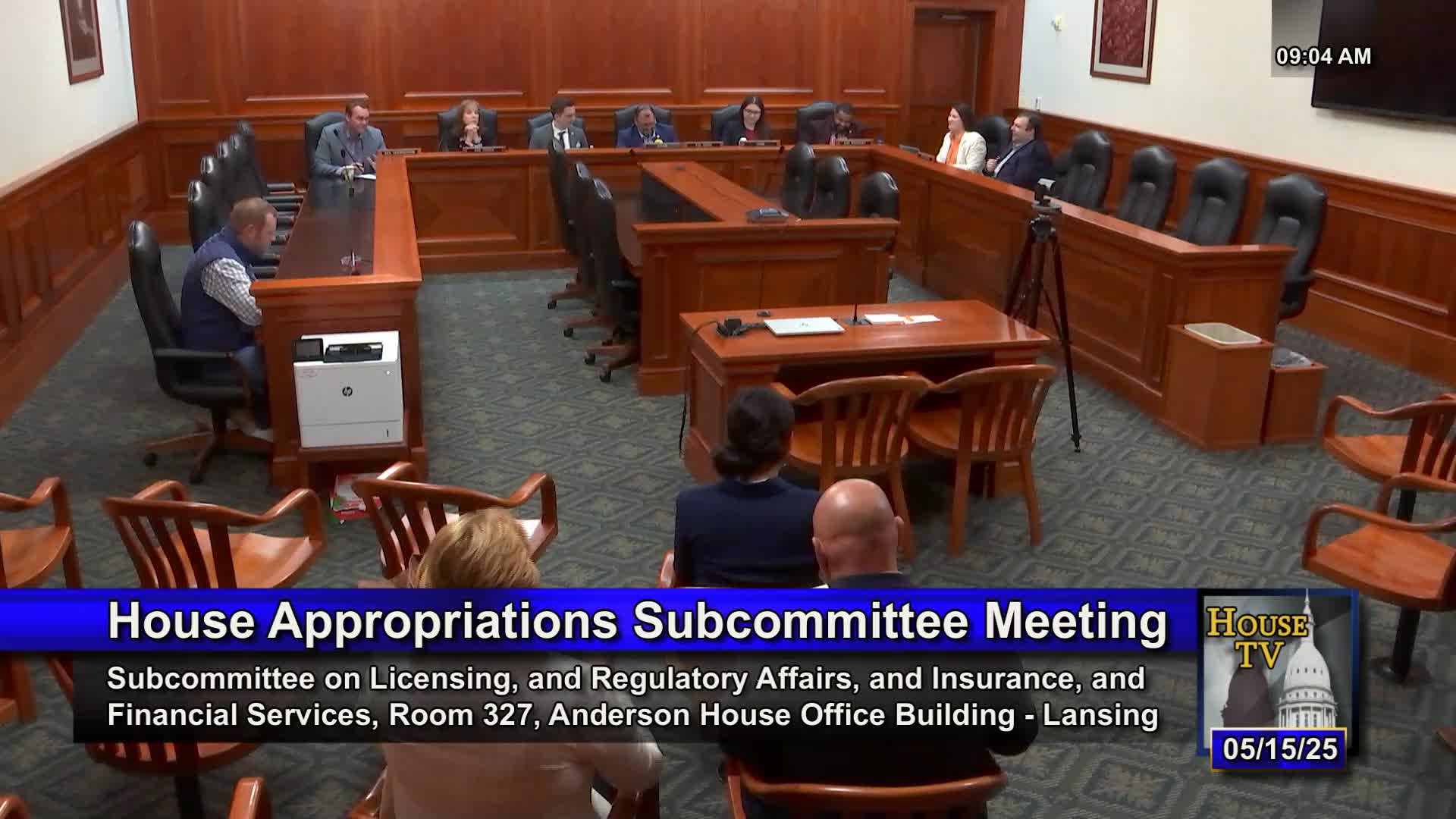
LANSING — Witnesses at a House Appropriations subcommittee hearing warned lawmakers that a proposed wholesale tax and aggressive enforcement are squeezing Michigan’s licensed cannabis businesses and risking a return to an illicit market.
Glenn Rowley, supervisor of Bangor Township, told the House Appropriations Committee Subcommittee on Licensing and Regulatory Affairs and Insurance and Financial Services that the township relied on cannabis-related revenue to avoid tapping rainy-day funds and to repair infrastructure. “Last year we received $756,972 as our share. The previous year, we received $886,295,” Rowley said. He described the industry’s local economic effects — rehabbing vacant buildings, rising property values and sponsorships for community programs — and urged lawmakers not to add new taxes or regulatory burdens: “Strangling the goose that lays the golden eggs is a terrible idea,” he said.
Denise Policella, partner at Omnis Law and founder of Cannabis Attorneys of Michigan, told the panel the licensed cannabis sector is “overly regulated and taxed,” and that companies face structural disadvantages tied to federal law. “The state of Michigan does not support its licensed cannabis industry. Full stop,” Policella said. She told lawmakers that federal prohibitions and Internal Revenue Code Section 280E limit businesses’ ability to take ordinary tax deductions, and that the Michigan Cannabis Regulatory Agency’s (CRA) requirement that licensees clear state treasury tax bills before renewal further strains operators.
Small-business operators who manufacture but do not operate retail storefronts said a proposed wholesale tax in a road-funding package would disproportionately harm non‑vertically integrated firms. Tyler (CEO of Willow Joe LLC, also referred to as WoJo) said a 32% wholesale tax combined with the loss of the 10% excise tax would “absolutely cripple any small business.” John Wagoner, compliance manager at Willow Joe LLC, said his company employs 57 people and pays high costs for testing and licensing. “We pay over a hundred thousand dollars a year in testing, over a hundred thousand dollars a year in licensing,” Wagoner said, adding that heavy fines and limited banking and insurance options raise operating costs further.
Lawmakers questioned witnesses about market oversupply, public-safety risks from unregulated hemp-derivative products and whether Michigan’s tax burden is low or high compared with other states. Representative Snyder noted that Michigan’s per-capita taxation on cannabis is lower than many states but asked whether local oversaturation is driving closures; Rowley said some businesses have shut as the market stabilized and prices fell. Representative McKinney raised a potential road-funding deal that could levy additional taxes on the industry; witnesses repeatedly cautioned that more taxation could push consumers to the black market.
Panel members also heard testimony that a lack of consistent lab standards and limited enforcement of illicit, unlicensed sellers are depressing licensed operators’ prices. Policella said some private labs follow different testing and sampling methods and that a state lab was proposed to standardize results; she said she is aware of complaints about lab practices but is not personally litigating those cases.
There was no formal committee action on taxation or regulatory changes during the hearing; the only recorded formal action was approval of the subcommittee minutes from May 8, 2025. Several members encouraged industry representatives to provide consolidated, written proposals and noted the committee’s interest in balancing road funding needs with small-business viability.
Why it matters: Michigan’s licensed cannabis market generates sizable state and local revenue and supports thousands of jobs, but witnesses told lawmakers that a combination of federal tax rules, limited access to banking and insurance, aggressive state enforcement, oversupply and possible new state taxes threatens firms that operate legally. Lawmakers face competing pressures to secure road funding and maintain a regulated retail market.
The subcommittee did not vote on any tax legislation at the hearing; additional hearings and bills were discussed as possible next steps.