Get Full Government Meeting Transcripts, Videos, & Alerts Forever!
Get email alerts on the Appropriations General Government topic
No spam. Unsubscribe anytime.
Michigan Department of State presents FY26 budget request, responds to Auditor General findings on branch operations and Real ID procedures
Summary
Officials from the Michigan Department of State outlined a $296.6 million FY26 budget request, described revenue collections and planned position fills, and responded to an Office of the Auditor General audit that raised four reportable findings including documentation and customer‑service data collection related to Real ID and branch operations.
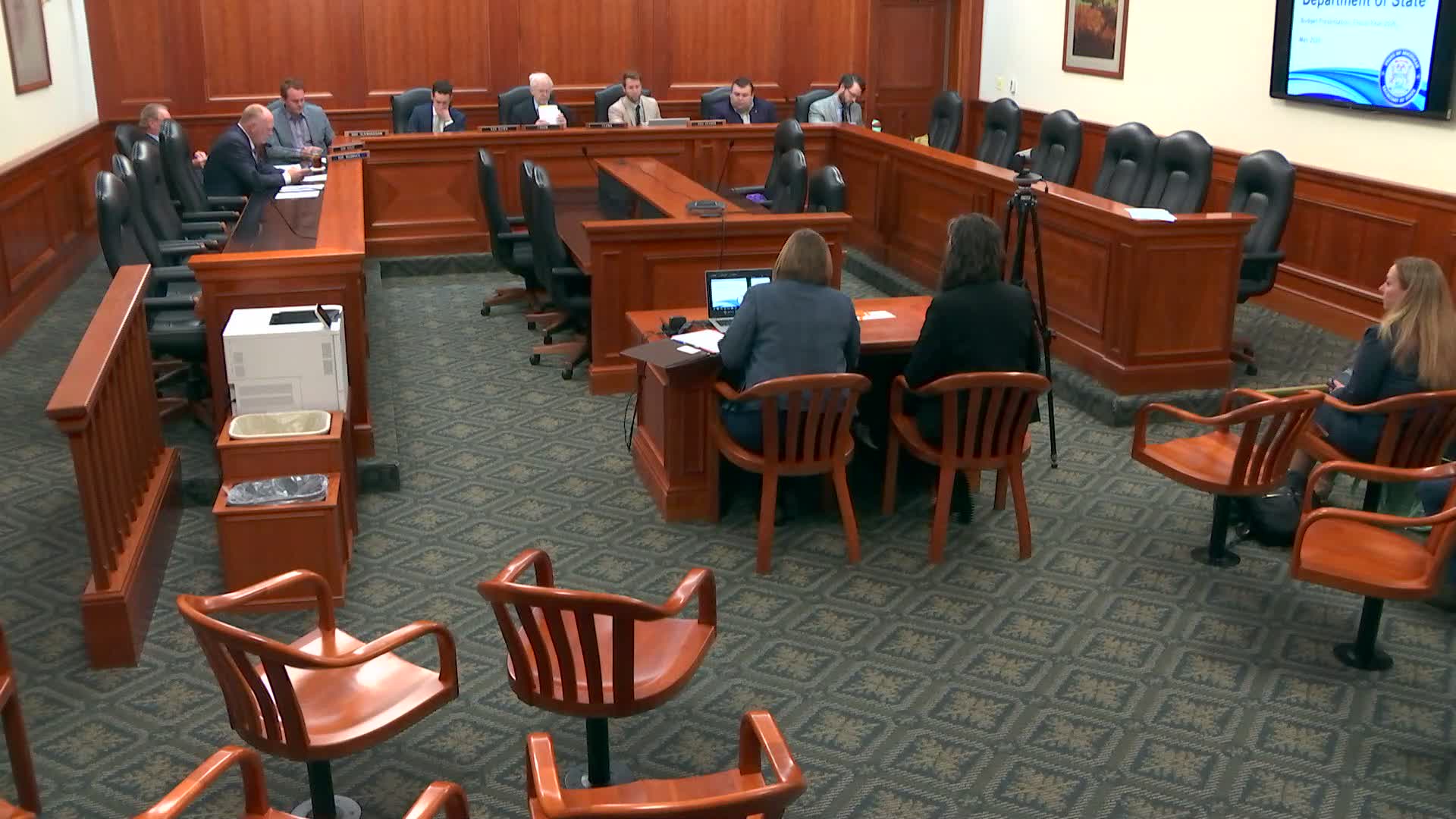
Lansing — Officials from the Michigan Department of State presented the department's FY26 budget request and answered lawmakers' questions Thursday before the House Appropriations Subcommittee on General Government.
The department said the governor's recommended FY26 appropriation for the Department of State (MDOS) is $296,597,400, an increase of $4,757,500 from FY25 driven primarily by restricted‑revenue requests to fill vacant positions and baseline cost adjustments.
“The only investment in our recommended budget is $1,600,000 in restricted revenue authorization to fill 4 positions in central operations to adequately support technology efforts and 8 positions in legal services,” said Sydney Paradigm, Financial Services Director, Michigan Department of State. Paradigm told the committee MDOS currently has about 43 appropriated but unfunded full‑time equivalents and said baseline adjustments total roughly $3,600,000, with about $440,200 in a technical reduction related to restricted revenue.
Why it matters: MDOS collects large volumes of restricted revenue used statewide and says its operating costs are a small share of those collections. Paradigm told the committee MDOS collected $3,500,000,000 in FY24, and that MDOS spending was $278,000,000 — about 8 cents of every dollar collected went to department operations. She said about $2.6 billion of FY24 collections were distributed for roads and education, with other shares to the general fund and several state agencies.
Most important details
- Revenue and budget: Paradigm said MDOS collected $3.5 billion in FY24; distributions listed included roughly $2.6 billion for roads and education, $560,700,000 to the general fund, $228,000,000 to MDOS, $49,100,000 to natural resources and $29,000,000 to state police. MDOS spent $278,000,000 in FY24. The FY26 governor's recommendation totals $296,597,400.
- Staffing and positions: The budget request would authorize filling 12 restricted‑revenue positions (4 central operations technology positions and 8 legal services positions) to address backlogs and rising fraud and audit workload. Paradigm said this request does not increase the overall FTE included in the budget but would fund previously unfunded appropriations.
- Fees, funds and timing: Paradigm described the tax (TAC) fund as a fixed‑fee restricted revenue source created in 2004 that has not adjusted for inflation; she said MDOS expects available fund balance and unallotted amounts to carry through but that the TAC fund sunsets on Oct. 1, 2027, and discussions are needed on future adjustments. She said the unallotted balance was about $54,000,000 with a $16,000,000 shortfall when comparing collections to authorization.
- Supplemental and grants: MDOS said it has a FY25 supplemental request for $9,600,000 and described a security grant reappropriation of $5,720,000 in unspent grant funding plus $1,000,000 in recently received grant funds for election security initiatives and voting equipment replacement reimbursements to local jurisdictions.
Audit and branch operations
The committee also heard MDOS's response to a 14‑month Office of the Auditor General (OAG) audit of the Branch Operations Division (BOD). Brian Bryson, Director of Information Security at MDOS, summarized the audit and the department's planned responses.
“The audit yielded no material findings,” Bryson told the committee, while acknowledging four reportable findings the OAG identified and MDOS intends to address. Bryson said the audit reviewed the Cars system (customer and automotive record system), staff interviews, surveys and on‑site observations and noted that BOD processes a large volume of transactions: branch offices handled an estimated 11.8 million transactions between Oct. 1, 2022 and May 31, 2024 and collected roughly $1.3 billion in revenue during that period.
Reportable findings and department responses
- Customer feedback and wait‑time data: The OAG recommended collecting and analyzing customer service information such as wait‑time data. MDOS said it is pursuing a customer feedback system and is negotiating a statewide contract with Qualtrics to survey customers by text or email after branch visits; Jackie Benton, Chief Operating Officer, said MDOS is negotiating initial quoted costs the department considers high and may seek alternatives if necessary.
- Real ID and scanned documentation: The OAG questioned retention of scanned images of Social Security numbers and residency documentation for Real ID and enhanced driver's licenses (EDLs). MDOS acknowledged the OAG's interpretation of federal Real ID requirements but said the scanning requirement conflicts with the Michigan Social Security Number Privacy Act and that MDOS already validates Social Security numbers in real time via the Social Security Online Verification Interface (SSOLV) and residency via the SAVE system and other electronic checks. Bryson said federal audits, including a December 2024 TSA assessment, had not found issues relating to storage of SSNs.
- Testing oversight and training: The audit recommended increased oversight of in‑branch testing and improvements to the state's training reporting system. MDOS said it will add testing observation items to district manager checklists, schedule testing oversight training, review physical spaces used for testing, and work with IT partners to improve training records reporting.
Numbers reported to committee (noted differences)
Paradigm said “in the last since March, 55,000 Michiganders have gotten their Real ID.” Bryson later told the committee, “Since March, more than 155,000 customers have converted to their Real ID,” a difference committee members asked MDOS about during questioning. The department did not provide an immediate reconciliation of those two figures during the hearing.
Lawmakers' questions and operational issues
Members pressed MDOS on branch staffing and service delivery. Paradigm said branch offices have 903 appropriated staff in the branch appropriation and the branch operations division employed 840 staff as of May 31, 2024; she said most branch staff report in‑person five days a week while many nonbranch employees operate on a hybrid schedule.
Representative Snyder asked about the reappropriation of $5.72 million in unspent grant funding; Paradigm said federal election‑security funds were distributed to states with no set expenditure deadline and that MDOS offered reimbursements to local jurisdictions and held funds to support future equipment replacement needs. On the TAC fund, Paradigm recommended a mechanism to index certain fees for inflation to avoid recurring shortfalls.
Other operational items MDOS described included a $500,000 work project to reconfigure state‑owned MDOS facilities to support hybrid work and IT staffing changes and a multiagency product‑owner structure for systems such as Cars; Joe Spond was identified as director over core technology and the product owner for the Cars system.
Formal actions
Representative Rip Van Workum moved to approve the minutes of the committee's May 8, 2025 meeting; with no objections, the committee approved the minutes, the only formal action recorded during the MDOS presentation.
What comes next
Committee members scheduled follow‑up oversight: MDOS staff said they are negotiating the Qualtrics contract and will pursue system improvements for customer feedback, training records and testing oversight. The committee also announced a special joint meeting Tuesday with the House Oversight Committee and a future meeting with the Department of Technology, Management & Budget to discuss related technology issues.
Ending
MDOS officials left the committee with its budget request on the record and with plans to implement the audit recommendations described to the committee and to continue negotiating the customer‑feedback contract. Lawmakers signaled further hearings and oversight on MDOS technology and branch operations going forward.