Get Full Government Meeting Transcripts, Videos, & Alerts Forever!
Get email alerts on the District Finances topic
No spam. Unsubscribe anytime.
School board hears third-quarter financial report; reviews multiple finance-related policies and flags elevator repair cost
Summary
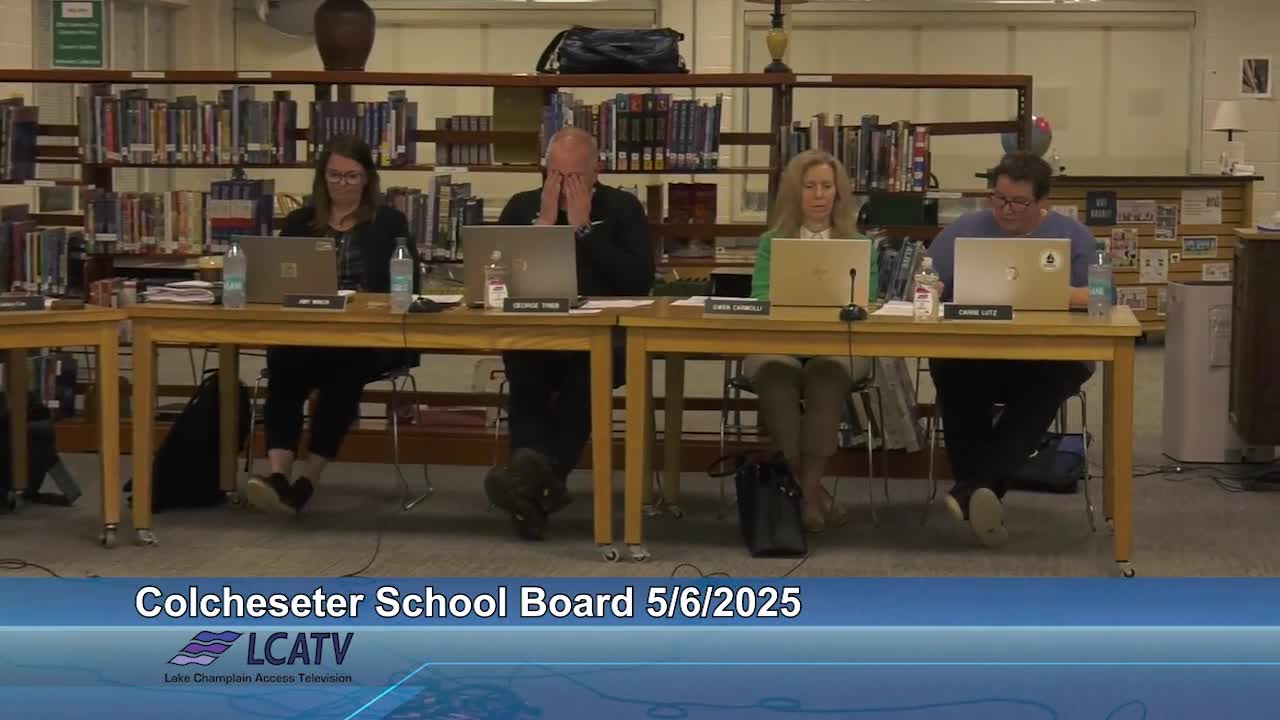
At the May 6 Colchester School Board meeting, district finance staff reported that third-quarter spending is tracking to plan but an unbudgeted elevator repair may cost $140,000–$150,000; the board moved several financial and grant-related policies forward and delayed final approval of the fiscal management policy for wording clarifications.
Colchester School District finance staff presented the third-quarter financial report at the May 6 school board meeting and told trustees revenues and expenditures are tracking close to prior-year levels but the district faces several cost pressures.
District finance staff member George reported that the district’s year-to-date spending rate was roughly 70.1 percent, near last year’s 69.7 percent, and that interest earnings were higher than expected. He said a timing anomaly was producing an extraordinary reimbursement that will increase revenue this fiscal year while some grant-funded spending (IDEA-B) is expected to be lower than budgeted. On the expense side, George flagged professional‑led services, construction work (including restroom renovations) and district software purchases carried over from ESSER funding as drivers of increased spending.
George told the board an unplanned elevator failure at Colchester High School had been repaired and that repair costs could ultimately be in the $140,000–$150,000 range. He said the board could choose to use capital reserve funds to cover that cost but that decision would come back to the board when the year‑end surplus is finalized and reported to the state in August.
Board members asked how much of the software spend supports infrastructure (SIS, cybersecurity) versus instructional software. District staff said a recent audit identified roughly $100,000 in software contracts the district will discontinue, and estimated about 30–40 percent of software spending was for infrastructure/security and the remainder for instructional uses; they said the district is tightening authorization processes for new software purchases.
On governance, the board held readings and votes on several finance- and grants-related policies. Trustees approved the second and final readings of grant funding policy (E2), travel and expenses (E5), capitalization of assets (E7) and fraud (E9). The fiscal and business management policy (E1) passed a second reading but the board asked staff to return the policy for a third reading to check consistent language where the text referred to the “school board” versus the “district.” The board also approved student activity account policy (E4) and donations policy (E10) on final reading.
The board discussed internal controls for student activity accounts and was told the district audits a sample of accounts quarterly and requires adult oversight and signatures on disbursements; the district said it is one of the few local districts that systematically audits student activity funds and the process helps detect and correct control weaknesses.
Actions on the consent agenda included approval of a long hiring list (district staff said only two licensed positions remain to be filled for next year), and the board approved the job description for a Clerk of the Works (a position expected to be posted to provide construction oversight for the impending Porter's Point project). The board also approved the minutes from the April 15 meeting.
Several motions were made and approved by voice vote; where the transcript recorded votes, the board voice vote was noted as “Aye.”