CMS reports flat midyear early‑literacy DIBELS results; district outlines MTSS, high‑dosage tutoring and family supports
Loading...
Summary
Superintendent Hill and academic staff presented the midyear (MOY) DIBELS early literacy report showing kindergarten MOY at 56%, unchanged from last year, and explained district strategies including MTSS, master teacher support, Meaningful Medicine and a high‑dosage tutoring pilot in 19 schools.
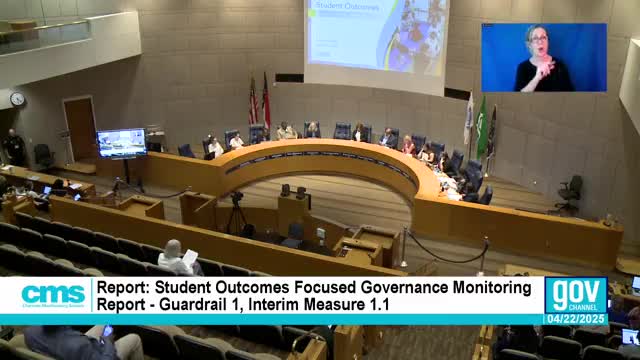
Charlotte-Mecklenburg Schools presented its student outcomes focused governance monitoring report for Goal 1 (early literacy) at the April 22 board meeting, reporting middle‑of‑year DIBELS results and a suite of interventions intended to accelerate learning before the end of the school year.
Dr. Hill said the district’s kindergarten target for the prior year was 77% at or above benchmark but actual year‑end achievement was 74%; the district’s midyear (MOY) proportion of kindergarten students at or above benchmark this year is 56%, the same as last year. "At this time of the year, the most important thing for students to be able to know is the correct letter sounds and nonsense word fluency," Hill said, describing the components the district is prioritizing.
Administrators reviewed supports intended to increase growth between MOY and year‑end: multilayered core instruction and MTSS coaching, increased professional development for master teachers and K–2 teachers, decodable readers and phonics drills for families to use at home, and an attendance initiative that includes a "Meaningful Medicine" program in partnership with Bank of America and Atrium Health to reduce missed school days by providing virtual treatment and medication at participating schools.
Board members questioned the flat MOY trend and pressed for clarity on interventions. Dr. Hill noted that last year kindergarten students gained about 17.6 percentage points from MOY to year end; she said the district expects acceleration this year because of more targeted coaching, better coordination and high‑dosage tutoring pilots. The district reported 19 schools currently implementing high‑dosage tutoring (17 of them classified as low performing) and said it uses the vendor Once for K–1 tutors; different vendors will be used in grades 1–4.
The report also described Read to Achieve requirements under North Carolina law that require individual reading plans (IRPs) for K–3 students not at benchmark. Hill explained tiering decisions: students with deficits in nonsense word fluency but mastery in letter naming may receive Tier 2 supplemental supports; students who have not mastered letter naming fluency receive more intensive small‑group instruction (Tier 3).
Board members asked whether attendance correlates with literacy outcomes for subgroups such as Hispanic students. Administrators said they have not completed that subgroup‑level absenteeism analysis but agreed to provide it. The district said it will triangulate end‑of‑year DIBELS, i‑Ready and classroom observations to inform tiering and intervention decisions going into 2025–26.
The report concluded with district plans to scale tutoring and family engagement next year — including an ‘‘adopt‑a‑school’’ model to match community partners to schools — while emphasizing that the current tutoring rollout began small to ensure fidelity.