Get Full Government Meeting Transcripts, Videos, & Alerts Forever!
Get email alerts on the Budget topic
No spam. Unsubscribe anytime.
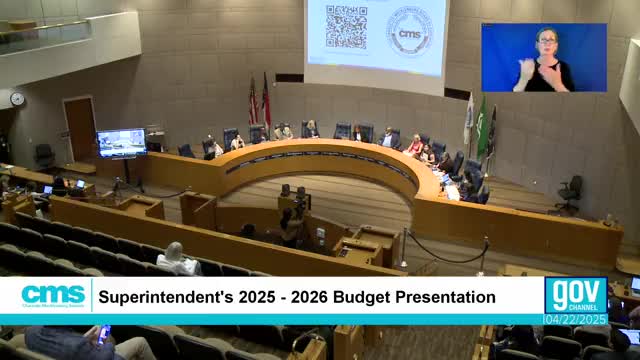
Charlotte-Mecklenburg Schools board adopts 2025-26 budget after heated debate; vote 5-3
Summary
The Charlotte-Mecklenburg Board of Education approved Superintendent Hill’s 2025–26 operating and capital budget recommendation after hours of discussion about teacher pay and risk from potential federal cuts. The measure passed 5–3 with several board members urging greater local and state investment for educators.
The Charlotte-Mecklenburg Board of Education voted 5–3 on April 22 to approve Superintendent Hill’s recommended 2025–26 operating, capital outlay and enterprise fund budgets.
Superintendent Hill recommended the budget after multiple committee meetings and public hearings, saying the proposal aligns district resources to board goals and directs $29 million in expansion toward employee compensation. "To be clear, that means 27,000,000 of the entire $29,000,000 budget expansion is supporting pay increases for both our certified educators and our classified hourly employees," Hill said.
The budget package includes a 3% statewide-funded salary increase for staff, an average 5% increase in the county-paid teacher supplement, salary corrections for classified staff, investments in extended learning, safety upgrades, technology and funding for counselors, social workers and psychologists. As presented, the superintendent framed the proposal as fiscally cautious while prioritizing personnel: "I recommend that you approve the 2025–26 Charlotte Mecklenburg Schools budget recommendation," Hill said.
Board debate focused heavily on whether the proposal does enough to retain and recruit teachers. Board member Liz Monterrey Duvall, who moved the budget, defended voting for the plan as pragmatic: "This proposal includes a 3% raise for all staff based on state funding and a 5% average increase in teacher supplement paid by the county and salary corrections for classified staff." Several board members said they supported the budget as a step forward but urged stronger local or state commitments.
Opponents argued the package underfunds staff given local cost-of-living pressures and impending state policy choices. Board member McClain said beginning teachers in the district earn less than $50,000 and described the package as insufficient to reverse turnover: "We can't afford to do this. Our teachers deserve our support for higher supplements and higher ask." Board member Nunn similarly urged larger local and state interventions, calling teacher pay a county and state problem.
Board members also discussed contingency planning for potential federal funding cuts. Administrators said the district holds back 35% of Title I planning allocations to protect personnel and would review reductions if official notices arrive: "Once it's been... communicated to us that we are going to lose federal funds, you will get that official notification," an administrator said during the discussion.
After concluding debate the board voted; the clerk reported the tally as five in favor and three opposed. The motion carried and the meeting was adjourned.
The board approved multiple committee policy items by unanimous roll calls earlier in the meeting; those motions were handled separately and are reported in this session’s actions list.