Get Full Government Meeting Transcripts, Videos, & Alerts Forever!
Get email alerts on the Broadband Franchise Renewal topic
No spam. Unsubscribe anytime.
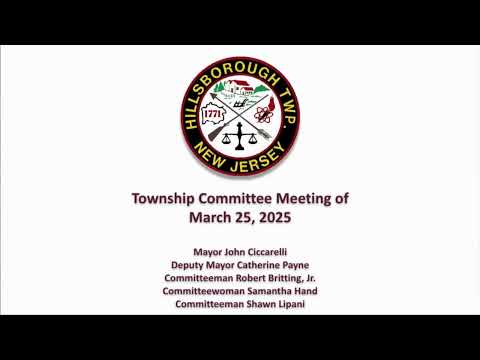
Hillsborough holds Comcast franchise public hearing; Comcast outlines renewal process, agrees to provide service data
Summary
Hillsborough held a public hearing on March 25 for Comcast’s municipal-consent renewal; Comcast said it filed its renewal application in September 2024 and that its current certificate of approval expires June 19, 2025.
Hillsborough Township held a public hearing on March 25 to consider municipal consent for Comcast’s cable-franchise renewal. Comcast’s senior government-affairs director, Rob Clifton, described the federal- and state-level process the company is following, answered questions from the committee and agreed to provide additional service reliability data to township officials.
Clifton said Comcast filed a renewal application in September 2024 and sent the required “6 to 6” notice under federal rules in June 2022. He said Comcast’s current certificate of approval (COA) for the municipality expires June 19, 2025. "We filed an application as the attorney said back in September of 20 24. The current agreement ... will expire on June nineteenth of this year," Clifton said.
Clifton and the township attorney summarized the municipal role under the federal/state framework. As Clifton put it, the governing body should consider whether the operator substantially complied with the existing franchise, whether service quality meets community needs, whether the operator has technical, financial and legal capacity, and whether the renewal is reasonable to meet future cable-related municipal needs. "The first is it has a cable operator substantially complied with the material terms of the existing franchise and with applicable law? Has the quality of the service, been reasonable, in light of, community needs? ... Does the operator have the technical, financial, and legal ability to provide the services that we propose to? And is the renewal proposal reasonable to meet the future cable related needs of the municipality," the attorney summarized.
Committee members and staff raised three practical concerns: (1) access to the voluminous renewal materials; (2) the local franchise fee and PEG capital grants; and (3) local service reliability and outages.
On public access to the application, officials said the municipal notice indicated a large document packet was available for review but that technical appendices had been redacted before public release. Clifton and the township confirmed the packet includes tariff, channel-lineup and corporate information; Clifton said technical appendices (engineering details) were redacted from the public copy to protect proprietary information. The mayor and committee asked that the municipality confirm how the packet is made available to residents.
On fees and grants, Clifton explained the mechanics of franchise-fee payments and PEG grants. He said municipalities receive an annual check (franchise fees) that is generally 2% of the basic cable charge; that percentage rises if a competing operator is certified to serve 60% or more of homes in a municipality. He also said Comcast offers a negotiated PEG-capital grant (based on historical subscriber counts) as part of municipal agreements. "...what we do is I will look at the highest amount of subscribers that you've had over a year period and construct a grant based on that," Clifton said.
Township officials pressed Comcast for service-reliability data. Several committee members described recurring outages and asked for metrics on outages, node-level incidents and average speeds. Clifton agreed to supply system data and to ask technical staff for a township-level report. "I will get in touch with my tech folks tomorrow and hopefully, with by early next week," Clifton said.
Clifton also told the committee that, after the public hearing, Comcast will provide a draft ordinance for municipal review that would formalize the right-of-way agreement; if municipal consent were withheld, the matter could move to mediation at the New Jersey Board of Public Utilities and, if necessary, an administrative hearing.
Clifton closed by reminding the committee of Comcast’s Internet Essentials affordability program and the company’s willingness to coordinate with social-services staff on sign-up details.
The public hearing was held and closed; committee members did not vote on municipal consent at the meeting. The next step is municipal review of Comcast’s draft ordinance and continued negotiation as required by the Board of Public Utilities process.