Get Full Government Meeting Transcripts, Videos, & Alerts Forever!
Get email alerts on the Behavioral Health Emergency Department Boarding topic
No spam. Unsubscribe anytime.
Hospitals tell Senate panel Medicaid patients wait longer for psychiatric placement; MHA, Pine Rest urge changes to pre-admission screening
Summary
Hospital and behavioral health officials told the Senate Committee on Health Policy that Medicaid patients in crisis often wait longer in emergency departments because community mental health agencies do not consistently complete pre-admission screening assessments within the three-hour window required for Medicaid.
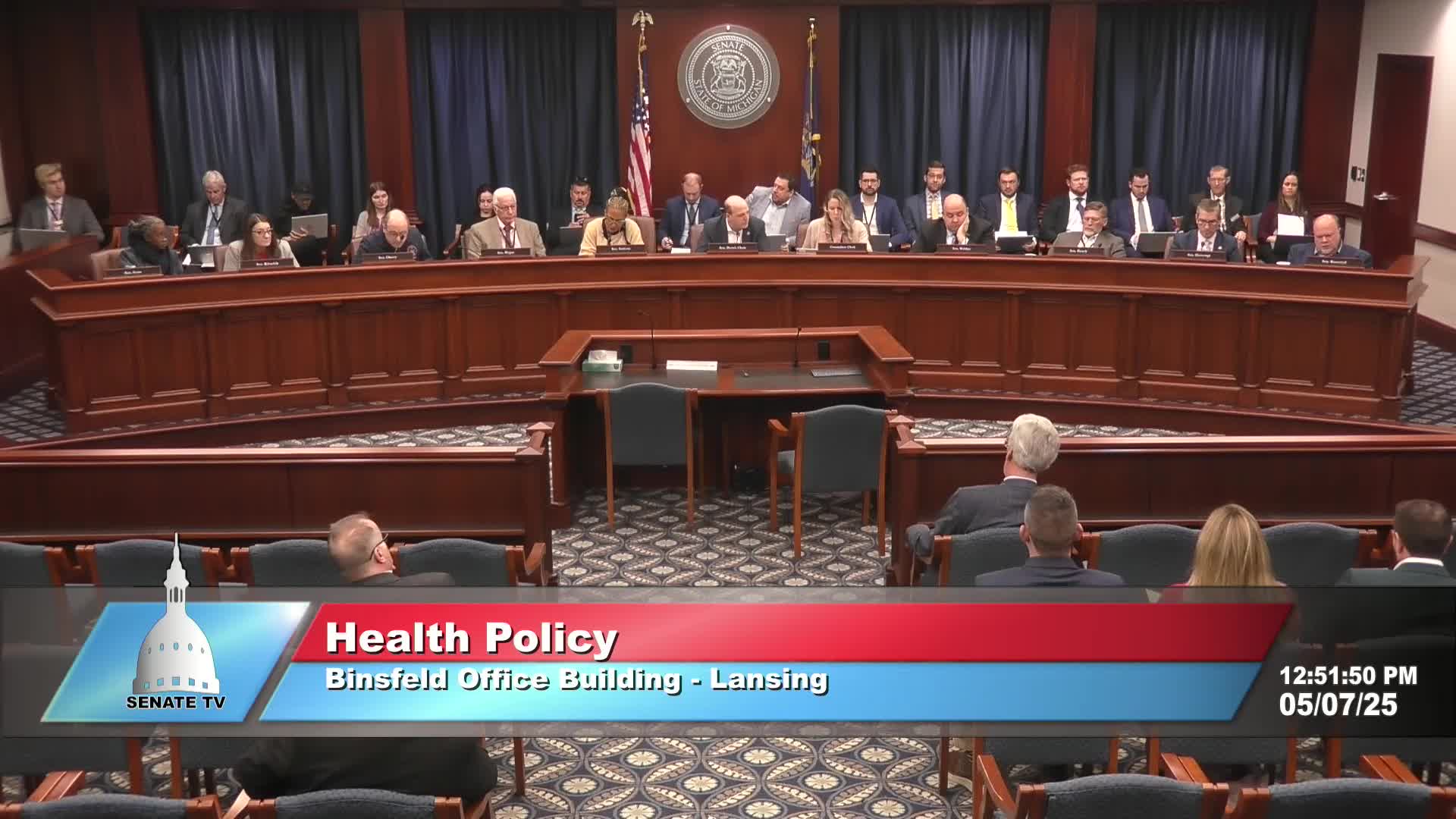
Hospital and behavioral health representatives told the Senate Committee on Health Policy on March 19 that Medicaid patients in behavioral health crisis wait longer — sometimes days — in emergency departments because community mental health agency (CMH) pre-admission screening processes are uneven and tied to payer rules.
Lauren Lapine, senior director of legislative and public policy at the Michigan Health & Hospital Association, said the association’s data collection found “on any given day there are over 155 patients that are waiting in emergency departments across the state for access to critical behavioral health services.” She told the committee that pediatric and geriatric patients board the longest and that Medicaid patients make up the largest share: “There are more than 8,000 patients that have Medicaid that are boarding in an emergency department over a calendar year compared to about 5,000 for those that are commercially insured,” she said.
Lapine described the statutory and contractual process that governs Medicaid behavioral health placements: a CMH must complete a pre-admission screening assessment within three hours for a Medicaid patient, and the CMH works on behalf of the prepaid inpatient health plan that decides payment. Lapine said hospitals often do not see that three-hour window met, and when CMH clinicians and hospital psychiatrists disagree about level of care, the disagreement can delay placement for days.
Kyle Hoffmaster, a registered nurse and director of patient access at Pine Rest Christian Mental Health Services, told the committee Pine Rest frequently has available beds but cannot receive patients because CMHs require that a screening be completed in an emergency department. Pine Rest operates urgent-care walk-in clinics and, he said, “we are adding additional stress and cost to families to go to emergency department, and in many instances, are adding additional stress to the EMS system to unnecessarily transport a patient to an emergency department.” He urged allowing clinically qualified hospital staff to complete the pre-admission screening if the CMH cannot meet the three-hour standard.
Committee members asked whether CMH staffing and standardization vary by county; both presenters said the process differs widely across CMHs and days of the week. Lapine and Hoffmaster said some CMHs treat the three-hour clock as starting when a voicemail is retrieved, which can mean patients wait the entire weekend before a screening begins.
Committee members and presenters raised models of community crisis response such as Common Ground and Pine Rest’s urgent care as examples of diversion that reduce arrests and emergency department stays, and members discussed state budget priorities for facility expansion. No committee amendments were offered; the committee adjourned and proceeded to other agenda items after the presentation.
The presentation identified procedural issues and urged legislative and administrative changes to standardize pre-admission screening, clarify when the three-hour clock starts and permit qualified hospital clinicians to perform screenings when CMHs cannot meet the statutory timeframe. Presenters said they are willing to work with lawmakers to design solutions but did not present specific draft statutory language at the hearing.