Get Full Government Meeting Transcripts, Videos, & Alerts Forever!
Get email alerts on the Land Use Rezoning topic
No spam. Unsubscribe anytime.
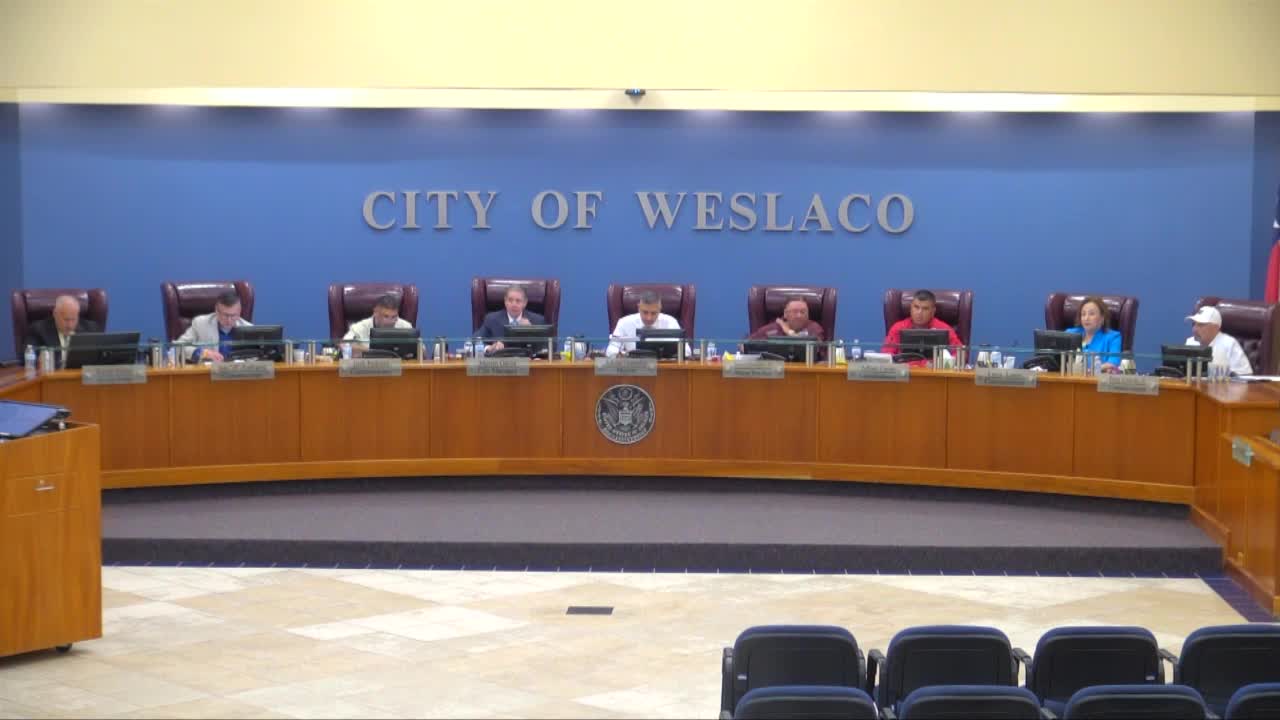
Weslaco commission approves rezoning for 901 San Joaquin after public hearing and legal review
Summary
After a public hearing in which neighbors raised flooding, traffic and proximity-to-schools concerns, the Weslaco City Commission approved rezoning of 901 San Joaquin from R-1 (single-family) to B-1 (neighborhood business) following legal advice in closed session.
The Weslaco City Commission on April 16 approved a rezoning ordinance (Ordinance 2025-05, first reading) to change 901 San Joaquin from R-1, single-family dwelling, to B-1, neighborhood business, after a public hearing and consultation with the city attorney in executive session.
The rezoning request was presented after a public hearing where Linda Garcia, who said she owns the property at 901 San Joaquin, described plans for a small, mostly to-go coffee shop and bakery with limited seating and modest on-site improvements. Neighbors led by Yolanda Mendez said they oppose the rezoning, citing recurring flooding, limited on-site parking, increased traffic near schools and churches, and the possibility a commercial designation could later enable other, less-desirable businesses to occupy the site.
PNC and staff recommended approval, noting the parcel lies along Pike Boulevard and is identified on the city’s future land-use map as part of a future commercial corridor. Staff said notification letters were mailed to property owners within the required 200-foot radius; the record shows 28 property owners were notified and that petitions against the rezoning met the threshold to require a majority vote. Commissioners discussed options for additional neighborhood outreach, buffering and the limits of rezoning versus conditional-use controls.
Commissioners were advised in closed session by the city attorney before taking final action. After the legal consultation, Commissioner Rodriguez made the motion to approve the rezoning and Commissioner Lopez seconded. The motion passed; the commission recorded the action as an approval of the rezoning ordinance on first reading as presented.
Under the city’s procedures discussed at the meeting, site-development requirements — including buffer fencing, on-site drainage improvements and compliance with building, fire and accessibility codes — must be demonstrated during the applicant’s construction review. City staff and the commission noted that any change in business type that would require a conditional-use permit (for example, alcohol sales or sexually oriented businesses) would require a separate return to the commission for review and possible permit conditions.
The commission’s action does not itself authorize construction; it changes the zoning classification and allows by-right B-1 uses subject to later permitting and development standards. The commission also discussed bringing neighborhood concerns back for follow-up and encouraged the applicant and neighbors to meet before the next meeting.
Votes/procedural note: the motion to approve was moved by Commissioner Rodriguez and seconded by Commissioner Lopez; after legal advice in executive session the commission voted to approve the item.