Get Full Government Meeting Transcripts, Videos, & Alerts Forever!
Get email alerts on the Infrastructure Projects topic
No spam. Unsubscribe anytime.
Weslaco commissioners and staff prioritize transportation, drainage and grant strategy; ask EDC for coordination
Summary
City officials outlined major transportation corridors (Mile 10 North, a proposed Weslaco Loop, State Highway 495), multi‑phase drainage projects and grant strategies, and discussed local matches and interlocal coordination at the March 13 special meeting.
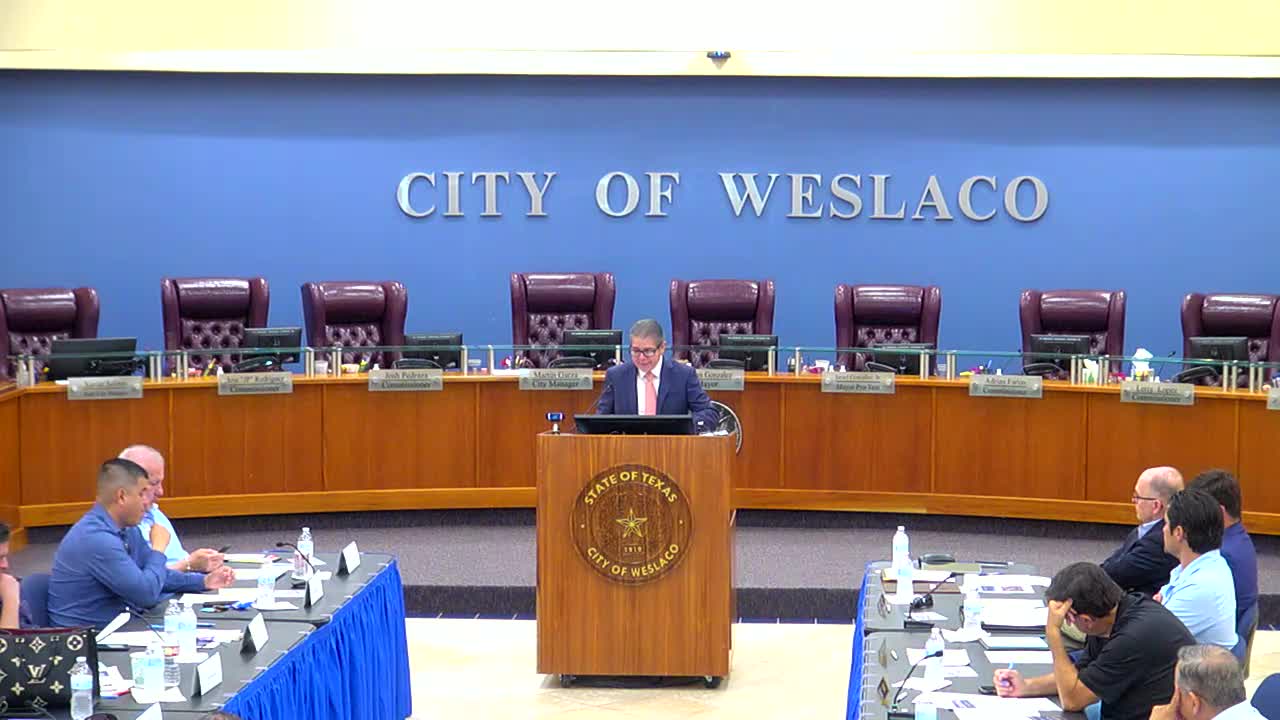
City officials used a March 13 joint special meeting with the Weslaco Economic Development Corporation to highlight near‑term infrastructure priorities, funding strategies and a request for coordinated local matches on large transportation and drainage projects.
Mayor Gonzales and city staff described three priority transportation efforts: the Mile 10 North expansion, a feasibility study for a Weslaco Loop corridor and work to advance the State Highway 495 corridor. City staff said Mile 10 North is in right‑of‑way acquisition (described in the presentation as phase 3) and that the overall project cost was presented as $36,000,000; officials said roughly $26,000,000 has been allocated so far through federal/MPO funds and that a $4,000,000 earmark from U.S. Rep. Vicente Gonzalez was included in prior allocations.
City staff said the Mile 10 North project will require local participation for right‑of‑way and construction phases; staff described a local participation estimate for right‑of‑way that they characterized as roughly $1,032,000 with the city’s share cited in the presentation as about $516,000 (staff said the county and city are intended to split local participation). For later construction phases, staff forecast additional local matches and asked the commission to consider budget planning for FY2026 to accommodate those matches.
The Weslaco Loop Transportation Study was described as a conceptual corridor that would link FM 1015 to I‑2 and relieve traffic on 1015; the city and county funded a shared feasibility study. Staff said the feasibility phase is underway and that the conceptual project carries an estimated total cost of $78,000,000 when fully developed.
City staff also discussed State Highway 495 work that would ultimately connect parts of the county from the west to the east and noted interlocal cooperation with the city of Donna and Hidalgo County precinct staff for a related feasibility study (the feasibility work was described as cost‑shared among participating cities and the county). Officials said the study cost shared by the partners was roughly $330,000 and that participating jurisdictions together contributed local funds to support the feasibility work.
Officials described a multi‑phase drainage program (presented under project names in the record) that includes planned underground box culverts and large construction phases. Staff said one combined drainage phase was being scoped at approximately $114,000,000 and another at $60,000,000; those figures were presented as planning‑level estimates tied to a phased approach (design and construction for one phase, design‑only for another). City staff said the city’s current available bond money for drainage after recent commitments is roughly $2,500,000 and that local matching requirements for many state and federal grants can range from 20% to as much as 75% depending on the program.
On intersection improvements, staff and the EDC said the VOTECH Pike intersection is an immediate concern; staff said they are negotiating with engineering consultants to develop two options (short‑term traffic control and a longer‑term reconstructed intersection with right‑of‑way). City staff identified the federal Safe Streets for All (SS4A) grant as one potential funding source for intersection and pedestrian/bicycle infrastructure and said the city’s grant writer, Gabriel Perez, will pursue available grant opportunities.
City staff described internal process improvements that aim to accelerate developer interactions—most notably a Subdivision Review Team (SRT) that meets weekly and is intended to place permitting, city engineering, code enforcement and fire‑marshal representatives in a single meeting to speed early project coordination.
Officials repeatedly emphasized the need to ‘‘think differently’’ and to align commission priorities with staff so the city can secure local matches and pursue federal/state funds; staff said many grants require a significant local match and that the commission will need to prioritize projects and consider future bonds to fund required matches.
The commission convened an executive session under Texas Government Code section 551.087 to discuss confidential economic development negotiations (the record shows project codenames discussed in closed session). When the meeting resumed, the commission took no public action on those project names during open session and then adjourned.